




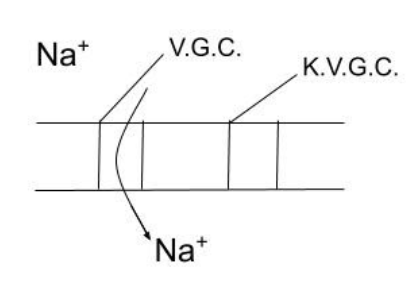
In the given diagram which stage of conduction of nerve impulse through nerve fibre is observed:
A. Polarisation
B. Depolarisation
C. Repolarisation
D. Hyperpolarization
Answer
 Verified
574.2k+ views
Hint: The distribution of ions on both sides of the membrane of a nerve fibre creates an electrochemical gradient. The concentration of sodium ions is more on the outside of the cell, and the concentration of potassium ions is more on the inside. The inner side of the membrane is negatively charged and the outer side is positively charged. An influx of sodium ions would affect the polarity of the membrane.
Complete answer:
In the given diagram, the depolarisation stage of the conduction of a nerve impulse can be observed.
• As mentioned, there is an unequal distribution of ions on both sides of the cell membrane. More sodium ions are present on the outside of the membrane than inside. Similarly, more potassium ions are present inside than outside. This creates an electrochemical gradient.
• The movement of ions across the membrane can occur only through voltage-gated channels. There are 2 types of voltage-gated channels – one for sodium ion and one for potassium ion.
• When a stimulus generates a membrane voltage of or beyond 55mV, the sodium voltage-gated channel opens. This causes the influx of sodium ions.
• As the number of sodium ions increases inside the cell, the membrane potential becomes less negative and this stage is referred to as depolarisation.
• The sodium channel gets inactivated once the voltage reaches 30mV.
Hence, the correct answer is option (B).
Note: Once the membrane voltage reaches 30mV, the sodium channels get inactivated and the potassium voltage-gated channels open. This causes the movement of potassium ions from inside the cell to outside. This makes the membrane potential more negative and this stage is referred to as repolarisation. This is also known as Absolute Refractory Period as no other action potential or impulse can occur at this stage.
Complete answer:
In the given diagram, the depolarisation stage of the conduction of a nerve impulse can be observed.
• As mentioned, there is an unequal distribution of ions on both sides of the cell membrane. More sodium ions are present on the outside of the membrane than inside. Similarly, more potassium ions are present inside than outside. This creates an electrochemical gradient.
• The movement of ions across the membrane can occur only through voltage-gated channels. There are 2 types of voltage-gated channels – one for sodium ion and one for potassium ion.
• When a stimulus generates a membrane voltage of or beyond 55mV, the sodium voltage-gated channel opens. This causes the influx of sodium ions.
• As the number of sodium ions increases inside the cell, the membrane potential becomes less negative and this stage is referred to as depolarisation.
• The sodium channel gets inactivated once the voltage reaches 30mV.
Hence, the correct answer is option (B).
Note: Once the membrane voltage reaches 30mV, the sodium channels get inactivated and the potassium voltage-gated channels open. This causes the movement of potassium ions from inside the cell to outside. This makes the membrane potential more negative and this stage is referred to as repolarisation. This is also known as Absolute Refractory Period as no other action potential or impulse can occur at this stage.
Recently Updated Pages
Master Class 11 Computer Science: Engaging Questions & Answers for Success

Master Class 11 Business Studies: Engaging Questions & Answers for Success
Master Class 11 Economics: Engaging Questions & Answers for Success
Master Class 11 English: Engaging Questions & Answers for Success
Master Class 11 Maths: Engaging Questions & Answers for Success
Master Class 11 Biology: Engaging Questions & Answers for Success
Trending doubts
One Metric ton is equal to kg A 10000 B 1000 C 100 class 11 physics CBSE
There are 720 permutations of the digits 1 2 3 4 5 class 11 maths CBSE
Discuss the various forms of bacteria class 11 biology CBSE
Draw a diagram of a plant cell and label at least eight class 11 biology CBSE
State the laws of reflection of light
10 examples of friction in our daily life