




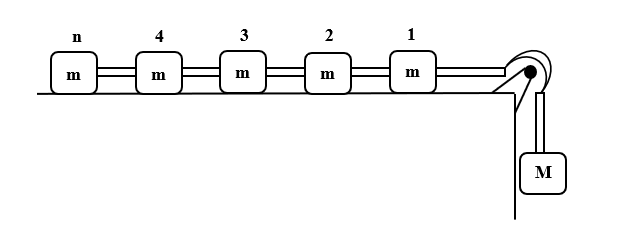
In the given arrangement, n number of equal masses are connected by strings of negligible masses. The tension in the string connected to ${n}^{th}$ mass is:
$A. \dfrac {mMg}{nm + M}$
$B. \dfrac {mMg}{nmM}$
$C. mg$
$D. nmg$
Answer
 Verified
589.2k+ views
Hint: To solve this question, first find the tension in the string connected to mass M. Then, find the tension in the string connected to n number of equal masses. Equate these two equations. Then, rearrange these equations such that you get the acceleration of these masses. Now, obtain the equation for tension in the string connected to ${n}^{th}$ mass. Substitute the expression for acceleration which you obtained in earlier steps. This will give the tension in the string connected to ${n}^{th}$ mass.
Complete step-by-step answer:
Tension in the string connected to mass M is given by,
$Mg-T= Ma$
$\Rightarrow T= Mg-Ma$ …(1)
Tension in the string connected to n number of equal masses is given by,
$T= nma$ …(2)
Comparing equation. (1) and (2) we get.
$Mg-Ma= nma$
$\Rightarrow Mg= nma+Ma$
$\Rightarrow Mg= a\left(nm+M \right)$
$\Rightarrow a= \dfrac {Mg}{nm+M}$ …(3)
Now, the tension in the string connected to ${n}^{th}$ mass will be given by,
${T}_{n}=ma$
Substituting equation. (3) in above equation we get,
${T}_{n}= \dfrac {mMg}{nm+M}$
Thus, the tension in the string connected to ${n}^{th}$ mass is $\dfrac {mMg}{nm+M}$.
So, the correct answer is option A i.e. $\dfrac {mMg}{nm+M}$.
So, the correct answer is “Option A”.
Note: Students usually get confused between stress and tension. They should remember that the tension is the force acting along the length when an object is pulled from both sides. Whereas stress the effect of force acting on the object. The tension is one of the forces which is produced when mass is attached to a string under gravitational force. S.I unit of tension is the same as that of force which is Newton denoted by N.
Complete step-by-step answer:
Tension in the string connected to mass M is given by,
$Mg-T= Ma$
$\Rightarrow T= Mg-Ma$ …(1)
Tension in the string connected to n number of equal masses is given by,
$T= nma$ …(2)
Comparing equation. (1) and (2) we get.
$Mg-Ma= nma$
$\Rightarrow Mg= nma+Ma$
$\Rightarrow Mg= a\left(nm+M \right)$
$\Rightarrow a= \dfrac {Mg}{nm+M}$ …(3)
Now, the tension in the string connected to ${n}^{th}$ mass will be given by,
${T}_{n}=ma$
Substituting equation. (3) in above equation we get,
${T}_{n}= \dfrac {mMg}{nm+M}$
Thus, the tension in the string connected to ${n}^{th}$ mass is $\dfrac {mMg}{nm+M}$.
So, the correct answer is option A i.e. $\dfrac {mMg}{nm+M}$.
So, the correct answer is “Option A”.
Note: Students usually get confused between stress and tension. They should remember that the tension is the force acting along the length when an object is pulled from both sides. Whereas stress the effect of force acting on the object. The tension is one of the forces which is produced when mass is attached to a string under gravitational force. S.I unit of tension is the same as that of force which is Newton denoted by N.
Recently Updated Pages
Master Class 11 Social Science: Engaging Questions & Answers for Success

Master Class 11 Physics: Engaging Questions & Answers for Success
Master Class 11 Maths: Engaging Questions & Answers for Success
Master Class 11 Economics: Engaging Questions & Answers for Success
Master Class 11 Computer Science: Engaging Questions & Answers for Success
Master Class 11 Chemistry: Engaging Questions & Answers for Success
Trending doubts
One Metric ton is equal to kg A 10000 B 1000 C 100 class 11 physics CBSE
There are 720 permutations of the digits 1 2 3 4 5 class 11 maths CBSE
1 Quintal is equal to a 110 kg b 10 kg c 100kg d 1000 class 11 physics CBSE
State and prove Bernoullis theorem class 11 physics CBSE
Difference Between Prokaryotic Cells and Eukaryotic Cells
Which among the following are examples of coming together class 11 social science CBSE