




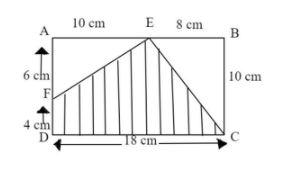
In the following figure, find the area of the shaded region.
Answer
 Verified
654.3k+ views
Hint: As in this question, we will first find the area of the non-shaded region i.e. two right angled triangles with length and base given in the question. Then we subtract that non-shaded region from the whole area of the rectangle. So, this approach will give us a foresee result.
Complete step-by-step answer:
As in this given figure we know that $ABCD$ is rectangle with length$\left( l \right)$ as given as $18cm$ and breadth$\left( b \right)$ as given as $10cm$.
So, the area of rectangle$\left( a \right)$ is
$a = l \times b = 18 \times 10 = 180c{m^2}$
Now there are two triangles named as $\vartriangle AFE{\text{ and }}\vartriangle BCE$, as we know that this given figure is a rectangle and the triangles are forming in between this particular figure. So, we can say that
$\therefore \angle A = \angle B = \angle C = \angle D = {90^ \circ }$
In these triangles $\vartriangle AFE{\text{ and }}\vartriangle BCE$ the angles $\angle A{\text{ and }}\angle B$ are right angles. Since, these triangles are right angled triangles.
Now, we will find the area of these triangles with the help of formula i.e. $\dfrac{1}{2} \times base \times height$
In $\vartriangle AFE$ the $base\left( b \right) = 10cm{\text{ and }}height\left( h \right) = 6cm$
Therefore, the area $ = \dfrac{1}{2} \times b \times h = \dfrac{1}{2} \times 10 \times 6 = 30c{m^2}$
In $\vartriangle BCE$ the $base\left( b \right) = 8cm{\text{ and }}height\left( h \right) = 10cm$
Therefore, the area $ = \dfrac{1}{2} \times b \times h = \dfrac{1}{2} \times 8 \times 10 = 40c{m^2}$
Hence, the non-shaded region is $30 + 40 = 70c{m^2}$
To find the area of the shaded region we have to subtract the non-shaded region from area of the rectangle
area of the shaded $ = $ area of the rectangle $ - $ area of non-shaded region i.e. sum of the area of
triangles $\vartriangle AFE{\text{ and }}\vartriangle BCE$
$ = 180 - 70 = 110c{m^2}$
Hence, the area of the shaded region is $110c{m^2}$.
Note: In a right angled triangle, there should be one angle as a right angle or ${90^ \circ }$. The sides adjacent to the right angle are called base and perpendicular i.e. height which are essential to find the area of the triangle. All angles of the rectangle are right angles or ${90^ \circ }$. One must not see that shaded region as any type of quadrilateral as there is no direct formula to that quadrilateral. The easiest and convenient approach to solve this question is given above.
Complete step-by-step answer:
As in this given figure we know that $ABCD$ is rectangle with length$\left( l \right)$ as given as $18cm$ and breadth$\left( b \right)$ as given as $10cm$.
So, the area of rectangle$\left( a \right)$ is
$a = l \times b = 18 \times 10 = 180c{m^2}$
Now there are two triangles named as $\vartriangle AFE{\text{ and }}\vartriangle BCE$, as we know that this given figure is a rectangle and the triangles are forming in between this particular figure. So, we can say that
$\therefore \angle A = \angle B = \angle C = \angle D = {90^ \circ }$
In these triangles $\vartriangle AFE{\text{ and }}\vartriangle BCE$ the angles $\angle A{\text{ and }}\angle B$ are right angles. Since, these triangles are right angled triangles.
Now, we will find the area of these triangles with the help of formula i.e. $\dfrac{1}{2} \times base \times height$
In $\vartriangle AFE$ the $base\left( b \right) = 10cm{\text{ and }}height\left( h \right) = 6cm$
Therefore, the area $ = \dfrac{1}{2} \times b \times h = \dfrac{1}{2} \times 10 \times 6 = 30c{m^2}$
In $\vartriangle BCE$ the $base\left( b \right) = 8cm{\text{ and }}height\left( h \right) = 10cm$
Therefore, the area $ = \dfrac{1}{2} \times b \times h = \dfrac{1}{2} \times 8 \times 10 = 40c{m^2}$
Hence, the non-shaded region is $30 + 40 = 70c{m^2}$
To find the area of the shaded region we have to subtract the non-shaded region from area of the rectangle
area of the shaded $ = $ area of the rectangle $ - $ area of non-shaded region i.e. sum of the area of
triangles $\vartriangle AFE{\text{ and }}\vartriangle BCE$
$ = 180 - 70 = 110c{m^2}$
Hence, the area of the shaded region is $110c{m^2}$.
Note: In a right angled triangle, there should be one angle as a right angle or ${90^ \circ }$. The sides adjacent to the right angle are called base and perpendicular i.e. height which are essential to find the area of the triangle. All angles of the rectangle are right angles or ${90^ \circ }$. One must not see that shaded region as any type of quadrilateral as there is no direct formula to that quadrilateral. The easiest and convenient approach to solve this question is given above.
Recently Updated Pages
Differentiate between voluntary action and reflex class 10 biology CBSE

The uses of bleaching powder are A It is used bleaching class 10 chemistry CBSE
Fill in the blanks with abstract nouns of the words class 10 english CBSE
How many threedigit numbers are there class 10 maths CBSE
What is a reflex arc class 10 biology CBSE
Construct a square whose diagonal is 6cm Measure the class 10 maths CBSE
Trending doubts
Explain the Treaty of Vienna of 1815 class 10 social science CBSE
The slogan Jai Hind was given by A Lal Bahadur Shastri class 10 social science CBSE
10 examples of evaporation in daily life with explanations
What is the full form of POSCO class 10 social science CBSE
Identify the feminine form of noun nephew a shenephew class 10 english CBSE
CSIR full form?