



In the following figure AP and BP are tangents to the circle and $\angle APB=40{}^\circ $ . Find the value of $\angle AQB$ .
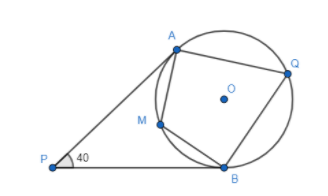
Answer
 Verified
613.5k+ views
Hint: Start by drawing a representative diagram of the above situation and draw line segments joining AO and BO. Use the property that the angle between radius and tangent of a circle is always $90{}^\circ $ . So, in quadrilateral AOBP, two angles are right angles and the one is $40{}^\circ $ . Use the property that the sum of all the interior angles of quadrilateral is equal to $360{}^\circ $ and finally use that the angle subtended by a segment of the circle at the centre of the circle is twice the angle subtended by the segment at the circumference of the circle to reach the answer.
Complete step-by-step answer:
Let us start by drawing a representative diagram of the situation mentioned in the question along with required construction.
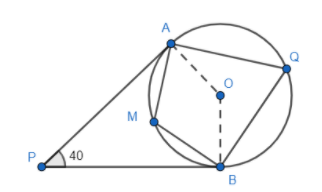
In the above figure, AP and BP are the tangents to the circle with centre O. Now we know that the tangents from a given point P. Angle OAP and angle OBP is $90{}^\circ $ as the angle between radius and tangent of a circle is always $90{}^\circ $ .
Now according to the property that the sum of all the interior angles of a quadrilateral is equal to $360{}^\circ $ . So, if we apply this in quadrilateral AOBP, we get
$\angle APB+\angle OAP+\angle OBP+\angle BOA=360{}^\circ $
\[\Rightarrow 40{}^\circ +90{}^\circ +90{}^\circ +\angle BOA=360{}^\circ \]
\[\Rightarrow \angle BOA=140{}^\circ \]
Now we know that the angle subtended by a segment of the circle at the centre of the circle is twice the angle subtended by the segment at the circumference of the circle.
\[\therefore \dfrac{1}{2}\times \angle BOA=\angle AQB\]
\[\Rightarrow \dfrac{1}{2}\times 140{}^\circ =70{}^\circ =\angle AQB\]
Therefore, the value of \[\angle AQB=70{}^\circ \] .
Note: Remember that AMBQ is a cyclic quadrilateral, so if needed you can use the properties of cyclic quadrilateral as well. Also, be very careful while using the relation \[\dfrac{1}{2}\times \angle BOA=\angle AQB\] , because it is a general mistake that students take \[\angle BOA=\dfrac{1}{2}\times \angle AQB\] , which is completely wrong.
Complete step-by-step answer:
Let us start by drawing a representative diagram of the situation mentioned in the question along with required construction.
In the above figure, AP and BP are the tangents to the circle with centre O. Now we know that the tangents from a given point P. Angle OAP and angle OBP is $90{}^\circ $ as the angle between radius and tangent of a circle is always $90{}^\circ $ .
Now according to the property that the sum of all the interior angles of a quadrilateral is equal to $360{}^\circ $ . So, if we apply this in quadrilateral AOBP, we get
$\angle APB+\angle OAP+\angle OBP+\angle BOA=360{}^\circ $
\[\Rightarrow 40{}^\circ +90{}^\circ +90{}^\circ +\angle BOA=360{}^\circ \]
\[\Rightarrow \angle BOA=140{}^\circ \]
Now we know that the angle subtended by a segment of the circle at the centre of the circle is twice the angle subtended by the segment at the circumference of the circle.
\[\therefore \dfrac{1}{2}\times \angle BOA=\angle AQB\]
\[\Rightarrow \dfrac{1}{2}\times 140{}^\circ =70{}^\circ =\angle AQB\]
Therefore, the value of \[\angle AQB=70{}^\circ \] .
Note: Remember that AMBQ is a cyclic quadrilateral, so if needed you can use the properties of cyclic quadrilateral as well. Also, be very careful while using the relation \[\dfrac{1}{2}\times \angle BOA=\angle AQB\] , because it is a general mistake that students take \[\angle BOA=\dfrac{1}{2}\times \angle AQB\] , which is completely wrong.

Recently Updated Pages
Master Class 9 Social Science: Engaging Questions & Answers for Success

Master Class 9 Science: Engaging Questions & Answers for Success
Master Class 9 Maths: Engaging Questions & Answers for Success
Master Class 9 General Knowledge: Engaging Questions & Answers for Success
Class 9 Question and Answer - Your Ultimate Solutions Guide
Master Class 8 Social Science: Engaging Questions & Answers for Success
Trending doubts
Find the sum of series 1 + 2 + 3 + 4 + 5 + + 100 class 9 maths CBSE
What is the Full Form of ISI and RAW
Fill the blanks with the suitable prepositions 1 The class 9 english CBSE
Difference Between Plant Cell and Animal Cell
Who is eligible for RTE class 9 social science CBSE
What is pollution? How many types of pollution? Define it