




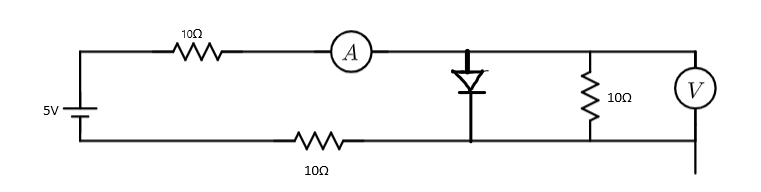
In the following circuit diagram, if the diode is ideal, what is the value recorded by the ammeter?
A) Zero
B) \[0.25\]
C) $0.5$
D) $0.75$
Answer
 Verified
628.2k+ views
Hint: Ideal diode behaves like a perfect conductor and the current is proportional to the applied voltage over a wide range. Its resistance is equal to the reciprocal of the slope of the line, is constant.
Formula used:
Ohm’s law, $V = IR$, where $V$=voltage across the circuit, $I$= current flow across the circuit, $R$=Resistance of the resistors.
Complete step by step solution:
Let us consider the diagram that is given in the question. The ammeter is connected to a circuit to calculate the current flow through it. The ammeter is connected in series combination with the circuit. The voltmeter is connected in parallel combination to the circuit to calculate the voltage across the circuit as voltage remains the same in parallel branches.
The diode is ideal. So, there is no voltage drop across it.
$5V = 10I + 10I$
After the addition of the current values,
$ \Rightarrow 5 = 20I$
$ \Rightarrow I = \dfrac{5}{{20}}A$
$\therefore I = 0.25A$
Hence the correct option is (B).
Additional information:
There are actually two ways to measure the current that is flowing through the circuit. One is by an ammeter and another method is by a voltmeter. Both are electrical instruments and have a major difference between them. For an ideal ammeter, the value of resistance is zero. Changing the range is not possible. For the ideal voltmeter, the value of resistance approximately tends to infinity. Changing of range in the voltmeter is possible.
Note:
1. The ideal diode does not have a threshold voltage. Once any forward voltage is applied across the diode, it will conduct current instantly across its junctions.
2. Ideal diode does not have breakdown voltage; this is because the diode has unlimited resistance to reverse voltage.
3. The key function of an ideal diode is to control the direction of the current flow.
4. Current trying to flow if the reverse direction is blocked.
5. The ideal curve of $I$-$V$ represents a nonlinear resistance as same as an ideal diode.
Formula used:
Ohm’s law, $V = IR$, where $V$=voltage across the circuit, $I$= current flow across the circuit, $R$=Resistance of the resistors.
Complete step by step solution:
Let us consider the diagram that is given in the question. The ammeter is connected to a circuit to calculate the current flow through it. The ammeter is connected in series combination with the circuit. The voltmeter is connected in parallel combination to the circuit to calculate the voltage across the circuit as voltage remains the same in parallel branches.
The diode is ideal. So, there is no voltage drop across it.
$5V = 10I + 10I$
After the addition of the current values,
$ \Rightarrow 5 = 20I$
$ \Rightarrow I = \dfrac{5}{{20}}A$
$\therefore I = 0.25A$
Hence the correct option is (B).
Additional information:
There are actually two ways to measure the current that is flowing through the circuit. One is by an ammeter and another method is by a voltmeter. Both are electrical instruments and have a major difference between them. For an ideal ammeter, the value of resistance is zero. Changing the range is not possible. For the ideal voltmeter, the value of resistance approximately tends to infinity. Changing of range in the voltmeter is possible.
Note:
1. The ideal diode does not have a threshold voltage. Once any forward voltage is applied across the diode, it will conduct current instantly across its junctions.
2. Ideal diode does not have breakdown voltage; this is because the diode has unlimited resistance to reverse voltage.
3. The key function of an ideal diode is to control the direction of the current flow.
4. Current trying to flow if the reverse direction is blocked.
5. The ideal curve of $I$-$V$ represents a nonlinear resistance as same as an ideal diode.
Recently Updated Pages
Master Class 12 Business Studies: Engaging Questions & Answers for Success

Master Class 12 Chemistry: Engaging Questions & Answers for Success
Master Class 12 Biology: Engaging Questions & Answers for Success
Class 12 Question and Answer - Your Ultimate Solutions Guide
Master Class 11 English: Engaging Questions & Answers for Success
Master Class 11 Social Science: Engaging Questions & Answers for Success
Trending doubts
Which are the Top 10 Largest Countries of the World?
Draw a labelled sketch of the human eye class 12 physics CBSE
Differentiate between homogeneous and heterogeneous class 12 chemistry CBSE
Differentiate between Pyramid of energy and pyramid class 12 biology CBSE
Why is the cell called the structural and functional class 12 biology CBSE
Draw the diagram of the pyramid of energy Explain In class 12 biology CBSE