




In the following acid-base reaction, how would you identify the acid, base and their conjugate acids and bases:
\[NH_4^ + \, + \,HCO_3^ - \, \to \,N{H_3}\, + \,{H_2}C{O_3}\]
Answer
 Verified
616.2k+ views
Hint: When an acid and base get reacted it forms a salt. The parent acid and the parent base can be determined by splitting the salt into the cationic part and anionic part. The pH of salt will be neutral, that’s the reason when acid and base react the neutralization takes place. Since, the acid pH lies between \[pH\,\,1 - 6\] and base \[pH\] lies between \[pH\,\,8 - 14\] .
Complete step-by-step answer:An acid is a substance which can donate its proton. The base is a substance which can donate its hydroxy ions. Base and acid react to form salt and water. The hydroxy comes from base and proton from the acid to form water.
Salt can be defined as the neutralization of a product from acid and base.
Let’s discuss the Lewis acid and Lewis base;
Lewis acid: the ion which can accept the pair of electrons also known as Bronsted-lowry base.
Lewis base: the ion which can donate the pair of electrons also known as Bronsted-lowry acid.
The change from\[NH_4^ + \] to \[N{H_3}\] shows that a proton was donated from \[NH_4^ + \], so simply put, \[NH_4^ + \]is the acid, and we know that\[N{H_3}\] is the base.
Since \[N{H_3}\] is the neutral state, \[NH_4^ + \]is the conjugate acid.
The change from \[HCO_3^ - \] to \[{H_2}C{O_3}\] shows that a proton was accepted by \[HCO_3^ - \], so simply put, \[HCO_3^ - \]is the base, and \[{H_2}C{O_3}\] is the acid.
Since \[{H_2}C{O_3}\] is the neutral state, \[HCO_3^ - \]is the conjugate base.
Overall, we have:
\[NH_4^ + \]:
Proton donor (Bronsted -Lowry acid)
Electron acceptor (Lewis acid)
\[N{H_3}\]:
Proton acceptor (Bronsted -Lowry base)
Electron donor (Lewis base)
\[HCO_3^ - \]:
Proton acceptor (Bronsted -Lowry base)
Electron donor (Lewis base)
\[{H_2}C{O_3}\]:
Proton donor (Bronsted -Lowry acid)
Electron acceptor (Lewis acid)
Let’s observe the diagram of how it shows;
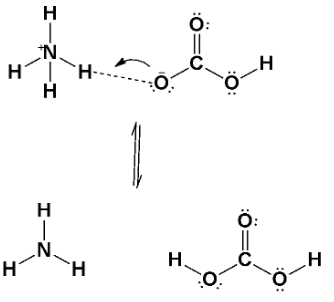
Note: A Lewis acid is a substance, such as the \[{H^ + }\] ion, that can accept a pair of nonbonding electrons. In simple words, a Lewis acid is an electron-pair acceptor. A Lewis base is any substance, such as the \[O{H^ - }\] ion, that can donate a pair of nonbonding electrons. A Lewis base is, therefore, an electron-pair donor.
Complete step-by-step answer:An acid is a substance which can donate its proton. The base is a substance which can donate its hydroxy ions. Base and acid react to form salt and water. The hydroxy comes from base and proton from the acid to form water.
Salt can be defined as the neutralization of a product from acid and base.
Let’s discuss the Lewis acid and Lewis base;
Lewis acid: the ion which can accept the pair of electrons also known as Bronsted-lowry base.
Lewis base: the ion which can donate the pair of electrons also known as Bronsted-lowry acid.
The change from\[NH_4^ + \] to \[N{H_3}\] shows that a proton was donated from \[NH_4^ + \], so simply put, \[NH_4^ + \]is the acid, and we know that\[N{H_3}\] is the base.
Since \[N{H_3}\] is the neutral state, \[NH_4^ + \]is the conjugate acid.
The change from \[HCO_3^ - \] to \[{H_2}C{O_3}\] shows that a proton was accepted by \[HCO_3^ - \], so simply put, \[HCO_3^ - \]is the base, and \[{H_2}C{O_3}\] is the acid.
Since \[{H_2}C{O_3}\] is the neutral state, \[HCO_3^ - \]is the conjugate base.
Overall, we have:
\[NH_4^ + \]:
Proton donor (Bronsted -Lowry acid)
Electron acceptor (Lewis acid)
\[N{H_3}\]:
Proton acceptor (Bronsted -Lowry base)
Electron donor (Lewis base)
\[HCO_3^ - \]:
Proton acceptor (Bronsted -Lowry base)
Electron donor (Lewis base)
\[{H_2}C{O_3}\]:
Proton donor (Bronsted -Lowry acid)
Electron acceptor (Lewis acid)
Let’s observe the diagram of how it shows;
Note: A Lewis acid is a substance, such as the \[{H^ + }\] ion, that can accept a pair of nonbonding electrons. In simple words, a Lewis acid is an electron-pair acceptor. A Lewis base is any substance, such as the \[O{H^ - }\] ion, that can donate a pair of nonbonding electrons. A Lewis base is, therefore, an electron-pair donor.
Recently Updated Pages
If x a + bt + ct2 where x is in meters and t is in class 11 physics CBSE

A car covers the first half distance between two places class 11 physics CBSE
The resultant of two vectors overrightarrow P and overrightarrow class 11 physics CBSE
Find the value of cos 135 class 11 maths CBSE
A mass M is held in place by an applied force F and class 11 physics CBSE
A solution of glucose in water is labelled as 10 dfracwv class 11 chemistry CBSE
Trending doubts
One Metric ton is equal to kg A 10000 B 1000 C 100 class 11 physics CBSE
Find the value of the expression given below sin 30circ class 11 maths CBSE
What do you mean by retardation What is its SI uni class 11 physics CBSE
Draw a diagram of nephron and explain its structur class 11 biology CBSE
10 examples of friction in our daily life
Difference between physical and chemical change class 11 chemistry CBSE