



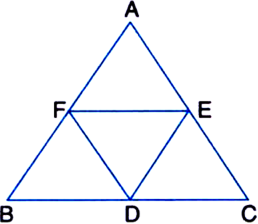
In the figure\[\Delta ABC\] ,\[D,E,F\] are the mid points of the side \[BC,CA\] and \[AB\] respectively. Show that
(i) \[BDEF\] is a parallelogram
(ii) \[ar(\Delta DEF) = \dfrac{1}{4}ar(\Delta ABC)\]
(iii) \[ar(BDEF) = \dfrac{1}{2}ar(\Delta ABC)\]
Answer
 Verified
597k+ views
Hint: Here, we use (i) the properties of congruence of triangles
(ii) properties of parallel lines
(iii) properties of midpoint of a line
Complete step-by-step answer:
Given, triangle in which D,E and F are the mid points of the sides and
(i)to prove that \[BDEF\] is a parallelogram
We know that the line segments joining the mid-point of two sides of a triangle are parallel to the 3rd side.
Now consider \[\Delta ABC\]
Where \[F\] is the mid-point of \[AB\]
and \[E\] Is the mid-point of \[AC\]
Which implies \[EF||BC\]
Which implies \[EF||BD\] (since, parts of the parallel lines are parallel)
Similarly, \[DE||BF\]
Which implies \[BDEF\] is a parallelogram
Hence proved
(ii) to prove \[ar(\Delta DEF) = \dfrac{1}{4}ar(\Delta ABC)\]
Using first part we can prove that \[FDCE\] is a parallelogram and \[AFDE\] is a parallelogram
As we know that the diagonals of a parallelogram divides it into two congruent triangles
Therefore in \[BDEF\]
\[\Delta DBF \cong \Delta DEF\]
It implies \[ar(\Delta DBF) = ar(\Delta DEF)......(1)\] (as area of congruent triangles is same)
Similarly,
\[ar(\Delta DEC) = ar(\Delta DEF)......(2)\]
\[ar(\Delta AFE) = ar(\Delta DEF)......(3)\]
From equation (1), (2) and (3) we get
\[ar(\Delta DBF) = ar(\Delta DEC) = ar(\Delta AFE) = ar(\Delta DEF).\]
Now, \[ar(\Delta DBF) + ar(\Delta AFE) + ar(\Delta DEC) + ar(\Delta DEF) = ar(\Delta ABC)\]
\[ \Rightarrow 4ar(\Delta DEF) = ar(\Delta ABC)\]
\[ \Rightarrow ar(\Delta DEF) = \dfrac{1}{4}ar(\Delta ABC)\]
Hence proved
(iii) to prove \[ar(BDEF) = \dfrac{1}{2}ar(\Delta ABC)\]
We know that \[ar(BDEF) = ar(\Delta DBF) + ar(\Delta DEF)\]
\[ \Rightarrow ar(BDEF) = 2ar(\Delta DEF)\]
\[ \Rightarrow ar(\Delta DEF) = \dfrac{1}{2}ar(BDEF)......(4)\]
Also, \[ar(\Delta DEF) = \dfrac{1}{4}ar(\Delta ABC)......(5)\]
Therefore, from equation (4) and (5) we get
\[ \Rightarrow \dfrac{1}{2}ar(BDEF) = \dfrac{1}{4}ar(\Delta ABC)\]
\[ \Rightarrow ar(BDEF) = \dfrac{1}{2}ar(\Delta ABC)\]
Hence, proved
Note: The above results could only be shown because we could use the properties of the midpoints given in the question. If we hadn’t been given the midpoints the above results could not have been stated.
(ii) properties of parallel lines
(iii) properties of midpoint of a line
Complete step-by-step answer:
Given, triangle in which D,E and F are the mid points of the sides and
(i)to prove that \[BDEF\] is a parallelogram
We know that the line segments joining the mid-point of two sides of a triangle are parallel to the 3rd side.
Now consider \[\Delta ABC\]
Where \[F\] is the mid-point of \[AB\]
and \[E\] Is the mid-point of \[AC\]
Which implies \[EF||BC\]
Which implies \[EF||BD\] (since, parts of the parallel lines are parallel)
Similarly, \[DE||BF\]
Which implies \[BDEF\] is a parallelogram
Hence proved
(ii) to prove \[ar(\Delta DEF) = \dfrac{1}{4}ar(\Delta ABC)\]
Using first part we can prove that \[FDCE\] is a parallelogram and \[AFDE\] is a parallelogram
As we know that the diagonals of a parallelogram divides it into two congruent triangles
Therefore in \[BDEF\]
\[\Delta DBF \cong \Delta DEF\]
It implies \[ar(\Delta DBF) = ar(\Delta DEF)......(1)\] (as area of congruent triangles is same)
Similarly,
\[ar(\Delta DEC) = ar(\Delta DEF)......(2)\]
\[ar(\Delta AFE) = ar(\Delta DEF)......(3)\]
From equation (1), (2) and (3) we get
\[ar(\Delta DBF) = ar(\Delta DEC) = ar(\Delta AFE) = ar(\Delta DEF).\]
Now, \[ar(\Delta DBF) + ar(\Delta AFE) + ar(\Delta DEC) + ar(\Delta DEF) = ar(\Delta ABC)\]
\[ \Rightarrow 4ar(\Delta DEF) = ar(\Delta ABC)\]
\[ \Rightarrow ar(\Delta DEF) = \dfrac{1}{4}ar(\Delta ABC)\]
Hence proved
(iii) to prove \[ar(BDEF) = \dfrac{1}{2}ar(\Delta ABC)\]
We know that \[ar(BDEF) = ar(\Delta DBF) + ar(\Delta DEF)\]
\[ \Rightarrow ar(BDEF) = 2ar(\Delta DEF)\]
\[ \Rightarrow ar(\Delta DEF) = \dfrac{1}{2}ar(BDEF)......(4)\]
Also, \[ar(\Delta DEF) = \dfrac{1}{4}ar(\Delta ABC)......(5)\]
Therefore, from equation (4) and (5) we get
\[ \Rightarrow \dfrac{1}{2}ar(BDEF) = \dfrac{1}{4}ar(\Delta ABC)\]
\[ \Rightarrow ar(BDEF) = \dfrac{1}{2}ar(\Delta ABC)\]
Hence, proved
Note: The above results could only be shown because we could use the properties of the midpoints given in the question. If we hadn’t been given the midpoints the above results could not have been stated.

Recently Updated Pages
Master Class 7 English: Engaging Questions & Answers for Success

Master Class 7 Maths: Engaging Questions & Answers for Success
Master Class 7 Science: Engaging Questions & Answers for Success
Class 7 Question and Answer - Your Ultimate Solutions Guide
Master Class 9 General Knowledge: Engaging Questions & Answers for Success
Master Class 9 Social Science: Engaging Questions & Answers for Success
Trending doubts
The value of 6 more than 7 is A 1 B 1 C 13 D 13 class 7 maths CBSE
Convert 200 Million dollars in rupees class 7 maths CBSE
List of coprime numbers from 1 to 100 class 7 maths CBSE
AIM To prepare stained temporary mount of onion peel class 7 biology CBSE
The plural of Chief is Chieves A True B False class 7 english CBSE
Write a letter to the editor of the national daily class 7 english CBSE