




In the figure, $ XY\parallel AC $ and $ XY $ divides the triangular region $ ABC $ into two equal areas. Determine $ AX:XB. $
(A) $ (\sqrt 3 - 1):1 $
(B) $ (\sqrt 2 - 1):1 $
(C) $ (\sqrt 7 - 1):1 $
(D) $ (\sqrt {11} - 1):1 $
Answer
 Verified
577.5k+ views
Hint: Prove that the triangles $ \Delta ABC $ and $ \Delta BXY $ are similar. And then use the property that the ratio of area of two similar triangles is equal to the square of the ratio of the corresponding sides of the two triangles. This will help you find the required ratio.
Complete step-by-step answer:
In this question a figure I given as,
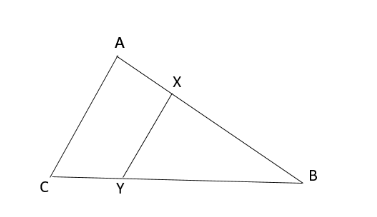
It is given in the question that, $ XY\parallel AC $
$ XY $ divides the triangular region $ ABC $ into two equal areas.
We have to find the ratio, $ AX:XB. $
Consider the triangles, $ \Delta ABC \& \Delta DXY. $
$ LB = LB $ . . . . (common side)
$ \angle BXY = \angle BAC $ (corresponding angles of parallel sides)
$ \angle BYX = \angle BCC $ . . . . (By corresponding angle properties)
So, by using ASA criteria of similarity of triangles, we can say that
$ \Delta ABC \sim \Delta BXY $
So by ASA , $ \Delta ABC \sim \Delta BXY $
Now, we know that the ratio of the area of the similar triangles is equal to the square of the ratio of the corresponding sides of the two triangles.
By this property, we can write the ratio of the areas of $ \Delta ABC\& \Delta BXY = $ square of ratio of their proportional sides.
$ \Rightarrow \dfrac{{Area(\Delta ABC)}}{{Area(\Delta BXY)}} = {\left( {\dfrac{{AB}}{{BX}}} \right)^2} $ . . . . . . . (By similarity properties)
$ \Rightarrow $ $ \dfrac{{Area(\Delta BXY) + Area(quadrilateral,ACXY)}}{{Area(\Delta BXY)}} = {\left( {\dfrac{{AX}}{{BX}}} \right)^2} $
$ \Rightarrow \dfrac{{2Area(\Delta BXY)}}{{Area(\Delta BXY)}} = {\left( {\dfrac{{AB}}{{BX}}} \right)^2} $
By cancelling the common terms we can write
$ \Rightarrow \dfrac{2}{1} = {\left( {\dfrac{{AB}}{{BX}}} \right)^2} $
$ \Rightarrow \dfrac{{AB}}{{BX}} = \sqrt 2 $
$ AB = \sqrt 2 BX $ . . . . . (1)
Now we have to find $ \dfrac{{AX}}{{BX}} $
Here, $ AB $ can be written as $ (AB + BX) $ from figure,
$ \Rightarrow AB = AX + BX $
Substitute in equation (1)
$ AX + BX = BX\sqrt 2 $
$ AX = BX\sqrt 2 - BX $
$ AX = BX\left( {\sqrt 2 - 1} \right) $
$ \therefore \dfrac{{AX}}{{BX}} = (\sqrt 2 - 1):1 $
So, the correct answer is “Option B”.
Note: XY divides triangle $ ABC $ into two parts of equal area does not mean that $ X and Y $ mid-points of sides $ AB $ and $ BC $ . Be careful that knowing the properties of similar triangles is very important to solve such questions.
Complete step-by-step answer:
In this question a figure I given as,
It is given in the question that, $ XY\parallel AC $
$ XY $ divides the triangular region $ ABC $ into two equal areas.
We have to find the ratio, $ AX:XB. $
Consider the triangles, $ \Delta ABC \& \Delta DXY. $
$ LB = LB $ . . . . (common side)
$ \angle BXY = \angle BAC $ (corresponding angles of parallel sides)
$ \angle BYX = \angle BCC $ . . . . (By corresponding angle properties)
So, by using ASA criteria of similarity of triangles, we can say that
$ \Delta ABC \sim \Delta BXY $
So by ASA , $ \Delta ABC \sim \Delta BXY $
Now, we know that the ratio of the area of the similar triangles is equal to the square of the ratio of the corresponding sides of the two triangles.
By this property, we can write the ratio of the areas of $ \Delta ABC\& \Delta BXY = $ square of ratio of their proportional sides.
$ \Rightarrow \dfrac{{Area(\Delta ABC)}}{{Area(\Delta BXY)}} = {\left( {\dfrac{{AB}}{{BX}}} \right)^2} $ . . . . . . . (By similarity properties)
$ \Rightarrow $ $ \dfrac{{Area(\Delta BXY) + Area(quadrilateral,ACXY)}}{{Area(\Delta BXY)}} = {\left( {\dfrac{{AX}}{{BX}}} \right)^2} $
$ \Rightarrow \dfrac{{2Area(\Delta BXY)}}{{Area(\Delta BXY)}} = {\left( {\dfrac{{AB}}{{BX}}} \right)^2} $
By cancelling the common terms we can write
$ \Rightarrow \dfrac{2}{1} = {\left( {\dfrac{{AB}}{{BX}}} \right)^2} $
$ \Rightarrow \dfrac{{AB}}{{BX}} = \sqrt 2 $
$ AB = \sqrt 2 BX $ . . . . . (1)
Now we have to find $ \dfrac{{AX}}{{BX}} $
Here, $ AB $ can be written as $ (AB + BX) $ from figure,
$ \Rightarrow AB = AX + BX $
Substitute in equation (1)
$ AX + BX = BX\sqrt 2 $
$ AX = BX\sqrt 2 - BX $
$ AX = BX\left( {\sqrt 2 - 1} \right) $
$ \therefore \dfrac{{AX}}{{BX}} = (\sqrt 2 - 1):1 $
So, the correct answer is “Option B”.
Note: XY divides triangle $ ABC $ into two parts of equal area does not mean that $ X and Y $ mid-points of sides $ AB $ and $ BC $ . Be careful that knowing the properties of similar triangles is very important to solve such questions.
Recently Updated Pages
Master Class 8 Social Science: Engaging Questions & Answers for Success

Master Class 8 English: Engaging Questions & Answers for Success
Class 8 Question and Answer - Your Ultimate Solutions Guide
Master Class 8 Maths: Engaging Questions & Answers for Success
Master Class 8 Science: Engaging Questions & Answers for Success
Master Class 9 General Knowledge: Engaging Questions & Answers for Success
Trending doubts
What is BLO What is the full form of BLO class 8 social science CBSE
Citizens of India can vote at the age of A 18 years class 8 social science CBSE
Full form of STD, ISD and PCO
Advantages and disadvantages of science
Right to vote is a AFundamental Right BFundamental class 8 social science CBSE
What are the 12 elements of nature class 8 chemistry CBSE