




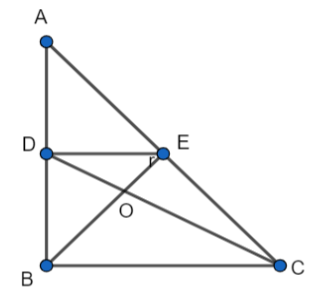
In the figure, triangle ABC is right-angled at B. Given that AB=9cm, AC=15cm, and D, E are the mid-points of the sides AB and AC respectively. Calculate, the length of BC.
Answer
 Verified
627.9k+ views
Hint: The given triangle is a right-angle triangle which is right-angled at B. We know that we can apply Pythagoras theorem in a right-angle triangle. We can apply Pythagoras theorem in the \[\Delta ABC\] and solve it further.
Complete step-by-step solution -
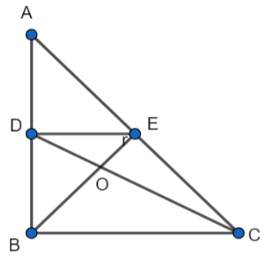
According to the figure, we have \[\Delta ABC\] which is right-angled at B.
We know that we can apply Pythagoras theorem in a right-angle triangle.
We have AB as the height of the triangle and it measures 9cm.
We have AC as the hypotenuse of the triangle and it measures 15cm.
Now, we can apply Pythagoras theorem.
\[{{\left( Hypotenuse \right)}^{2}}={{\left( Height \right)}^{2}}+{{\left( Base \right)}^{2}}\] …………………………(1)
On solving, we can write equation (1) as
\[{{\left( Base \right)}^{2}}={{\left( Hypotenuse \right)}^{2}}-{{\left( Height \right)}^{2}}\] ……………………..(2)
Putting, Hypotenuse=15cm and Height=9cm in equation (2), we get
\[{{\left( Base \right)}^{2}}={{\left( 15 \right)}^{2}}-{{\left( 9 \right)}^{2}}\] ………….(3)
We know that, \[{{15}^{2}}=225\] and \[{{9}^{2}}=81\] .
Putting \[{{15}^{2}}=225\] and \[{{9}^{2}}=81\] in equation (3), we get
\[\begin{align}
& {{\left( Base \right)}^{2}}={{\left( 15 \right)}^{2}}-{{\left( 9 \right)}^{2}} \\
& \Rightarrow {{\left( Base \right)}^{2}}=225-81 \\
& \Rightarrow {{\left( Base \right)}^{2}}=144 \\
& \Rightarrow Base=12 \\
\end{align}\]
In \[\Delta ABC\] , we have BC as base and after applying Pythagoras theorem in the \[\Delta ABC\] , we have got base which is equal to 12cm.
Hence, the length BC in \[\Delta ABC\] is equal to 12cm.
Note: We have solved this question only by using the Pythagoras theorem. So, we have only used the height and hypotenuse. Since we have not used the remaining data provided in the question. So, one may easily get confused about what to do with the remaining data provided. So, don’t get confused and keep your focus only to find the base. The remaining data has nothing to do and is meaningless in the process to find the base.
Complete step-by-step solution -
According to the figure, we have \[\Delta ABC\] which is right-angled at B.
We know that we can apply Pythagoras theorem in a right-angle triangle.
We have AB as the height of the triangle and it measures 9cm.
We have AC as the hypotenuse of the triangle and it measures 15cm.
Now, we can apply Pythagoras theorem.
\[{{\left( Hypotenuse \right)}^{2}}={{\left( Height \right)}^{2}}+{{\left( Base \right)}^{2}}\] …………………………(1)
On solving, we can write equation (1) as
\[{{\left( Base \right)}^{2}}={{\left( Hypotenuse \right)}^{2}}-{{\left( Height \right)}^{2}}\] ……………………..(2)
Putting, Hypotenuse=15cm and Height=9cm in equation (2), we get
\[{{\left( Base \right)}^{2}}={{\left( 15 \right)}^{2}}-{{\left( 9 \right)}^{2}}\] ………….(3)
We know that, \[{{15}^{2}}=225\] and \[{{9}^{2}}=81\] .
Putting \[{{15}^{2}}=225\] and \[{{9}^{2}}=81\] in equation (3), we get
\[\begin{align}
& {{\left( Base \right)}^{2}}={{\left( 15 \right)}^{2}}-{{\left( 9 \right)}^{2}} \\
& \Rightarrow {{\left( Base \right)}^{2}}=225-81 \\
& \Rightarrow {{\left( Base \right)}^{2}}=144 \\
& \Rightarrow Base=12 \\
\end{align}\]
In \[\Delta ABC\] , we have BC as base and after applying Pythagoras theorem in the \[\Delta ABC\] , we have got base which is equal to 12cm.
Hence, the length BC in \[\Delta ABC\] is equal to 12cm.
Note: We have solved this question only by using the Pythagoras theorem. So, we have only used the height and hypotenuse. Since we have not used the remaining data provided in the question. So, one may easily get confused about what to do with the remaining data provided. So, don’t get confused and keep your focus only to find the base. The remaining data has nothing to do and is meaningless in the process to find the base.
Recently Updated Pages
Master Class 10 Computer Science: Engaging Questions & Answers for Success

Master Class 10 General Knowledge: Engaging Questions & Answers for Success
Master Class 10 English: Engaging Questions & Answers for Success
Master Class 10 Social Science: Engaging Questions & Answers for Success
Master Class 10 Maths: Engaging Questions & Answers for Success
Master Class 10 Science: Engaging Questions & Answers for Success
Trending doubts
Explain the Treaty of Vienna of 1815 class 10 social science CBSE
What is the median of the first 10 natural numbers class 10 maths CBSE
Who Won 36 Oscar Awards? Record Holder Revealed
What is the name of Japan Parliament?
Why is it 530 pm in india when it is 1200 afternoon class 10 social science CBSE
Select the word that is correctly spelled a Twelveth class 10 english CBSE