




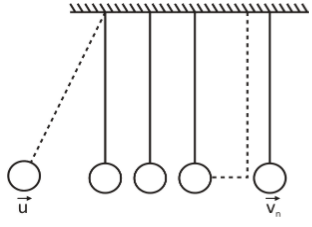
In the figure there are n identical spheres of mass m suspended with wires of equal length. The spheres are almost in contact with each other. Sphere 1 is pulled aside and released . If sphere 1 strikes sphere 2 with velocity u. find an expression for velocity ${v_n}$ of the nth sphere immediately after being struck by the one adjacent to it. The coefficient of restitution for all the impacts is e.
Answer
 Verified
636.3k+ views
Hint: you need to find velocity of sphere after first collision and then find out the relationship between the velocities before and after collision. Once you know the relation you can find the velocity for nth collision.
Complete step by step answer:
let velocities after first collision be ${v_1}$ and ${v_2}$
where${v_1}$is velocity of the first particle and ${v_2}$ is velocity of the second particle.
applying momentum conservation we have
$initial\,momentum = final\,momentum \Rightarrow mu = m{v_1} + m{v_2}$
And $e = \dfrac{{{v_2} - {v_1}}}{u} \Rightarrow eu = {v_2} - {v_1}$
Solving both the equations
$eu = {v_2} - (u - {v_2}) \Rightarrow {v_2} = \dfrac{{(e + 1)u}}{2}$
As we can see velocity changes by a factor of $\dfrac{{e + 1}}{2}$after each collision
So after nth collision velocity will change by a factor of $\dfrac{{{{(e + 1)}^n}}}{{{2^n}}}$
Therefore , ${v_n} = \dfrac{{{{(e + 1)}^n}}}{{{2^n}}}u$
Note:
Although pendulums are colliding but they are colliding in its lowest position(horizontally) so we can treat it as a spheres colliding in plane ground. And if there are multiple collisions on a single sphere we should neglect it unless asked.
Complete step by step answer:
let velocities after first collision be ${v_1}$ and ${v_2}$
where${v_1}$is velocity of the first particle and ${v_2}$ is velocity of the second particle.
applying momentum conservation we have
$initial\,momentum = final\,momentum \Rightarrow mu = m{v_1} + m{v_2}$
And $e = \dfrac{{{v_2} - {v_1}}}{u} \Rightarrow eu = {v_2} - {v_1}$
Solving both the equations
$eu = {v_2} - (u - {v_2}) \Rightarrow {v_2} = \dfrac{{(e + 1)u}}{2}$
As we can see velocity changes by a factor of $\dfrac{{e + 1}}{2}$after each collision
So after nth collision velocity will change by a factor of $\dfrac{{{{(e + 1)}^n}}}{{{2^n}}}$
Therefore , ${v_n} = \dfrac{{{{(e + 1)}^n}}}{{{2^n}}}u$
Note:
Although pendulums are colliding but they are colliding in its lowest position(horizontally) so we can treat it as a spheres colliding in plane ground. And if there are multiple collisions on a single sphere we should neglect it unless asked.
Recently Updated Pages
Which will be the least stable resonating structure class 11 chemistry CBSE

How many 5 digit telephone numbers can be construc-class-11-maths-CBSE
How do you find the angle of the resultant vector class 11 physics CBSE
Draw labelled diagram of the following i Gram seed class 11 biology CBSE
1 Quintal is equal to a 110 kg b 10 kg c 100kg d 1000 class 11 physics CBSE
What is the need and importance of classification class 11 biology CBSE
Trending doubts
One Metric ton is equal to kg A 10000 B 1000 C 100 class 11 physics CBSE
Find the value of the expression given below sin 30circ class 11 maths CBSE
Draw a diagram of nephron and explain its structur class 11 biology CBSE
10 examples of friction in our daily life
Proton was discovered by A Thomson B Rutherford C Chadwick class 11 chemistry CBSE
The teeth used for biting and cutting food are called class 11 biology CBSE