



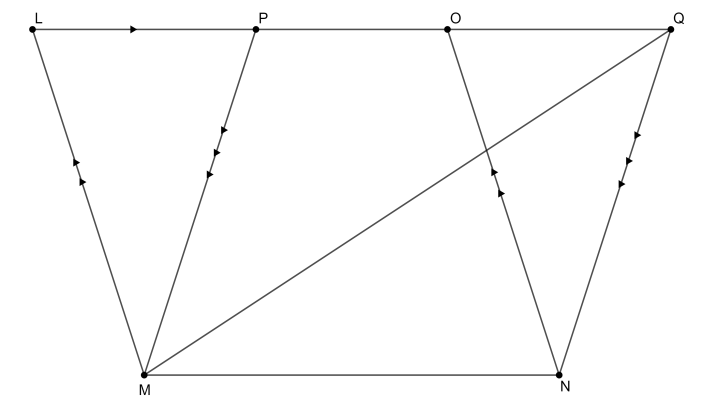
In the figure, the area of the parallelogram LMNO is 240 sq. cm. Find the area of parallelogram PMNQ and triangle PMQ.
Answer
 Verified
574.5k+ views
Hint: We will use the formula for the area of a parallelogram. The area of a parallelogram is given by $\text{Area of parallelogram = base }\times \text{ height}$. We will also use the formula for the area of a triangle. The formula for area of triangle is given by $\text{Area of triangle = }\dfrac{1}{2}\times \text{base}\times \text{height}$. We will also use the properties of parallel lines.
Complete step by step solution:
We know that quadrilateral LMNO is a parallelogram and its area is 240 sq. cm. The base of parallelogram LMNO is segmented as MN. We know that $\text{Area of parallelogram = base }\times \text{ height}$. Substituting the known elements in the formula for the area of the parallelogram, we get
$240=\text{MN}\times \text{height}$.
Now, we know that side MN and side LO are parallel. From the figure, we can see that points P and Q are collinear with points L and O. So, the height of the parallelogram PMNQ is the same as that of parallelogram LMNO. This is because of the property of the parallel lines that the distance between two parallel lines remains unchanged. We can also see that the base of parallelogram PMNQ is segmented as MN, the same as that of parallelogram LMNO. So, using the formula for the area of a parallelogram we get
$\text{Area of parallelogram PMNQ = MN}\times \text{height}$
Substituting $\text{MN}\times \text{height = 240}$ in the above equation, we get
$\text{Area of parallelogram PMNQ = 240 sq}\text{. cm}\text{.}$
Now, we have to find the area of triangle PMQ. We know that $\text{Area of triangle = }\dfrac{1}{2}\times \text{base}\times \text{height}$
The base of triangle PMQ is segmented as PQ and the height is the same as the height of parallelogram PMNQ. Now, in parallelogram PMNQ, segment PQ is parallel to segment MN and their lengths are also equal since it is a parallelogram. So, we can replace the base PQ by segment MN. So, substituting these values in the formula for the area of triangle, we get $\text{Area of triangle = }\dfrac{1}{2}\times \text{MN}\times \text{height}$
Again, substituting $\text{MN}\times \text{height = 240}$ in the above equation, we get
$\text{Area of triangle = }\dfrac{1}{2}\times 240=120\text{ sq}\text{. cm}\text{.}$
So, the area of the triangle PMQ is 120 sq. cm.
Note: The segment MQ is the diagonal of parallelogram PMNQ. The diagonal of a parallelogram divides the parallelogram into two equal triangles. So, the area of such a triangle will be half of the area of the parallelogram. We arrived at the same conclusion by using the formula for the area of the triangle. It is important that we understand the formulae for the areas of given objects so that we can use them in a way that is convenient for us.
Complete step by step solution:
We know that quadrilateral LMNO is a parallelogram and its area is 240 sq. cm. The base of parallelogram LMNO is segmented as MN. We know that $\text{Area of parallelogram = base }\times \text{ height}$. Substituting the known elements in the formula for the area of the parallelogram, we get
$240=\text{MN}\times \text{height}$.
Now, we know that side MN and side LO are parallel. From the figure, we can see that points P and Q are collinear with points L and O. So, the height of the parallelogram PMNQ is the same as that of parallelogram LMNO. This is because of the property of the parallel lines that the distance between two parallel lines remains unchanged. We can also see that the base of parallelogram PMNQ is segmented as MN, the same as that of parallelogram LMNO. So, using the formula for the area of a parallelogram we get
$\text{Area of parallelogram PMNQ = MN}\times \text{height}$
Substituting $\text{MN}\times \text{height = 240}$ in the above equation, we get
$\text{Area of parallelogram PMNQ = 240 sq}\text{. cm}\text{.}$
Now, we have to find the area of triangle PMQ. We know that $\text{Area of triangle = }\dfrac{1}{2}\times \text{base}\times \text{height}$
The base of triangle PMQ is segmented as PQ and the height is the same as the height of parallelogram PMNQ. Now, in parallelogram PMNQ, segment PQ is parallel to segment MN and their lengths are also equal since it is a parallelogram. So, we can replace the base PQ by segment MN. So, substituting these values in the formula for the area of triangle, we get $\text{Area of triangle = }\dfrac{1}{2}\times \text{MN}\times \text{height}$
Again, substituting $\text{MN}\times \text{height = 240}$ in the above equation, we get
$\text{Area of triangle = }\dfrac{1}{2}\times 240=120\text{ sq}\text{. cm}\text{.}$
So, the area of the triangle PMQ is 120 sq. cm.
Note: The segment MQ is the diagonal of parallelogram PMNQ. The diagonal of a parallelogram divides the parallelogram into two equal triangles. So, the area of such a triangle will be half of the area of the parallelogram. We arrived at the same conclusion by using the formula for the area of the triangle. It is important that we understand the formulae for the areas of given objects so that we can use them in a way that is convenient for us.
Recently Updated Pages
Master Class 9 General Knowledge: Engaging Questions & Answers for Success

Master Class 9 Social Science: Engaging Questions & Answers for Success
Master Class 9 English: Engaging Questions & Answers for Success
Master Class 9 Maths: Engaging Questions & Answers for Success
Master Class 9 Science: Engaging Questions & Answers for Success
Class 9 Question and Answer - Your Ultimate Solutions Guide
Trending doubts
Difference Between Plant Cell and Animal Cell
Fill the blanks with the suitable prepositions 1 The class 9 english CBSE
Who is eligible for RTE class 9 social science CBSE
Which places in India experience sunrise first and class 9 social science CBSE
What is pollution? How many types of pollution? Define it
Name 10 Living and Non living things class 9 biology CBSE