




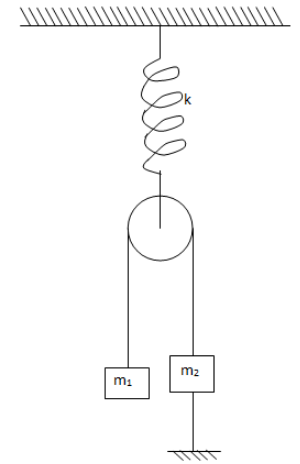
In the figure shows, pulley and spring are ideal. Find the potential energy stored in the spring (\[{m_1} > {m_2}\])
Answer
 Verified
572.7k+ views
Hint:We are asked to find the potential energy stored in the spring. First, recall the formula to find potential energy stored in a spring. Draw a free body diagram of the problem. Using this diagram, find the value of displacement and use this value to find potential energy of the spring.
Complete step by step answer:
Given a figure where pulley and spring are ideal.The formula to find potential energy stored in a spring is,
\[P.E = \dfrac{1}{2}k{x^2}\] (i)
where \[k\] is the spring constant and \[x\] is the displacement from the mean position.
Let us draw the free body diagram for the problem.
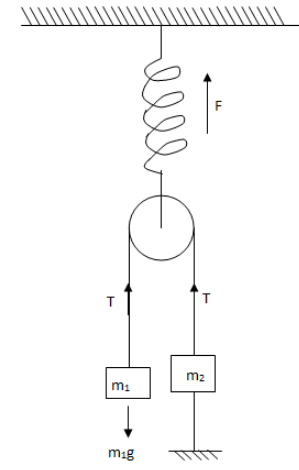
In the figure, \[F\] is the restoring force of the spring, \[T\] is the tension on the string and \[g\] is acceleration due to gravity.
Restoring force is given by the formula,
\[F = kx\] (ii)
where \[k\] is the spring constant and \[x\] is the displacement from the mean position.
From the figure we observe,
\[T + T = F\]
Putting the value of \[F\] we get,
\[T + T = kx\]
\[ \Rightarrow 2T = kx\]
\[ \Rightarrow T = \dfrac{1}{2}kx\] (iii)
From the figure we get,
\[T = {m_1}g\]
Putting the value of \[T\] we get,
\[\dfrac{1}{2}kx = {m_1}g\]
\[ \Rightarrow x = \dfrac{{2{m_1}g}}{k}\]
Now, putting this value of \[x\] in equation (i) we get the potential energy as,
\[P.E = \dfrac{1}{2}k{\left( {\dfrac{{2{m_1}g}}{k}} \right)^2}\]
\[ \Rightarrow P.E = \dfrac{1}{2}k\left( {\dfrac{{4{m_1}^2{g^2}}}{{{k^2}}}} \right)\]
\[ \therefore P.E = \dfrac{{2{m_1}^2{g^2}}}{k}\]
Therefore the potential energy stored in the spring is \[\dfrac{{2{m_1}^2{g^2}}}{k}\].
Note:For such types of problems, before proceeding for calculations, draw a free body diagram. A free body diagram is a diagram showing the forces and their directions acting on a given system. Here we have used the term restoring force, restoring force is the force which brings back an object to its mean position or equilibrium.
Complete step by step answer:
Given a figure where pulley and spring are ideal.The formula to find potential energy stored in a spring is,
\[P.E = \dfrac{1}{2}k{x^2}\] (i)
where \[k\] is the spring constant and \[x\] is the displacement from the mean position.
Let us draw the free body diagram for the problem.
In the figure, \[F\] is the restoring force of the spring, \[T\] is the tension on the string and \[g\] is acceleration due to gravity.
Restoring force is given by the formula,
\[F = kx\] (ii)
where \[k\] is the spring constant and \[x\] is the displacement from the mean position.
From the figure we observe,
\[T + T = F\]
Putting the value of \[F\] we get,
\[T + T = kx\]
\[ \Rightarrow 2T = kx\]
\[ \Rightarrow T = \dfrac{1}{2}kx\] (iii)
From the figure we get,
\[T = {m_1}g\]
Putting the value of \[T\] we get,
\[\dfrac{1}{2}kx = {m_1}g\]
\[ \Rightarrow x = \dfrac{{2{m_1}g}}{k}\]
Now, putting this value of \[x\] in equation (i) we get the potential energy as,
\[P.E = \dfrac{1}{2}k{\left( {\dfrac{{2{m_1}g}}{k}} \right)^2}\]
\[ \Rightarrow P.E = \dfrac{1}{2}k\left( {\dfrac{{4{m_1}^2{g^2}}}{{{k^2}}}} \right)\]
\[ \therefore P.E = \dfrac{{2{m_1}^2{g^2}}}{k}\]
Therefore the potential energy stored in the spring is \[\dfrac{{2{m_1}^2{g^2}}}{k}\].
Note:For such types of problems, before proceeding for calculations, draw a free body diagram. A free body diagram is a diagram showing the forces and their directions acting on a given system. Here we have used the term restoring force, restoring force is the force which brings back an object to its mean position or equilibrium.
Recently Updated Pages
Master Class 11 Social Science: Engaging Questions & Answers for Success

Master Class 11 Physics: Engaging Questions & Answers for Success
Master Class 11 Maths: Engaging Questions & Answers for Success
Master Class 11 Economics: Engaging Questions & Answers for Success
Master Class 11 Computer Science: Engaging Questions & Answers for Success
Master Class 11 Chemistry: Engaging Questions & Answers for Success
Trending doubts
One Metric ton is equal to kg A 10000 B 1000 C 100 class 11 physics CBSE
There are 720 permutations of the digits 1 2 3 4 5 class 11 maths CBSE
1 Quintal is equal to a 110 kg b 10 kg c 100kg d 1000 class 11 physics CBSE
State and prove Bernoullis theorem class 11 physics CBSE
Difference Between Prokaryotic Cells and Eukaryotic Cells
Discuss the various forms of bacteria class 11 biology CBSE