




In the figure shown what is the equivalent capacitance between ‘A’ and ‘B’?

A. $3.75\,F$
B. $2\,F$
C. $21\,F$
D. $16\,F$
Answer
 Verified
591.6k+ views
Hint: First redraw the circuit diagram in a simplified manner and label the junctions. Replace series or parallel capacitors with their equivalent capacitors. Continue this process until only one equivalent capacitor is left.
Complete step-by-step answer:
First we redraw the circuit diagram in a simplified manner as shown in figure below.
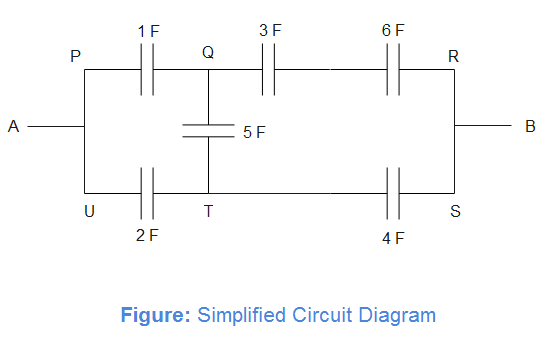
In branch QR two capacitors of 3 F and 6 F are connected in series. We replace these with a capacitor of equivalent capacitance.
Equivalent capacitance of capacitors in series is given as
$\dfrac{1}{{{C}_{QR}}}=\dfrac{1}{3}+\dfrac{1}{6}=\dfrac{2}{6}$
This implies that,
${{C}_{QR}}=2\,F$
Now the circuit becomes as shown below
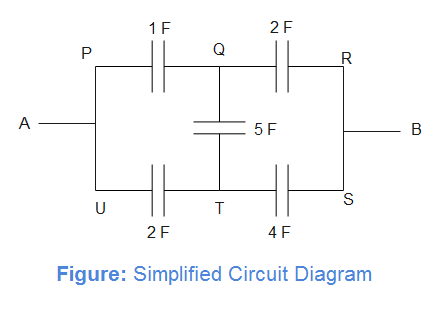
We observe that
$\dfrac{{{C}_{PQ}}}{{{C}_{UT}}}=\dfrac{{{C}_{QR}}}{{{C}_{TS}}}$
This circuit is equivalent to Wheatstone bridge and capacitor in branch QT can be neglected.
Now, capacitors of capacitance 1 F and 2 F in branch PR and capacitors of capacitance 2 F and 4 F in branch US are in series. So equivalent capacitance of branch PR and US is
$\dfrac{1}{{{C}_{PR}}}=\dfrac{1}{1}+\dfrac{1}{2}=\dfrac{3}{2}$
This means ${{C}_{PR}}=\dfrac{2}{3}F$
Similarly, ${{C}_{US}}=\dfrac{4}{3}F$
Now, branches PR and US are connected in parallel. Equivalent capacitance of parallel capacitors is sum of the capacitance of each capacitor. Therefore,
${{C}_{AB}}={{C}_{PR}}+{{C}_{US}}=\dfrac{2}{3}+\dfrac{4}{3}$
On solving this, we get equivalent capacitance between ‘A’ and ‘B’ as
${{C}_{AB}}=2\,F$
Hence, option B is correct.
So, the correct answer is “Option B”.
Note: To solve such problems, first simplify the circuit and then, replace series or parallel capacitors with their equivalent capacitors. Continue this process until only one equivalent capacitor is left.
Similar processes can be carried out for resistors also.
Complete step-by-step answer:
First we redraw the circuit diagram in a simplified manner as shown in figure below.
In branch QR two capacitors of 3 F and 6 F are connected in series. We replace these with a capacitor of equivalent capacitance.
Equivalent capacitance of capacitors in series is given as
$\dfrac{1}{{{C}_{QR}}}=\dfrac{1}{3}+\dfrac{1}{6}=\dfrac{2}{6}$
This implies that,
${{C}_{QR}}=2\,F$
Now the circuit becomes as shown below
We observe that
$\dfrac{{{C}_{PQ}}}{{{C}_{UT}}}=\dfrac{{{C}_{QR}}}{{{C}_{TS}}}$
This circuit is equivalent to Wheatstone bridge and capacitor in branch QT can be neglected.
Now, capacitors of capacitance 1 F and 2 F in branch PR and capacitors of capacitance 2 F and 4 F in branch US are in series. So equivalent capacitance of branch PR and US is
$\dfrac{1}{{{C}_{PR}}}=\dfrac{1}{1}+\dfrac{1}{2}=\dfrac{3}{2}$
This means ${{C}_{PR}}=\dfrac{2}{3}F$
Similarly, ${{C}_{US}}=\dfrac{4}{3}F$
Now, branches PR and US are connected in parallel. Equivalent capacitance of parallel capacitors is sum of the capacitance of each capacitor. Therefore,
${{C}_{AB}}={{C}_{PR}}+{{C}_{US}}=\dfrac{2}{3}+\dfrac{4}{3}$
On solving this, we get equivalent capacitance between ‘A’ and ‘B’ as
${{C}_{AB}}=2\,F$
Hence, option B is correct.
So, the correct answer is “Option B”.
Note: To solve such problems, first simplify the circuit and then, replace series or parallel capacitors with their equivalent capacitors. Continue this process until only one equivalent capacitor is left.
Similar processes can be carried out for resistors also.
Recently Updated Pages
Master Class 12 Social Science: Engaging Questions & Answers for Success

Master Class 12 Physics: Engaging Questions & Answers for Success
Master Class 12 Maths: Engaging Questions & Answers for Success
Master Class 12 Economics: Engaging Questions & Answers for Success
Master Class 12 Chemistry: Engaging Questions & Answers for Success
Master Class 12 Business Studies: Engaging Questions & Answers for Success
Trending doubts
Which are the Top 10 Largest Countries of the World?
Draw a labelled sketch of the human eye class 12 physics CBSE
Explain the structure of megasporangium class 12 biology CBSE
What are the major means of transport Explain each class 12 social science CBSE
How many chromosomes are found in human ovum a 46 b class 12 biology CBSE
The diagram of the section of a maize grain is given class 12 biology CBSE