




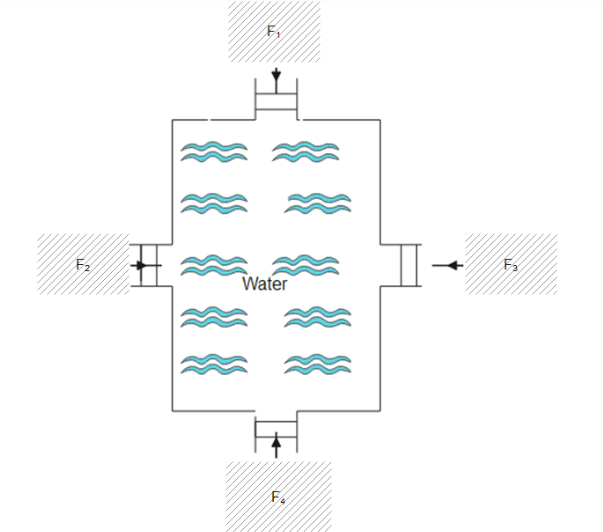
In the figure shown water is filled in a symmetrical container. Four Pistons of equal area are used at the four openings to keep the water in equilibrium. Now an additional force is applied at each piston. The increasing pressure at the center of the container due to this addition is
A. $\dfrac{F}{A}$
B. $\dfrac{{2F}}{A}$
C. $\dfrac{{4F}}{A}$
D. $0$
Answer
 Verified
524.1k+ views
Hint:In order to solve this type of questions we have to be clear with the concept of fluid mechanics. We also have to know Archimedes' principle and its applications. Also we have to be clear with the pascal's law and its applications. Observing the question we see that each side is applied force of F, thus our total force of $4F$ is applied.
Complete step by step answer:
Pascal law—For a fluid at rest in a closed container, the pressure applied at any point is transmitted equally to all the portions inside the container without any loss in energy. From the question we can see the net force applied on the symmetrical container is $4F$.The total area upon which this force is acted upon is $4A$.From the definition of pressure, we see that the pressure is $\dfrac{{4F}}{{4A}} = \dfrac{F}{A}$ .
Now from Pascal’s principle we see that a change in pressure applied to an enclosed fluid is transmitted in equal amount to all portions of the fluid and to the walls of the container; thus we can say that $\dfrac{F}{A}$ is transferred all the other three Pistons where $F_4,F_2,F_3$ are applied.
Now forces $F_4,F_2,F_3$ balance the applied pressure and keeps the water in equilibrium. Thus, from this we can see that there is no additional force due to the other forces. Hence, we can say the pressure exerted on the cylindrical container is $\dfrac{F}{A}$.
Note: This type of questions can easily be solved if we know the Pascal Law. Some of the applications of Pascal's principle are used in the functioning of the hydraulic press, hydraulic lift and brakes, which are asked in questions. DON’T get confused over Force and Pressure, pressure is equally transmitted and not force.
Complete step by step answer:
Pascal law—For a fluid at rest in a closed container, the pressure applied at any point is transmitted equally to all the portions inside the container without any loss in energy. From the question we can see the net force applied on the symmetrical container is $4F$.The total area upon which this force is acted upon is $4A$.From the definition of pressure, we see that the pressure is $\dfrac{{4F}}{{4A}} = \dfrac{F}{A}$ .
Now from Pascal’s principle we see that a change in pressure applied to an enclosed fluid is transmitted in equal amount to all portions of the fluid and to the walls of the container; thus we can say that $\dfrac{F}{A}$ is transferred all the other three Pistons where $F_4,F_2,F_3$ are applied.
Now forces $F_4,F_2,F_3$ balance the applied pressure and keeps the water in equilibrium. Thus, from this we can see that there is no additional force due to the other forces. Hence, we can say the pressure exerted on the cylindrical container is $\dfrac{F}{A}$.
Note: This type of questions can easily be solved if we know the Pascal Law. Some of the applications of Pascal's principle are used in the functioning of the hydraulic press, hydraulic lift and brakes, which are asked in questions. DON’T get confused over Force and Pressure, pressure is equally transmitted and not force.
Recently Updated Pages
Three beakers labelled as A B and C each containing 25 mL of water were taken A small amount of NaOH anhydrous CuSO4 and NaCl were added to the beakers A B and C respectively It was observed that there was an increase in the temperature of the solutions contained in beakers A and B whereas in case of beaker C the temperature of the solution falls Which one of the following statements isarecorrect i In beakers A and B exothermic process has occurred ii In beakers A and B endothermic process has occurred iii In beaker C exothermic process has occurred iv In beaker C endothermic process has occurred

Master Class 11 Social Science: Engaging Questions & Answers for Success
Master Class 11 Physics: Engaging Questions & Answers for Success
Master Class 11 Maths: Engaging Questions & Answers for Success
Master Class 11 Economics: Engaging Questions & Answers for Success
Master Class 11 Computer Science: Engaging Questions & Answers for Success
Three beakers labelled as A B and C each containing 25 mL of water were taken A small amount of NaOH anhydrous CuSO4 and NaCl were added to the beakers A B and C respectively It was observed that there was an increase in the temperature of the solutions contained in beakers A and B whereas in case of beaker C the temperature of the solution falls Which one of the following statements isarecorrect i In beakers A and B exothermic process has occurred ii In beakers A and B endothermic process has occurred iii In beaker C exothermic process has occurred iv In beaker C endothermic process has occurred
Master Class 11 Social Science: Engaging Questions & Answers for Success
Master Class 11 Physics: Engaging Questions & Answers for Success
Trending doubts
One Metric ton is equal to kg A 10000 B 1000 C 100 class 11 physics CBSE
There are 720 permutations of the digits 1 2 3 4 5 class 11 maths CBSE
1 Quintal is equal to a 110 kg b 10 kg c 100kg d 1000 class 11 physics CBSE
State and prove Bernoullis theorem class 11 physics CBSE
Difference Between Prokaryotic Cells and Eukaryotic Cells
Which among the following are examples of coming together class 11 social science CBSE