




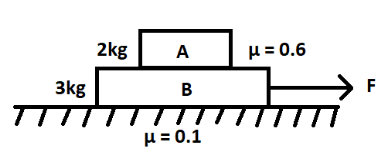
In the figure shown below the friction force between $A$ and $B$ is ${f_1}$ and between $B$ and ground is ${f_2}$. If ${f_1} = 2{f_2}$, then find $F$.
Answer
 Verified
511.5k+ views
Hint:To solve this problem we need to draw the free body diagram for individual blocks as shown below. A free body diagram is the graphical representation that is used to visualize the applied force, resulting force and moments on a body for the given condition. They help us to identify the connected bodies or body with all the moments, forces and reactions which are acting on the body. A series of free body diagrams are required to solve the complex problem. A free body diagram is an important step in understanding certain topics like dynamics, static and other forms of classical mechanics.
Complete step by step answer:
Given that: Friction force between $A$ and $B$ is equal to ${f_1}$. Friction force between $B$ and ground is equal to ${f_2}$. Free body diagram of block of mass $2kg$
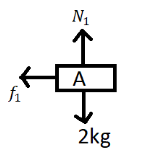
${m_1} = 2kg$
Therefore, ${N_1} = {m_1}g$
Substituting the given data in above equation, we get
${N_1} = 2 \times 10$
$\Rightarrow {N_1} = 20N$
$\Rightarrow {f_1} = {\mu _1}{N_1}$
$\Rightarrow {f_{1\max }} = 0.6 \times 20$
Therefore, ${f_{1\max }} = 12N$ ………. $\left( 1 \right)$
Free body diagram of block of mass $3kg$
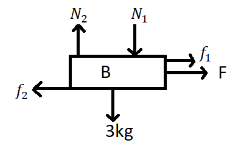
${m_2} = {m_1} + 3kg$
Substituting the given data
${m_2} = 2kg + 3kg \\
\Rightarrow {m_2} = 5kg $
$\Rightarrow {N_2} = {m_2}g$
${\Rightarrow N_2} = 5 \times 10 = 50kg$
$\Rightarrow {f_2} = {\mu _2}{N_2}$
$\Rightarrow {f_2} = \left( {0.1} \right)50$
$\Rightarrow {f_2} = 5N$
Now, from the given data
${f_1} = 2{f_2}$
Therefore,
${f_1} = 2 \times 5$
$\Rightarrow {f_1} = 10N$
Since, ${f_{1\max }} > {f_1}$ both blocks move together
Hence acceleration $\left( a \right) = \dfrac{{{f_1}}}{m} = \dfrac{{10}}{2} = 5m{s^{ - 2}}$
From the free body diagram of block of mass $3kg$ we get
$F - {f_2} = \left( {{m_1} + {m_2}} \right)a$
On substituting the given data we get
$F - 5 = \left( {3 + 2} \right)5$
On simplifying the above equation
$\therefore F = 30\,N$
Hence, the value of $F$ is 30 N.
Note:The amount of friction existing between two surfaces is known as coefficient of friction given by the symbol $\mu $ . The force required for sliding is less when the coefficient of friction is less whereas the force required for sliding is more when coefficient of friction is more. The formula for coefficient of friction is given as $\mu = \dfrac{\text{frictional force}}{\text{Normal force}}$.
Complete step by step answer:
Given that: Friction force between $A$ and $B$ is equal to ${f_1}$. Friction force between $B$ and ground is equal to ${f_2}$. Free body diagram of block of mass $2kg$
${m_1} = 2kg$
Therefore, ${N_1} = {m_1}g$
Substituting the given data in above equation, we get
${N_1} = 2 \times 10$
$\Rightarrow {N_1} = 20N$
$\Rightarrow {f_1} = {\mu _1}{N_1}$
$\Rightarrow {f_{1\max }} = 0.6 \times 20$
Therefore, ${f_{1\max }} = 12N$ ………. $\left( 1 \right)$
Free body diagram of block of mass $3kg$
${m_2} = {m_1} + 3kg$
Substituting the given data
${m_2} = 2kg + 3kg \\
\Rightarrow {m_2} = 5kg $
$\Rightarrow {N_2} = {m_2}g$
${\Rightarrow N_2} = 5 \times 10 = 50kg$
$\Rightarrow {f_2} = {\mu _2}{N_2}$
$\Rightarrow {f_2} = \left( {0.1} \right)50$
$\Rightarrow {f_2} = 5N$
Now, from the given data
${f_1} = 2{f_2}$
Therefore,
${f_1} = 2 \times 5$
$\Rightarrow {f_1} = 10N$
Since, ${f_{1\max }} > {f_1}$ both blocks move together
Hence acceleration $\left( a \right) = \dfrac{{{f_1}}}{m} = \dfrac{{10}}{2} = 5m{s^{ - 2}}$
From the free body diagram of block of mass $3kg$ we get
$F - {f_2} = \left( {{m_1} + {m_2}} \right)a$
On substituting the given data we get
$F - 5 = \left( {3 + 2} \right)5$
On simplifying the above equation
$\therefore F = 30\,N$
Hence, the value of $F$ is 30 N.
Note:The amount of friction existing between two surfaces is known as coefficient of friction given by the symbol $\mu $ . The force required for sliding is less when the coefficient of friction is less whereas the force required for sliding is more when coefficient of friction is more. The formula for coefficient of friction is given as $\mu = \dfrac{\text{frictional force}}{\text{Normal force}}$.
Recently Updated Pages
Master Class 11 Computer Science: Engaging Questions & Answers for Success

Master Class 11 Business Studies: Engaging Questions & Answers for Success
Master Class 11 Economics: Engaging Questions & Answers for Success
Master Class 11 English: Engaging Questions & Answers for Success
Master Class 11 Maths: Engaging Questions & Answers for Success
Master Class 11 Biology: Engaging Questions & Answers for Success
Trending doubts
One Metric ton is equal to kg A 10000 B 1000 C 100 class 11 physics CBSE
There are 720 permutations of the digits 1 2 3 4 5 class 11 maths CBSE
Discuss the various forms of bacteria class 11 biology CBSE
Draw a diagram of a plant cell and label at least eight class 11 biology CBSE
State the laws of reflection of light
Explain zero factorial class 11 maths CBSE