




In the figure shown below, select the correct options.
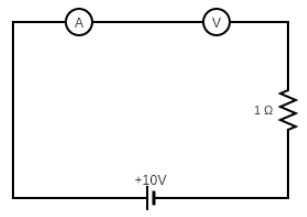
A. If both ammeter and voltmeter are ideal, then reading of ammeter is zero, reading of voltmeter is \[10\,V\].
B. If both ammeter and voltmeter are ideal, then reading of ammeter is \[10\,A\], reading of voltmeter is $0\,V$.
C. If ammeter is non ideal, voltmeter is ideal, then reading of ammeter is less than $10\,A$, reading of voltmeter is $10\,V$.
D. If ammeter is ideal, voltmeter is non ideal, then reading of ammeter is less than $10\,A$, reading of voltmeter is less than $10\,V$.
Answer
 Verified
524.7k+ views
Hint: To solve this question, we need to use the fact that ideal voltmeter has infinite resistance and ideal ammeter offers no resistance to current flow. If these components are non-ideal, then both of them will offer some finite resistance in the circuit and that will lead to extra voltage drop across them. This will cause change in readings.
Complete answer:
Since this is a multiple choice question, we will consider each option one by one.
Option A: If both ammeter and voltmeter are ideal then due to the infinite resistance of voltmeter, it will act as an open switch and current will flow through the circuit. Hence, ammeter will show zero reading and voltmeter will show $10$ V. This option is correct.
Option B: If both ammeter and voltmeter are ideal then option A is correct and option B is incorrect.
Option C: If ammeter is non ideal and voltmeter is ideal then here also voltmeter will act as an open switch and ammeter will show zero reading and voltmeter will show $10$ V.So, this option is correct.
Option D: Now, if the ammeter is ideal and the voltmeter is non ideal, then there will be some finite resistance in addition to $10\Omega $ because of the voltmeter. This will cause some potential drop across the voltmeter. Hence, the value of current will decrease as the net resistance of the circuit is increased, leading to ammeter reading less than $10\,A$. The additional potential drop across the voltmeter will lead to a reading less than $10\,V$. This option is also correct.
Hence, correct options are A, C and D.
Note: To measure current in circuit, ammeter is connected in series with the resistor and for voltage measurement, voltmeter is connected in parallel.The internal resistance of an ideal ammeter will be zero since it should allow current to pass through it. The ammeter is connected in series in a circuit to measure the current flow through the circuit.
Complete answer:
Since this is a multiple choice question, we will consider each option one by one.
Option A: If both ammeter and voltmeter are ideal then due to the infinite resistance of voltmeter, it will act as an open switch and current will flow through the circuit. Hence, ammeter will show zero reading and voltmeter will show $10$ V. This option is correct.
Option B: If both ammeter and voltmeter are ideal then option A is correct and option B is incorrect.
Option C: If ammeter is non ideal and voltmeter is ideal then here also voltmeter will act as an open switch and ammeter will show zero reading and voltmeter will show $10$ V.So, this option is correct.
Option D: Now, if the ammeter is ideal and the voltmeter is non ideal, then there will be some finite resistance in addition to $10\Omega $ because of the voltmeter. This will cause some potential drop across the voltmeter. Hence, the value of current will decrease as the net resistance of the circuit is increased, leading to ammeter reading less than $10\,A$. The additional potential drop across the voltmeter will lead to a reading less than $10\,V$. This option is also correct.
Hence, correct options are A, C and D.
Note: To measure current in circuit, ammeter is connected in series with the resistor and for voltage measurement, voltmeter is connected in parallel.The internal resistance of an ideal ammeter will be zero since it should allow current to pass through it. The ammeter is connected in series in a circuit to measure the current flow through the circuit.
Recently Updated Pages
Master Class 10 Computer Science: Engaging Questions & Answers for Success

Master Class 10 General Knowledge: Engaging Questions & Answers for Success
Master Class 10 English: Engaging Questions & Answers for Success
Master Class 10 Social Science: Engaging Questions & Answers for Success
Master Class 10 Maths: Engaging Questions & Answers for Success
Master Class 10 Science: Engaging Questions & Answers for Success
Trending doubts
What is the median of the first 10 natural numbers class 10 maths CBSE
Which women's tennis player has 24 Grand Slam singles titles?
Who is the Brand Ambassador of Incredible India?
Why is there a time difference of about 5 hours between class 10 social science CBSE
Write a letter to the principal requesting him to grant class 10 english CBSE
A moving boat is observed from the top of a 150 m high class 10 maths CBSE