




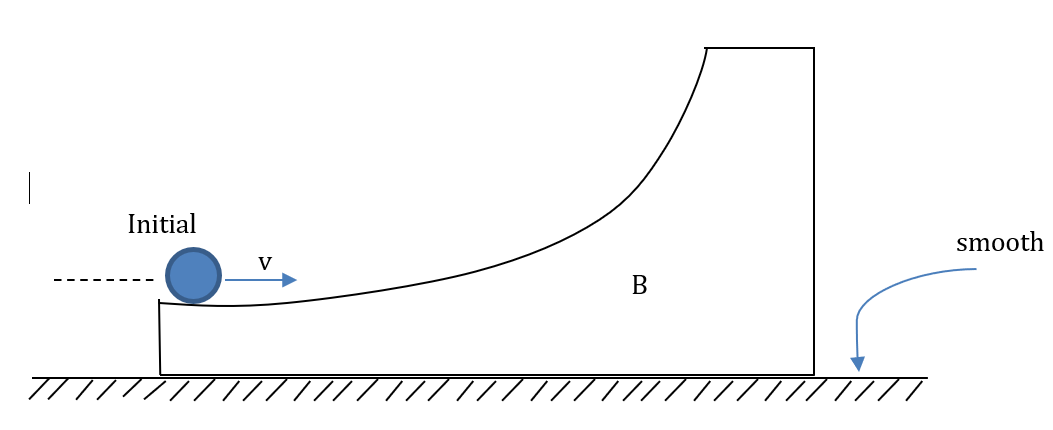
In the figure shown, a ring A is initially rolling without sliding with a velocity v, on the horizontal surface of the body B (of the same mass as A). All the surfaces are smooth. B has no initial velocity. What will be the maximum height reached by A on B?
$\begin{align}
& A.\dfrac{3{{v}^{2}}}{4g} \\
& B.\dfrac{{{v}^{2}}}{4g} \\
& C.\dfrac{{{v}^{2}}}{2g} \\
& D.\dfrac{{{v}^{2}}}{3g} \\
\end{align}$
Answer
 Verified
655.5k+ views
Hint: Use the law of conservation of total mechanical energy and the conservation of the total momentum to solve the problem. Do consider the rotational and translational Kinetic energy while using the conservation law.
Complete step-by-step answer:
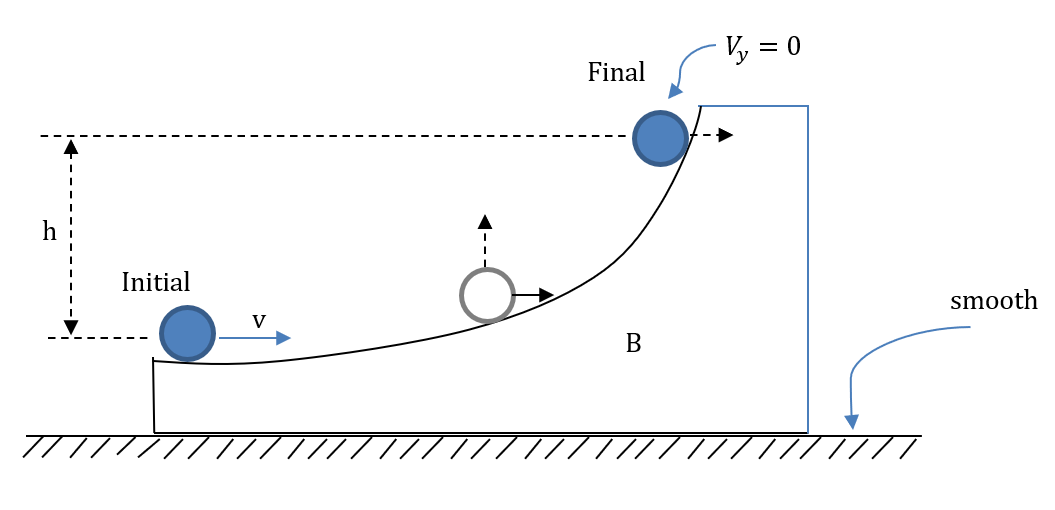
The given initial value of the velocity is v.When the ring is at the maximum height, the wedge and the ring have the same horizontal component of velocity. As all the surfaces are smooth, in the absence of friction between the ring and the wedge surface, the angular velocity of the ring remains constant.
The law conservation of the total mechanical energy says that total initial mechanical energy is the same as the total final mechanical energy and we get as
Rotational Kinetic energy is given by : $KE _{rot} = \dfrac{I\omega^2}{2}$
Translational Kinetic energy is given by : $KE _{trans} = \dfrac{mv^2}{2}$
Total initial mechanical energy as : $TME_{init} = \dfrac{1}{2} mv^2 + \dfrac{1}{2} I\omega^2$
Similarly, the final total mechanical energy becomes $TME_{final} = \dfrac{1}{2} mv^{I2} + \dfrac{1}{2} I\omega^2 + \dfrac{1}{2}mv^{I2} + mgh$where $v^I$ is the final common velocity of the bodies.
Using the conservation of momentum we get the initial momentum is equal to the final momentum we get : $mv + 0 = (2m)v^I$
$v^I = \dfrac{v}{2}$ so the substitution of this will give us
$\dfrac{1}{2} mv^2 + \dfrac{1}{2} I\omega^2 = \dfrac{1}{2} m(\dfrac{v}{2})^2 + \dfrac{1}{2} I\omega^2 + \dfrac{1}{2}(\dfrac{v}{2})^2 + mgh$
We get the value of $h = \dfrac{v^2}{4g}$
So using the conservation of the total mechanical energy we are able to find the value of $h = \dfrac{v^2}{4g}$, so B is correct here.
Note: The most common mistake that one can do in this kind of question with frictional surfaces is that we take the final value of rotational kinetic energy as zero and hence we get an error. Due to the frictionless surfaces, the value of rotational kinetic energy is the same .
Complete step-by-step answer:
The given initial value of the velocity is v.When the ring is at the maximum height, the wedge and the ring have the same horizontal component of velocity. As all the surfaces are smooth, in the absence of friction between the ring and the wedge surface, the angular velocity of the ring remains constant.
The law conservation of the total mechanical energy says that total initial mechanical energy is the same as the total final mechanical energy and we get as
Rotational Kinetic energy is given by : $KE _{rot} = \dfrac{I\omega^2}{2}$
Translational Kinetic energy is given by : $KE _{trans} = \dfrac{mv^2}{2}$
Total initial mechanical energy as : $TME_{init} = \dfrac{1}{2} mv^2 + \dfrac{1}{2} I\omega^2$
Similarly, the final total mechanical energy becomes $TME_{final} = \dfrac{1}{2} mv^{I2} + \dfrac{1}{2} I\omega^2 + \dfrac{1}{2}mv^{I2} + mgh$where $v^I$ is the final common velocity of the bodies.
Using the conservation of momentum we get the initial momentum is equal to the final momentum we get : $mv + 0 = (2m)v^I$
$v^I = \dfrac{v}{2}$ so the substitution of this will give us
$\dfrac{1}{2} mv^2 + \dfrac{1}{2} I\omega^2 = \dfrac{1}{2} m(\dfrac{v}{2})^2 + \dfrac{1}{2} I\omega^2 + \dfrac{1}{2}(\dfrac{v}{2})^2 + mgh$
We get the value of $h = \dfrac{v^2}{4g}$
So using the conservation of the total mechanical energy we are able to find the value of $h = \dfrac{v^2}{4g}$, so B is correct here.
Note: The most common mistake that one can do in this kind of question with frictional surfaces is that we take the final value of rotational kinetic energy as zero and hence we get an error. Due to the frictionless surfaces, the value of rotational kinetic energy is the same .
Recently Updated Pages
Master Class 11 Social Science: Engaging Questions & Answers for Success

Master Class 11 English: Engaging Questions & Answers for Success
Master Class 11 Accountancy: Engaging Questions & Answers for Success
Master Class 11 Physics: Engaging Questions & Answers for Success
Master Class 11 Computer Science: Engaging Questions & Answers for Success
Master Class 11 Business Studies: Engaging Questions & Answers for Success
Trending doubts
One Metric ton is equal to kg A 10000 B 1000 C 100 class 11 physics CBSE
Find the value of the expression given below sin 30circ class 11 maths CBSE
Draw a diagram of nephron and explain its structur class 11 biology CBSE
10 examples of friction in our daily life
Proton was discovered by A Thomson B Rutherford C Chadwick class 11 chemistry CBSE
The teeth used for biting and cutting food are called class 11 biology CBSE