




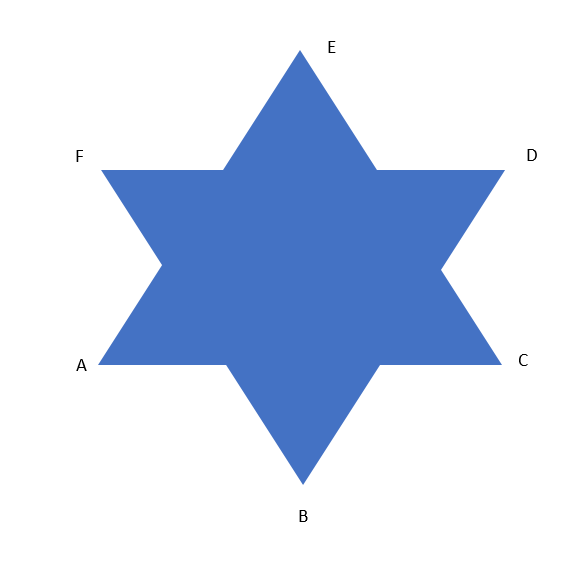
In the figure, show that $\angle A + \angle B + \angle C + \angle D + \angle E + \angle F = {360^ \circ }$.
Answer
 Verified
599.1k+ views
Hint: We will use the fact that the sum of angles in a triangle is ${180^ \circ }$. Using this in the two triangles which combine to form the given figure of a star and then adding those equations, we will get the required answer.
Step-By-Step answer:
We can clearly see that we are given the figure of a star with vertices A, B, C, D, E and F. Now, we can also very easily observe that it is formed of two different triangles.
We can observe that the triangles AEC and the triangle BDF form two different triangles and then when they are put together in an inverted form, we get the given star.
Now, we also know that we have a property named Triangle Property which states that the sum of interior angles of a triangle is ${180^ \circ }$.
Using this property in $\vartriangle AEC$:-
$ \Rightarrow \angle A + \angle C + \angle E = {180^ \circ }$ ………………….(1)
Now, using the same property in $\vartriangle BFD$:-
$ \Rightarrow \angle B + \angle F + \angle D = {180^ \circ }$ ………………….(2)
Now, let us add both the equations (1) and (2), we will then get:-
$ \Rightarrow \left( {\angle A + \angle C + \angle E} \right) + \left( {\angle B + \angle F + \angle D} \right) = {180^ \circ } + {180^ \circ }$
Adding up the right hand side and writing the left hand side without the parenthesis, we will obtain the following expression:-
$ \Rightarrow \angle A + \angle B + \angle C + \angle D + \angle E + \angle F = {360^ \circ }$
Hence, proved.
Note: The students must note that trying to prove it without using will be a difficult task since, we are not even given about the length of the sides and thus we cannot divide the interior angles of the hexagon (if we join the vertices of the figure given to us, we will get a hexagon).
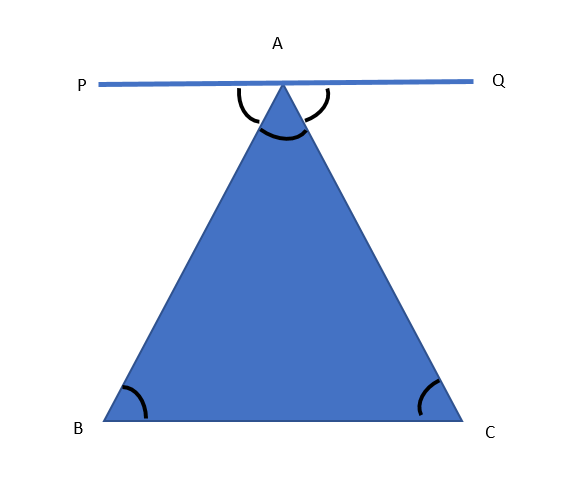
The students must note that they can easily prove that the sum of all the angles in a triangle is ${180^ \circ }$ by using the property of alternate angles on the straight line.
Step-By-Step answer:
We can clearly see that we are given the figure of a star with vertices A, B, C, D, E and F. Now, we can also very easily observe that it is formed of two different triangles.
We can observe that the triangles AEC and the triangle BDF form two different triangles and then when they are put together in an inverted form, we get the given star.
Now, we also know that we have a property named Triangle Property which states that the sum of interior angles of a triangle is ${180^ \circ }$.
Using this property in $\vartriangle AEC$:-
$ \Rightarrow \angle A + \angle C + \angle E = {180^ \circ }$ ………………….(1)
Now, using the same property in $\vartriangle BFD$:-
$ \Rightarrow \angle B + \angle F + \angle D = {180^ \circ }$ ………………….(2)
Now, let us add both the equations (1) and (2), we will then get:-
$ \Rightarrow \left( {\angle A + \angle C + \angle E} \right) + \left( {\angle B + \angle F + \angle D} \right) = {180^ \circ } + {180^ \circ }$
Adding up the right hand side and writing the left hand side without the parenthesis, we will obtain the following expression:-
$ \Rightarrow \angle A + \angle B + \angle C + \angle D + \angle E + \angle F = {360^ \circ }$
Hence, proved.
Note: The students must note that trying to prove it without using will be a difficult task since, we are not even given about the length of the sides and thus we cannot divide the interior angles of the hexagon (if we join the vertices of the figure given to us, we will get a hexagon).
The students must note that they can easily prove that the sum of all the angles in a triangle is ${180^ \circ }$ by using the property of alternate angles on the straight line.
Recently Updated Pages
Master Class 12 Economics: Engaging Questions & Answers for Success

Master Class 12 English: Engaging Questions & Answers for Success
Master Class 12 Social Science: Engaging Questions & Answers for Success
Master Class 12 Maths: Engaging Questions & Answers for Success
Master Class 12 Physics: Engaging Questions & Answers for Success
Master Class 9 General Knowledge: Engaging Questions & Answers for Success
Trending doubts
Explain the Treaty of Vienna of 1815 class 10 social science CBSE
Who Won 36 Oscar Awards? Record Holder Revealed
Why is it 530 pm in india when it is 1200 afternoon class 10 social science CBSE
Make a sketch of the human nerve cell What function class 10 biology CBSE
What is the full form of POSCO class 10 social science CBSE
Define Potential, Developed, Stock and Reserved resources