




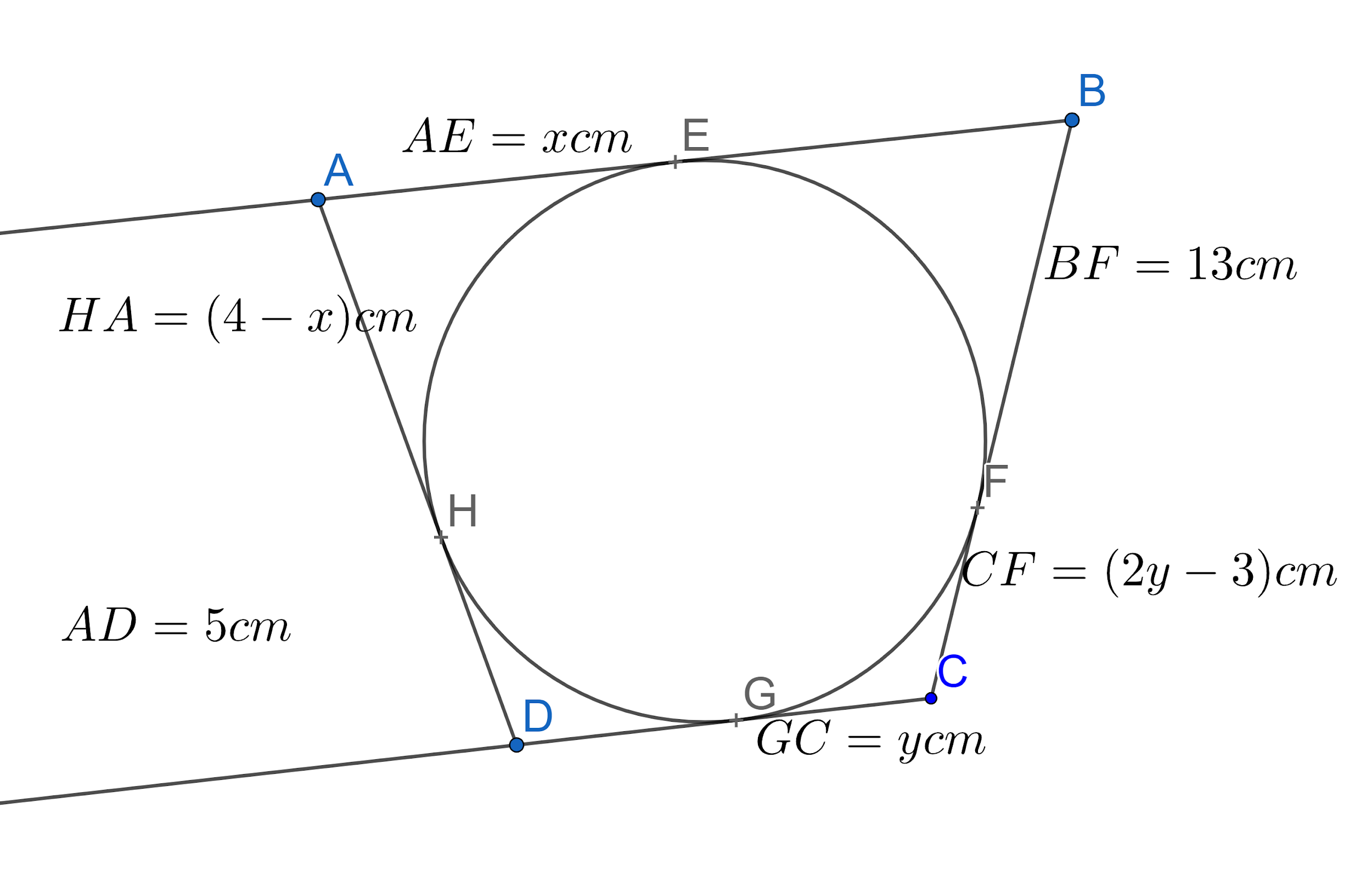
In the figure, quadrilateral ABCD circumstances the circle. Find the length of the side CD?
Answer
 Verified
612.3k+ views
Hint: From the figure we can see that the sides of the quadrilateral ABCD are tangents of the circle. We use the fact that the distance between the point of intersection of tangents and point of contact of a tangent on the circle is the same for both tangents to get the value of x and y. We then use the length of the side DA to get the line segment DH. We use the fact that the distance between the point of intersection of tangents and the point of contact of a tangent on the circle is the same for both tangents to find the length of DG. We then add the lengths DG and GC to get the length of the side CD.
Complete step-by-step solution:
According to the problem, we have a quadrilateral ABCD which circumstances the circle as shown in the figure. We need to find the length of the side CD.
Let us redraw the figure.
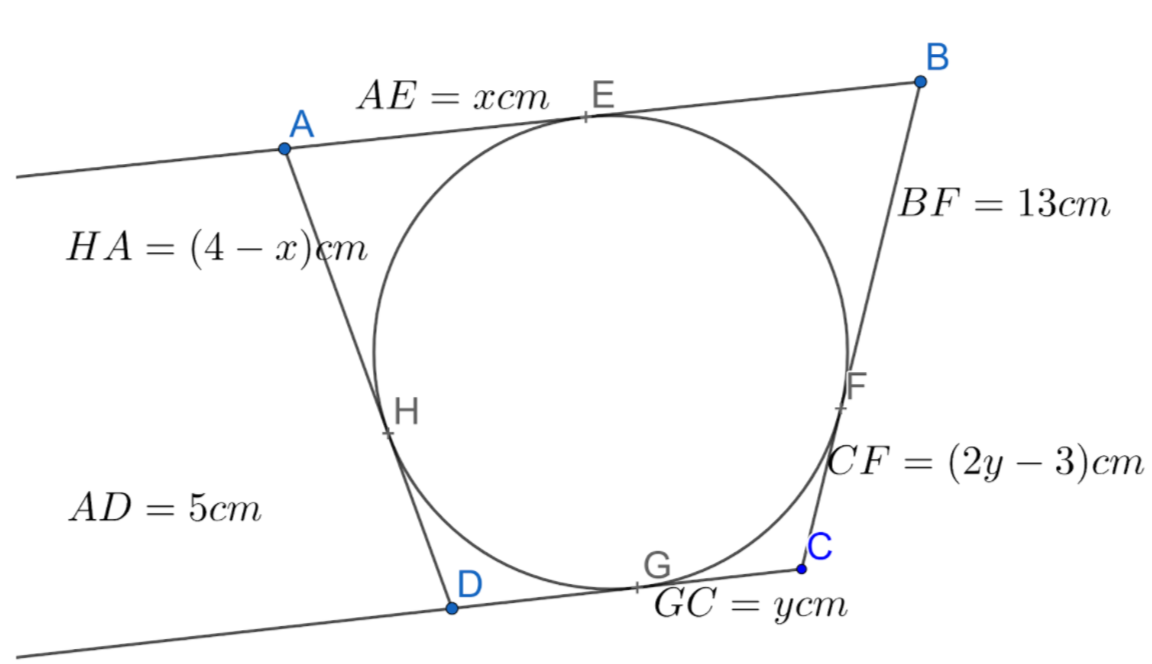
From the figure, we can see that the sides AB, BC, CD, and DA are tangents of the circles. We know that the distance between the point of intersection of tangents and point of contact of a tangent on the circle is the same for both tangents.
So, we have the tangents intersecting at point A. This gives us the length of the line segment AE equal to the length of the line segment AH i.e., $AH=AE$.
So, we have $x=4-x$.
$\Rightarrow x+x=4$.
$\Rightarrow 2x=4$.
$\Rightarrow x=\dfrac{4}{2}$.
$\Rightarrow x=2$ ---(1).
From the figure see that the length of the side AD is given as $5cm$. Let us find the length of $DH$.
We have $AH+HD=5$.
$\Rightarrow 4-x+HD=5$.
using equation (1) we get
$\Rightarrow 4-2+HD=5$.
$\Rightarrow 2+HD=5$.
$\Rightarrow HD=5-2$.
$\Rightarrow HD=3cm$ ---(2).
We can also see that the sides DA and CD intersect at D as they are the tangents to the circle, we get $DG=HD$.
Using equation (2) we get $DG=3cm$ ---(3).
We can also see that the sides BC and CD intersect at C as they are the tangents to the circle, we get \[CG=FC\].
So, we have $y=2y-3$.
$\Rightarrow 3=2y-y$.
$\Rightarrow y=3$.
So, the length of the line segment CG is 3cm.
From the figure, we can see that the length of the side CD is the sum of CG and GD.
So, we have $CD=CG+GD$.
$\Rightarrow CD=3+3$.
$\Rightarrow CD=6cm$.
We have found the length of the side CD as 6cm.
$\therefore$ The length of the side CD is 6cm.
Note: We should know that if any polygon circumstances the circle, then the sides of that polygon will be tangents to that given circle. We can prove all that we have just used in the problem. We can also find the perimeter and area of the quadrilateral by using the values we just found. We can also find the area and perimeter of the circle after finding the dimensions of the quadrilateral. Similarly, we can expect problems in which the circle circumscribes the quadrilateral.
Complete step-by-step solution:
According to the problem, we have a quadrilateral ABCD which circumstances the circle as shown in the figure. We need to find the length of the side CD.
Let us redraw the figure.
From the figure, we can see that the sides AB, BC, CD, and DA are tangents of the circles. We know that the distance between the point of intersection of tangents and point of contact of a tangent on the circle is the same for both tangents.
So, we have the tangents intersecting at point A. This gives us the length of the line segment AE equal to the length of the line segment AH i.e., $AH=AE$.
So, we have $x=4-x$.
$\Rightarrow x+x=4$.
$\Rightarrow 2x=4$.
$\Rightarrow x=\dfrac{4}{2}$.
$\Rightarrow x=2$ ---(1).
From the figure see that the length of the side AD is given as $5cm$. Let us find the length of $DH$.
We have $AH+HD=5$.
$\Rightarrow 4-x+HD=5$.
using equation (1) we get
$\Rightarrow 4-2+HD=5$.
$\Rightarrow 2+HD=5$.
$\Rightarrow HD=5-2$.
$\Rightarrow HD=3cm$ ---(2).
We can also see that the sides DA and CD intersect at D as they are the tangents to the circle, we get $DG=HD$.
Using equation (2) we get $DG=3cm$ ---(3).
We can also see that the sides BC and CD intersect at C as they are the tangents to the circle, we get \[CG=FC\].
So, we have $y=2y-3$.
$\Rightarrow 3=2y-y$.
$\Rightarrow y=3$.
So, the length of the line segment CG is 3cm.
From the figure, we can see that the length of the side CD is the sum of CG and GD.
So, we have $CD=CG+GD$.
$\Rightarrow CD=3+3$.
$\Rightarrow CD=6cm$.
We have found the length of the side CD as 6cm.
$\therefore$ The length of the side CD is 6cm.
Note: We should know that if any polygon circumstances the circle, then the sides of that polygon will be tangents to that given circle. We can prove all that we have just used in the problem. We can also find the perimeter and area of the quadrilateral by using the values we just found. We can also find the area and perimeter of the circle after finding the dimensions of the quadrilateral. Similarly, we can expect problems in which the circle circumscribes the quadrilateral.
Recently Updated Pages
Master Class 12 Business Studies: Engaging Questions & Answers for Success

Master Class 12 Biology: Engaging Questions & Answers for Success
Master Class 12 Chemistry: Engaging Questions & Answers for Success
Class 12 Question and Answer - Your Ultimate Solutions Guide
Master Class 11 Social Science: Engaging Questions & Answers for Success
Master Class 11 English: Engaging Questions & Answers for Success
Trending doubts
What is the Full Form of ICSE / ISC ?
Fill the blanks with the suitable prepositions 1 The class 9 english CBSE
Difference Between Plant Cell and Animal Cell
How many hours before the closure of election must class 9 social science CBSE
What is pollution? How many types of pollution? Define it
Name 10 Living and Non living things class 9 biology CBSE