




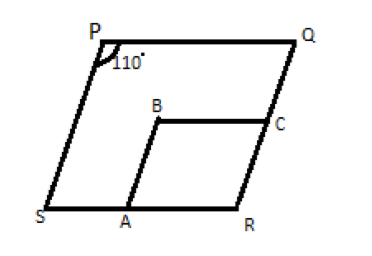
In the figure, PQRS and ABCR are two parallelograms. If$\angle P = 110^\circ $then find the measures of all angles of.
Answer
 Verified
621.6k+ views
Hint: Based on the given figure, we can see the one parallelogram is inside another parallelogram. Using the properties of parallelograms like opposite angles are always congruent and the sum of adjacent angles is$180^\circ $. By these properties we will be able to get the remaining angles in parallelogram. As the sum of all angles in a parallelogram is equal to$$360^\circ $$.
Complete step-by-step answer:
Given, PQRS and ABCR are two parallelograms.
Properties of Parallelogram can define what a parallelogram is:
Opposite sides are congruent (AB=DC).
Opposite angles are congruent (D=C).
Consecutive angles are supplementary (A+D= 180 degrees).
If one angle is right, then all angles are right.
The diagonals of a parallelogram bisect each other.
Each diagonal of a parallelogram separates it into two congruent triangles.
There are three special types of a parallelogram:
Rhombus: A parallelogram in which all sides are equal.
Rectangle: A parallelogram in which all angles are right angles and the diagonals are equal.
Square: A parallelogram with all equal sides and all equal to 90 degrees. The diagonals of a square are also equal
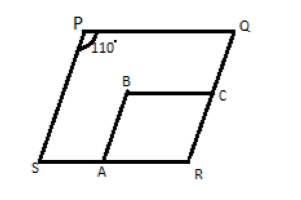
And $\angle P = 110^\circ $
$ \Rightarrow \angle SRQ = 110^\circ $(Opposite angle of a parallelogram are equal).
$ \Rightarrow \angle ARC = 110^\circ $
If $\angle ARC = 110^\circ $
$ \Rightarrow \angle ABC = 110^\circ $(Opposite of angle of$\angle ARC$in parallelogram)
Sum of adjacent angles of a parallelogram$ = 180^\circ $
$ \Rightarrow \angle ABC + \angle BCR = 180^\circ $… (1)
$ \Rightarrow \angle ABC + \angle BAR = 180^\circ $… (2)
From equation (1)
$ \Rightarrow \angle BCR = 180^\circ - \angle ABC$
$ \Rightarrow \angle BCR = 180^\circ - 110^\circ $
$ \Rightarrow \angle BCR = 70^\circ $
From equation (2)
$ \Rightarrow \angle BAR = 180^\circ - \angle ABC$
$ \Rightarrow \angle BAR = 180^\circ - 110^\circ $
$ \Rightarrow \angle BAR = 70^\circ $
Therefore, in parallelogram ABCR
$\angle A = 70^\circ $,$$\angle B = 110^\circ $$,$\angle C = 70^\circ $,$$\angle R = 110^\circ $$
Note: We can solve the above problem by considering the transversal intersecting with two parallel lines. Considering the transversal properties where by using corresponding angles are congruent property. If transversal intersects with two or more parallel lines then the formed corresponding angles, alternate interior angles and alternate exterior angles are congruent. The pairs of consecutive interior angles formed by the transversal are supplementary.
Complete step-by-step answer:
Given, PQRS and ABCR are two parallelograms.
Properties of Parallelogram can define what a parallelogram is:
Opposite sides are congruent (AB=DC).
Opposite angles are congruent (D=C).
Consecutive angles are supplementary (A+D= 180 degrees).
If one angle is right, then all angles are right.
The diagonals of a parallelogram bisect each other.
Each diagonal of a parallelogram separates it into two congruent triangles.
There are three special types of a parallelogram:
Rhombus: A parallelogram in which all sides are equal.
Rectangle: A parallelogram in which all angles are right angles and the diagonals are equal.
Square: A parallelogram with all equal sides and all equal to 90 degrees. The diagonals of a square are also equal
And $\angle P = 110^\circ $
$ \Rightarrow \angle SRQ = 110^\circ $(Opposite angle of a parallelogram are equal).
$ \Rightarrow \angle ARC = 110^\circ $
If $\angle ARC = 110^\circ $
$ \Rightarrow \angle ABC = 110^\circ $(Opposite of angle of$\angle ARC$in parallelogram)
Sum of adjacent angles of a parallelogram$ = 180^\circ $
$ \Rightarrow \angle ABC + \angle BCR = 180^\circ $… (1)
$ \Rightarrow \angle ABC + \angle BAR = 180^\circ $… (2)
From equation (1)
$ \Rightarrow \angle BCR = 180^\circ - \angle ABC$
$ \Rightarrow \angle BCR = 180^\circ - 110^\circ $
$ \Rightarrow \angle BCR = 70^\circ $
From equation (2)
$ \Rightarrow \angle BAR = 180^\circ - \angle ABC$
$ \Rightarrow \angle BAR = 180^\circ - 110^\circ $
$ \Rightarrow \angle BAR = 70^\circ $
Therefore, in parallelogram ABCR
$\angle A = 70^\circ $,$$\angle B = 110^\circ $$,$\angle C = 70^\circ $,$$\angle R = 110^\circ $$
Note: We can solve the above problem by considering the transversal intersecting with two parallel lines. Considering the transversal properties where by using corresponding angles are congruent property. If transversal intersects with two or more parallel lines then the formed corresponding angles, alternate interior angles and alternate exterior angles are congruent. The pairs of consecutive interior angles formed by the transversal are supplementary.
Recently Updated Pages
Master Class 12 Business Studies: Engaging Questions & Answers for Success

Master Class 12 Biology: Engaging Questions & Answers for Success
Master Class 12 Chemistry: Engaging Questions & Answers for Success
Class 12 Question and Answer - Your Ultimate Solutions Guide
Master Class 11 Social Science: Engaging Questions & Answers for Success
Master Class 11 English: Engaging Questions & Answers for Success
Trending doubts
Find the sum of series 1 + 2 + 3 + 4 + 5 + + 100 class 9 maths CBSE
Fill the blanks with the suitable prepositions 1 The class 9 english CBSE
Difference Between Plant Cell and Animal Cell
How many hours before the closure of election must class 9 social science CBSE
What is pollution? How many types of pollution? Define it
Name 10 Living and Non living things class 9 biology CBSE