




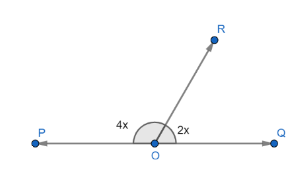
In the figure, $POQ$ is a line, $\angle POR=4x$ and $\angle QOR=2x$. Find the value of $x$.
A. $30{}^\circ $
B. $60{}^\circ $
C. $90{}^\circ $
D. $120{}^\circ $
Answer
 Verified
574.8k+ views
Hint: In this problem we will calculate the sum of the given angles from the diagram. We have the Linear pair of axioms $-\text{I}$ as ‘If a ray stands on a line, then the sum of two adjacent angles so formed is $180{}^\circ $’. According to this theorem we will equate the sum of angles shown in the diagram and equate it to $180{}^\circ $ , then we will have an equation in terms of $x$. To find the value of $x$ we will solve the equation.
Complete step-by-step answer:
Given that, $POQ$ is a line, $\angle POR=4x$ and $\angle QOR=2x$. The diagrammatic representation is as follows
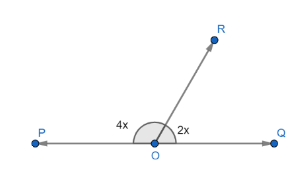
The sum of the adjacent angles in the diagram is
$\begin{align}
& \angle POR+\angle QOR=4x+2x \\
& \Rightarrow \angle POR+\angle QOR=6x.....\left( \text{i} \right) \\
\end{align}$
From the Linear pair of axioms $-\text{I}$, we have the sum of the pair of adjacent angles formed by a ray on a line is equal to $180{}^\circ $.
$\therefore \angle POR+\angle QOR=180{}^\circ $
From equation $\left( \text{i} \right)$, substituting the value of $\angle POR+\angle QOR=6x$ in the above equation, then we will have
$\begin{align}
& \angle POR+\angle QOR=180{}^\circ \\
& \Rightarrow 6x=180{}^\circ \\
\end{align}$
Dividing the above equation with $6$ then we will get
$\begin{align}
& \dfrac{6x}{6}=\dfrac{180{}^\circ }{6} \\
& \Rightarrow x=30{}^\circ \\
\end{align}$
$\therefore $ Option – A is the correct answer.
So, the correct answer is “Option A”.
Note: We have Linear pair of axioms $-\text{II}$ also. This axiom states that ‘If two angles form a linear pair, then uncommon arms of both the angles form a straight line.’ These two thermoses are very useful in solving this kind of problem.
Complete step-by-step answer:
Given that, $POQ$ is a line, $\angle POR=4x$ and $\angle QOR=2x$. The diagrammatic representation is as follows
The sum of the adjacent angles in the diagram is
$\begin{align}
& \angle POR+\angle QOR=4x+2x \\
& \Rightarrow \angle POR+\angle QOR=6x.....\left( \text{i} \right) \\
\end{align}$
From the Linear pair of axioms $-\text{I}$, we have the sum of the pair of adjacent angles formed by a ray on a line is equal to $180{}^\circ $.
$\therefore \angle POR+\angle QOR=180{}^\circ $
From equation $\left( \text{i} \right)$, substituting the value of $\angle POR+\angle QOR=6x$ in the above equation, then we will have
$\begin{align}
& \angle POR+\angle QOR=180{}^\circ \\
& \Rightarrow 6x=180{}^\circ \\
\end{align}$
Dividing the above equation with $6$ then we will get
$\begin{align}
& \dfrac{6x}{6}=\dfrac{180{}^\circ }{6} \\
& \Rightarrow x=30{}^\circ \\
\end{align}$
$\therefore $ Option – A is the correct answer.
So, the correct answer is “Option A”.
Note: We have Linear pair of axioms $-\text{II}$ also. This axiom states that ‘If two angles form a linear pair, then uncommon arms of both the angles form a straight line.’ These two thermoses are very useful in solving this kind of problem.
Recently Updated Pages
Master Class 10 Computer Science: Engaging Questions & Answers for Success

Master Class 10 General Knowledge: Engaging Questions & Answers for Success
Master Class 10 English: Engaging Questions & Answers for Success
Master Class 10 Social Science: Engaging Questions & Answers for Success
Master Class 10 Maths: Engaging Questions & Answers for Success
Master Class 10 Science: Engaging Questions & Answers for Success
Trending doubts
What is the median of the first 10 natural numbers class 10 maths CBSE
Which women's tennis player has 24 Grand Slam singles titles?
Who is the Brand Ambassador of Incredible India?
Why is there a time difference of about 5 hours between class 10 social science CBSE
Write a letter to the principal requesting him to grant class 10 english CBSE
A moving boat is observed from the top of a 150 m high class 10 maths CBSE