



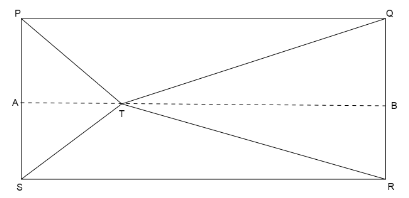
In the figure point T is in the interior of rectangle PQRS. Prove that \[T{S^2} + T{Q^2} = T{P^2} + T{R^2}\]. (As shown in the figure, draw segment \[AB\parallel SR\])
Answer
 Verified
585.6k+ views
Hint: Here we use the concept that opposite sides of a rectangle are equal in length. We draw a line segment AB parallel to the side SR. Using the right angled triangles formed, apply Pythagoras theorem in each triangle and write the sides. Substitute the values in LHS of the given equation.
* Pythagoras theorem states that in a right angled triangle, the sum of square of base and square of height is equal to square of the hypotenuse.
If we have a right angled triangle, \[\vartriangle ABC\]with right angle, \[\angle B = {90^ \circ }\]
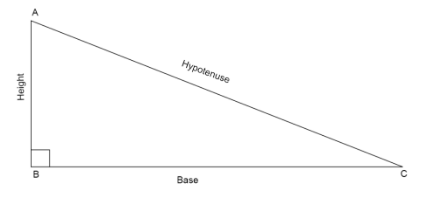
Then using the Pythagoras theorem we can write that \[A{C^2} = A{B^2} + B{C^2}\]
Complete step-by-step answer:
We are given a rectangle PQRS.
Since we know all interior angle of rectangle are right angles.
If we draw a line segment AB parallel to the side SR of the rectangle we will have \[\angle TAS = {90^ \circ }\]and\[\angle TBR = {90^ \circ }\](as line segments AB and SR are parallel and \[\angle ASR = \angle BRS = {90^ \circ }\])
Then we have four right triangles: \[\vartriangle PAT,\vartriangle SAT,\vartriangle RBT,\vartriangle QBT\]
In right triangle PAT, using Pythagoras theorem we have
\[T{P^2} = P{A^2} + A{T^2}\] … (1)
In right triangle SAT, using Pythagoras theorem we have
\[T{S^2} = A{T^2} + A{S^2}\] … (2)
In right triangle RBT, using Pythagoras theorem we have
\[T{R^2} = T{B^2} + B{R^2}\] … (3)
In right triangle QBT, using Pythagoras theorem we have
\[T{Q^2} = T{B^2} + B{Q^2}\] … (4)
Solve LHS of the equation
LHS \[ = T{S^2} + T{Q^2}\]
Substitute the values from equations (2) and (4)
\[ \Rightarrow T{S^2} + T{Q^2} = (A{T^2} + A{S^2}) + (T{B^2} + B{Q^2})\]
Since, the line segment AB is parallel to side SR.
Then sides \[AS = BR\]and\[AP = BQ\]
\[ \Rightarrow T{S^2} + T{Q^2} = (A{T^2} + B{R^2}) + (T{B^2} + A{P^2})\]
Open the brackets
\[ \Rightarrow T{S^2} + T{Q^2} = (A{T^2} + A{P^2}) + (B{R^2} + T{B^2})\]
Substitute the value of\[P{A^2} + A{T^2} = T{P^2}\]from equation (1) and\[T{B^2} + B{R^2} = T{R^2}\]from equation (3)
\[ \Rightarrow T{S^2} + T{Q^2} = T{P^2} + T{R^2}\]
Then LHS is equal to RHS of the equation.
Hence proved
Note: Students may try to prove this equation by showing that the two triangles PST and QRT are similar which they will show with the help of vertically opposite angles. This is a wrong approach because the sides of the triangles are not formed from straight lines, they are different lines and so we cannot have vertically opposite angles as equal. Also, while applying Pythagoras theorem many students write any side on any side of the equation, keep in mind the hypotenuse is on one side of the equation and base and perpendicular are on the other side of the equation.
* Pythagoras theorem states that in a right angled triangle, the sum of square of base and square of height is equal to square of the hypotenuse.
If we have a right angled triangle, \[\vartriangle ABC\]with right angle, \[\angle B = {90^ \circ }\]
Then using the Pythagoras theorem we can write that \[A{C^2} = A{B^2} + B{C^2}\]
Complete step-by-step answer:
We are given a rectangle PQRS.
Since we know all interior angle of rectangle are right angles.
If we draw a line segment AB parallel to the side SR of the rectangle we will have \[\angle TAS = {90^ \circ }\]and\[\angle TBR = {90^ \circ }\](as line segments AB and SR are parallel and \[\angle ASR = \angle BRS = {90^ \circ }\])
Then we have four right triangles: \[\vartriangle PAT,\vartriangle SAT,\vartriangle RBT,\vartriangle QBT\]
In right triangle PAT, using Pythagoras theorem we have
\[T{P^2} = P{A^2} + A{T^2}\] … (1)
In right triangle SAT, using Pythagoras theorem we have
\[T{S^2} = A{T^2} + A{S^2}\] … (2)
In right triangle RBT, using Pythagoras theorem we have
\[T{R^2} = T{B^2} + B{R^2}\] … (3)
In right triangle QBT, using Pythagoras theorem we have
\[T{Q^2} = T{B^2} + B{Q^2}\] … (4)
Solve LHS of the equation
LHS \[ = T{S^2} + T{Q^2}\]
Substitute the values from equations (2) and (4)
\[ \Rightarrow T{S^2} + T{Q^2} = (A{T^2} + A{S^2}) + (T{B^2} + B{Q^2})\]
Since, the line segment AB is parallel to side SR.
Then sides \[AS = BR\]and\[AP = BQ\]
\[ \Rightarrow T{S^2} + T{Q^2} = (A{T^2} + B{R^2}) + (T{B^2} + A{P^2})\]
Open the brackets
\[ \Rightarrow T{S^2} + T{Q^2} = (A{T^2} + A{P^2}) + (B{R^2} + T{B^2})\]
Substitute the value of\[P{A^2} + A{T^2} = T{P^2}\]from equation (1) and\[T{B^2} + B{R^2} = T{R^2}\]from equation (3)
\[ \Rightarrow T{S^2} + T{Q^2} = T{P^2} + T{R^2}\]
Then LHS is equal to RHS of the equation.
Hence proved
Note: Students may try to prove this equation by showing that the two triangles PST and QRT are similar which they will show with the help of vertically opposite angles. This is a wrong approach because the sides of the triangles are not formed from straight lines, they are different lines and so we cannot have vertically opposite angles as equal. Also, while applying Pythagoras theorem many students write any side on any side of the equation, keep in mind the hypotenuse is on one side of the equation and base and perpendicular are on the other side of the equation.
Recently Updated Pages
Master Class 9 General Knowledge: Engaging Questions & Answers for Success

Master Class 9 Social Science: Engaging Questions & Answers for Success
Master Class 9 English: Engaging Questions & Answers for Success
Master Class 9 Maths: Engaging Questions & Answers for Success
Master Class 9 Science: Engaging Questions & Answers for Success
Class 9 Question and Answer - Your Ultimate Solutions Guide
Trending doubts
Difference Between Plant Cell and Animal Cell
Fill the blanks with the suitable prepositions 1 The class 9 english CBSE
Who is eligible for RTE class 9 social science CBSE
Which places in India experience sunrise first and class 9 social science CBSE
What is pollution? How many types of pollution? Define it
Name 10 Living and Non living things class 9 biology CBSE