




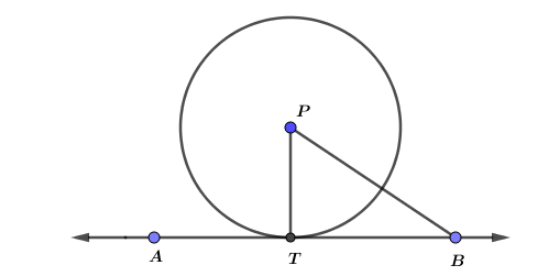
In the figure point P is the centre of the circle and line AB is the tangent to the circle at T. The radius of the circle is 6 cm. Find PB if ∠TPB = 60°.
A. 12 cm
B. 24 cm
C. 8 cm
D. 18 cm
Answer
 Verified
655.5k+ views
Hint: Here, first using property of tangent to a circle, prove that triangle PTB is a right triangle. As PTB is a right angled triangle, also ∠TPB is given, so we can use trigonometric tools to find the length of PB.
Complete step-by-step answer:
Given that a circle with centre P and radius PT = 6 cm, and AB is a tangent passing through T.
Also given ∠TPB = 60°.
Here, T is the point of contact of tangent and circle.
Since, AB is tangent to the circle, ∠PTB = 90°.
[Property of tangent to a circle: Tangent to a circle is always perpendicular to the point of contact]
In triangle ATB,
∠ATB + ∠TAB + ∠TBP = 180°
[Angle sum property: Angle sum property of a triangle states that sum of all angles of a triangle is 180°]
We have, ∠ATB = 90°, ∠TAB = 60°
Therefore, 90° + 60° + ∠TBP = 180°
150° + ∠TBP = 180°
∠TBP =180° − 150° = 30°
Now, again in triangle ATB,
sin ∠TBP = $\dfrac{{PT}}{{PB}}$
sin 30° = $\dfrac{6}{{PB}}$
$\dfrac{1}{2} = \dfrac{6}{{PB}}$
Cross multiplying
PB = 12 cm
Therefore, the length of PB is 12 cm.
Hence, option (A) is correct.
Note:
In these types of questions, if you find a right angled triangle, with one side and one standard angle like 30°, 45°, 60° are given, then always use a trigonometric method to find the unknown side.
As values of trigonometric tools like sine, cos, tan etc are defined for some angles like 30°, 45°, 60° can be easily used.
Complete step-by-step answer:
Given that a circle with centre P and radius PT = 6 cm, and AB is a tangent passing through T.
Also given ∠TPB = 60°.
Here, T is the point of contact of tangent and circle.
Since, AB is tangent to the circle, ∠PTB = 90°.
[Property of tangent to a circle: Tangent to a circle is always perpendicular to the point of contact]
In triangle ATB,
∠ATB + ∠TAB + ∠TBP = 180°
[Angle sum property: Angle sum property of a triangle states that sum of all angles of a triangle is 180°]
We have, ∠ATB = 90°, ∠TAB = 60°
Therefore, 90° + 60° + ∠TBP = 180°
150° + ∠TBP = 180°
∠TBP =180° − 150° = 30°
Now, again in triangle ATB,
sin ∠TBP = $\dfrac{{PT}}{{PB}}$
sin 30° = $\dfrac{6}{{PB}}$
$\dfrac{1}{2} = \dfrac{6}{{PB}}$
Cross multiplying
PB = 12 cm
Therefore, the length of PB is 12 cm.
Hence, option (A) is correct.
Note:
In these types of questions, if you find a right angled triangle, with one side and one standard angle like 30°, 45°, 60° are given, then always use a trigonometric method to find the unknown side.
As values of trigonometric tools like sine, cos, tan etc are defined for some angles like 30°, 45°, 60° can be easily used.
Recently Updated Pages
Master Class 11 Social Science: Engaging Questions & Answers for Success

Master Class 11 English: Engaging Questions & Answers for Success
Master Class 11 Accountancy: Engaging Questions & Answers for Success
Master Class 11 Physics: Engaging Questions & Answers for Success
Master Class 11 Computer Science: Engaging Questions & Answers for Success
Master Class 11 Business Studies: Engaging Questions & Answers for Success
Trending doubts
Find the value of the expression given below sin 30circ class 11 maths CBSE
The teeth used for biting and cutting food are called class 11 biology CBSE
Frogs heart when taken out of the body continues to class 11 biology CBSE
Draw a diagram of a plant cell and label at least eight class 11 biology CBSE
What is the maximum height of a projectile class 11 physics CBSE
Derive an expression for maximum height and range of class 11 physics CBSE