




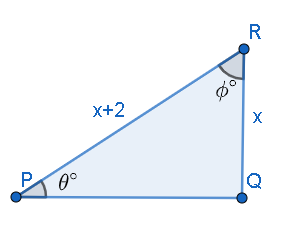
In the figure of $\Delta PQR,\angle P=\theta {}^\circ \text{ and }\angle R=\phi {}^\circ $ . Find
(i) $\sqrt{x+1}\cot \phi $
(ii) $\sqrt{{{x}^{3}}+{{x}^{2}}}\tan \theta $
(iii) $\cos \theta $
Answer
 Verified
514.8k+ views
Hint: We have to apply the Pythagoras theorem on the given right-angled triangle which states that the square of the hypotenuse of a right-angled triangle is equal to the sum of squares of the other two sides and find the value of PQ. Now, to find the value of $\sqrt{x+1}\cot \phi $ , we have to use the formula $\cot \phi =\dfrac{\text{Adjacent side}}{\text{Opposite side}}$ and simplify the expression. Similarly, for $\sqrt{{{x}^{3}}+{{x}^{2}}}\tan \theta $ , we have to substitute $\tan \theta =\dfrac{\text{Opposite side}}{\text{Adjacent side}}$ and simplify. Finally, $\cos \theta =\dfrac{\text{Adjacent side}}{\text{Hypotenuse}}$ gives the value of (iii).
Complete step by step solution:
We are given with a triangle $\Delta PQR$ with $\angle P=\theta {}^\circ \text{ and }\angle R=\phi {}^\circ $ . From the given figure, we can see that $\angle Q=90{}^\circ $ , that is, the $\Delta PQR$ is a right-angled triangle. We can now apply the Pythagoras theorem which states that the square of the hypotenuse of a right-angled triangle is equal to the sum of squares of the other two sides. In the given figure, we can see that PR is the hypotenuse. Therefore, we can write
$\Rightarrow P{{R}^{2}}=P{{Q}^{2}}+Q{{R}^{2}}$
From the given figure, we can see that $PR=x+2$ and $QR=x$ .
$\Rightarrow {{\left( x+2 \right)}^{2}}=P{{Q}^{2}}+{{x}^{2}}$
Let us find PQ. We have to take ${{x}^{2}}$ to the LHS.
$\begin{align}
& \Rightarrow {{\left( x+2 \right)}^{2}}-{{x}^{2}}=P{{Q}^{2}} \\
& \Rightarrow P{{Q}^{2}}={{\left( x+2 \right)}^{2}}-{{x}^{2}} \\
\end{align}$
We know that ${{\left( a+b \right)}^{2}}={{a}^{2}}+2ab+{{b}^{2}}$ . Therefore, the above equation can be written as
$\begin{align}
& \Rightarrow P{{Q}^{2}}={{x}^{2}}+2\times 2x+4-{{x}^{2}} \\
&\Rightarrow P{{Q}^{2}}=\require{cancel}\cancel{{{x}^{2}}}+4x+4\require{cancel}\cancel{-{{x}^{2}}} \\
& \Rightarrow P{{Q}^{2}}=4x+4 \\
\end{align}$
Let us take 4 outside from the terms in the RHS.
$\Rightarrow P{{Q}^{2}}=4\left( x+1 \right)$
We have to take square roots on both sides.
$\begin{align}
& \Rightarrow PQ=\sqrt{4\left( x+1 \right)} \\
& \Rightarrow PQ=2\sqrt{\left( x+1 \right)}...\left( i \right) \\
\end{align}$
Now, let us find the values of each of the given sections.
(i) We have to find the value of $\sqrt{x+1}\cot \phi $ . Let us express $\cot \phi $ in terms of the sides of a right-angled triangle for a specific angle $\phi $ .
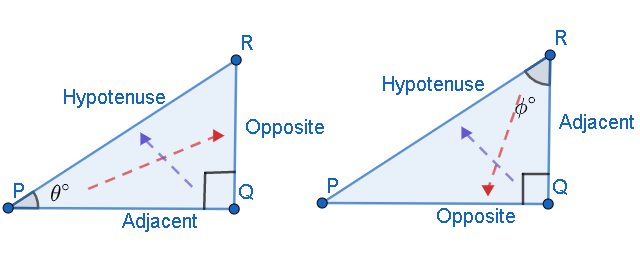
We know that $\cot \phi =\dfrac{\text{Adjacent side}}{\text{Opposite side}}$ . Here, we can see that the adjacent side specific to $\phi $ is QR and the opposite side is PQ. Therefore, we can write x$\sqrt{x+1}\cot \phi $ as
$\Rightarrow \sqrt{x+1}\cot \phi =\sqrt{x+1}\times \dfrac{QR}{PQ}$
Let us substitute (i) and the value of QR in the above expression.
$\Rightarrow \sqrt{x+1}\cot \phi =\sqrt{x+1}\times \dfrac{x}{2\sqrt{x+1}}$
Let us cancel the common terms.
$\begin{align}
& \Rightarrow \sqrt{x+1}\cot \phi =\require{cancel}\cancel{\sqrt{x+1}}\times \dfrac{x}{2\require{cancel}\cancel{\sqrt{x+1}}} \\
& \Rightarrow \sqrt{x+1}\cot \phi =\dfrac{x}{2} \\
\end{align}$
Hence, the value of $\sqrt{x+1}\cot \phi $ is $\dfrac{x}{2}$ .
(ii) We have to find the value of $\sqrt{{{x}^{3}}+{{x}^{2}}}\tan \theta $ . We know that $\tan \theta =\dfrac{\text{Opposite side}}{\text{Adjacent side}}$ .
From the figure, we can see that the opposite side specific to $\theta $ is QR and the adjacent side is PQ. Therefore, we can write $\sqrt{{{x}^{3}}+{{x}^{2}}}\tan \theta $ as
$\Rightarrow \sqrt{{{x}^{3}}+{{x}^{2}}}\tan \theta =\sqrt{{{x}^{3}}+{{x}^{2}}}\times \dfrac{QR}{PQ}$
Let us substitute (i) and the value of QR in the above expression.
$\Rightarrow \sqrt{{{x}^{3}}+{{x}^{2}}}\tan \theta =\sqrt{{{x}^{3}}+{{x}^{2}}}\times \dfrac{x}{2\sqrt{x+1}}$
Let us take ${{x}^{2}}$ outside from $\sqrt{{{x}^{3}}+{{x}^{2}}}$ .
$\begin{align}
& \Rightarrow \sqrt{{{x}^{3}}+{{x}^{2}}}\tan \theta =\sqrt{{{x}^{2}}\left( x+1 \right)}\times \dfrac{x}{2\sqrt{x+1}} \\
& \Rightarrow \sqrt{{{x}^{3}}+{{x}^{2}}}\tan \theta =x\sqrt{x+1}\times \dfrac{x}{2\sqrt{x+1}} \\
\end{align}$
Let us cancel the common terms.
$\begin{align}
& \Rightarrow \sqrt{{{x}^{3}}+{{x}^{2}}}\tan \theta =x\require{cancel}\cancel{\sqrt{x+1}}\times \dfrac{x}{2\require{cancel}\cancel{\sqrt{x+1}}} \\
& \Rightarrow \sqrt{{{x}^{3}}+{{x}^{2}}}\tan \theta =\dfrac{{{x}^{2}}}{2} \\
\end{align}$
Hence, the value of $\sqrt{{{x}^{3}}+{{x}^{2}}}\tan \theta $ is $\dfrac{{{x}^{2}}}{2}$ .
(iii) We have to find the value of $\cos \theta $ . We know that $\cos \theta =\dfrac{\text{Adjacent side}}{\text{Hypotenuse}}$ . From the given figure, we can see that the adjacent side specific to $\theta $ is PQ and the hypotenuse is PR.
$\begin{align}
& \Rightarrow \cos \theta =\dfrac{PQ}{PR} \\
& \Rightarrow \cos \theta =\dfrac{2\sqrt{x+1}}{x+2} \\
\end{align}$
Hence, the value of $\cos \theta $ is $\dfrac{2\sqrt{x+1}}{x+2}$ .
Note: Students must be thorough with the formulas of trigonometric ratios in terms of the sides of a right-angled triangle. They must note that we can apply these formulas and Pythagoras theorem only if the triangle is a right-angled one. We can find the adjacent and opposite sides as follows:
Complete step by step solution:
We are given with a triangle $\Delta PQR$ with $\angle P=\theta {}^\circ \text{ and }\angle R=\phi {}^\circ $ . From the given figure, we can see that $\angle Q=90{}^\circ $ , that is, the $\Delta PQR$ is a right-angled triangle. We can now apply the Pythagoras theorem which states that the square of the hypotenuse of a right-angled triangle is equal to the sum of squares of the other two sides. In the given figure, we can see that PR is the hypotenuse. Therefore, we can write
$\Rightarrow P{{R}^{2}}=P{{Q}^{2}}+Q{{R}^{2}}$
From the given figure, we can see that $PR=x+2$ and $QR=x$ .
$\Rightarrow {{\left( x+2 \right)}^{2}}=P{{Q}^{2}}+{{x}^{2}}$
Let us find PQ. We have to take ${{x}^{2}}$ to the LHS.
$\begin{align}
& \Rightarrow {{\left( x+2 \right)}^{2}}-{{x}^{2}}=P{{Q}^{2}} \\
& \Rightarrow P{{Q}^{2}}={{\left( x+2 \right)}^{2}}-{{x}^{2}} \\
\end{align}$
We know that ${{\left( a+b \right)}^{2}}={{a}^{2}}+2ab+{{b}^{2}}$ . Therefore, the above equation can be written as
$\begin{align}
& \Rightarrow P{{Q}^{2}}={{x}^{2}}+2\times 2x+4-{{x}^{2}} \\
&\Rightarrow P{{Q}^{2}}=\require{cancel}\cancel{{{x}^{2}}}+4x+4\require{cancel}\cancel{-{{x}^{2}}} \\
& \Rightarrow P{{Q}^{2}}=4x+4 \\
\end{align}$
Let us take 4 outside from the terms in the RHS.
$\Rightarrow P{{Q}^{2}}=4\left( x+1 \right)$
We have to take square roots on both sides.
$\begin{align}
& \Rightarrow PQ=\sqrt{4\left( x+1 \right)} \\
& \Rightarrow PQ=2\sqrt{\left( x+1 \right)}...\left( i \right) \\
\end{align}$
Now, let us find the values of each of the given sections.
(i) We have to find the value of $\sqrt{x+1}\cot \phi $ . Let us express $\cot \phi $ in terms of the sides of a right-angled triangle for a specific angle $\phi $ .
We know that $\cot \phi =\dfrac{\text{Adjacent side}}{\text{Opposite side}}$ . Here, we can see that the adjacent side specific to $\phi $ is QR and the opposite side is PQ. Therefore, we can write x$\sqrt{x+1}\cot \phi $ as
$\Rightarrow \sqrt{x+1}\cot \phi =\sqrt{x+1}\times \dfrac{QR}{PQ}$
Let us substitute (i) and the value of QR in the above expression.
$\Rightarrow \sqrt{x+1}\cot \phi =\sqrt{x+1}\times \dfrac{x}{2\sqrt{x+1}}$
Let us cancel the common terms.
$\begin{align}
& \Rightarrow \sqrt{x+1}\cot \phi =\require{cancel}\cancel{\sqrt{x+1}}\times \dfrac{x}{2\require{cancel}\cancel{\sqrt{x+1}}} \\
& \Rightarrow \sqrt{x+1}\cot \phi =\dfrac{x}{2} \\
\end{align}$
Hence, the value of $\sqrt{x+1}\cot \phi $ is $\dfrac{x}{2}$ .
(ii) We have to find the value of $\sqrt{{{x}^{3}}+{{x}^{2}}}\tan \theta $ . We know that $\tan \theta =\dfrac{\text{Opposite side}}{\text{Adjacent side}}$ .
From the figure, we can see that the opposite side specific to $\theta $ is QR and the adjacent side is PQ. Therefore, we can write $\sqrt{{{x}^{3}}+{{x}^{2}}}\tan \theta $ as
$\Rightarrow \sqrt{{{x}^{3}}+{{x}^{2}}}\tan \theta =\sqrt{{{x}^{3}}+{{x}^{2}}}\times \dfrac{QR}{PQ}$
Let us substitute (i) and the value of QR in the above expression.
$\Rightarrow \sqrt{{{x}^{3}}+{{x}^{2}}}\tan \theta =\sqrt{{{x}^{3}}+{{x}^{2}}}\times \dfrac{x}{2\sqrt{x+1}}$
Let us take ${{x}^{2}}$ outside from $\sqrt{{{x}^{3}}+{{x}^{2}}}$ .
$\begin{align}
& \Rightarrow \sqrt{{{x}^{3}}+{{x}^{2}}}\tan \theta =\sqrt{{{x}^{2}}\left( x+1 \right)}\times \dfrac{x}{2\sqrt{x+1}} \\
& \Rightarrow \sqrt{{{x}^{3}}+{{x}^{2}}}\tan \theta =x\sqrt{x+1}\times \dfrac{x}{2\sqrt{x+1}} \\
\end{align}$
Let us cancel the common terms.
$\begin{align}
& \Rightarrow \sqrt{{{x}^{3}}+{{x}^{2}}}\tan \theta =x\require{cancel}\cancel{\sqrt{x+1}}\times \dfrac{x}{2\require{cancel}\cancel{\sqrt{x+1}}} \\
& \Rightarrow \sqrt{{{x}^{3}}+{{x}^{2}}}\tan \theta =\dfrac{{{x}^{2}}}{2} \\
\end{align}$
Hence, the value of $\sqrt{{{x}^{3}}+{{x}^{2}}}\tan \theta $ is $\dfrac{{{x}^{2}}}{2}$ .
(iii) We have to find the value of $\cos \theta $ . We know that $\cos \theta =\dfrac{\text{Adjacent side}}{\text{Hypotenuse}}$ . From the given figure, we can see that the adjacent side specific to $\theta $ is PQ and the hypotenuse is PR.
$\begin{align}
& \Rightarrow \cos \theta =\dfrac{PQ}{PR} \\
& \Rightarrow \cos \theta =\dfrac{2\sqrt{x+1}}{x+2} \\
\end{align}$
Hence, the value of $\cos \theta $ is $\dfrac{2\sqrt{x+1}}{x+2}$ .
Note: Students must be thorough with the formulas of trigonometric ratios in terms of the sides of a right-angled triangle. They must note that we can apply these formulas and Pythagoras theorem only if the triangle is a right-angled one. We can find the adjacent and opposite sides as follows:
Recently Updated Pages
Master Class 10 Computer Science: Engaging Questions & Answers for Success

Master Class 10 General Knowledge: Engaging Questions & Answers for Success
Master Class 10 English: Engaging Questions & Answers for Success
Master Class 10 Social Science: Engaging Questions & Answers for Success
Master Class 10 Maths: Engaging Questions & Answers for Success
Master Class 10 Science: Engaging Questions & Answers for Success
Trending doubts
What is the median of the first 10 natural numbers class 10 maths CBSE
Which women's tennis player has 24 Grand Slam singles titles?
Who is the Brand Ambassador of Incredible India?
Why is there a time difference of about 5 hours between class 10 social science CBSE
Write a letter to the principal requesting him to grant class 10 english CBSE
A moving boat is observed from the top of a 150 m high class 10 maths CBSE