




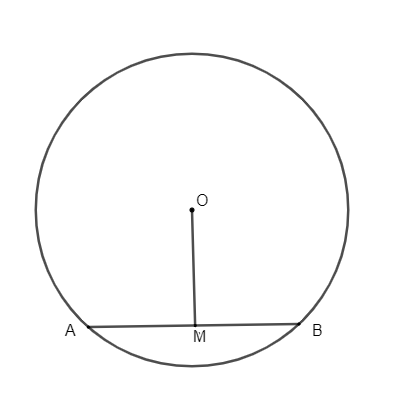
In the figure ‘o’ is the centre of the circle. OM = 3cm and AB = 8cm. Find the radius of the circle.
a)5 cm
b)4 cm
c)15 cm
d)8 cm
Answer
 Verified
636.3k+ views
Hint: OM is the perpendicular from the centre of the chord AB. Thus OM divides AB into half. Joint OA and take it as the radius we need to find. Using Pythagora's theorem in\[\vartriangle OAM\], find the length of OA.
Complete step-by-step answer:
We have been given a circle with centre ‘o’.
We need to find the radius of the circle. From the figure let us join OA and mark it as the radius of the given circle. Now we need to find the value of OA.
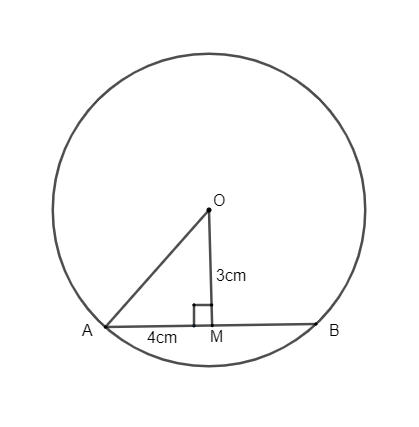
We have been given OM = 3cm and AB= 8cm.
We know that perpendicular from the centre of the circle to the chord bisect the chord. Now here OM is a perpendicular from the angle of the circle to the chord AB.
Thus \[AM=\dfrac{1}{2}AB\] (from the figure)
\[=\dfrac{1}{2}\times 8=4cm\]
Hence we got AM = 4cm.
Now \[\vartriangle OMA\]is a right triangle as\[OM\bot AB\].
By Pythagoras theorem, we can say that
\[O{{M}^{2}}+A{{M}^{2}}=O{{A}^{2}}\]
Put the values of OM = 3cm and AM = 4cm.
\[\begin{align}
& \therefore O{{A}^{2}}={{\left( 3 \right)}^{2}}+{{\left( 4 \right)}^{2}} \\
& \\
& =9+6=25 \\
& \\
& OA=\sqrt{25}=5cm \\
\end{align}\]
Hence we got OA = 5cm that is radius of the given circle is 5cm
\[\therefore \] Option (a) is the correct answer.
Note: You can also consider OB as radius, then AM = BM = 4cm.
Assume \[\vartriangle OMB\]and by Pythagoras theorem you will get OB = 5cm.
Here OA and OB both are the radius of the given circle. So,
OA = OB = 5cm.
Complete step-by-step answer:
We have been given a circle with centre ‘o’.
We need to find the radius of the circle. From the figure let us join OA and mark it as the radius of the given circle. Now we need to find the value of OA.
We have been given OM = 3cm and AB= 8cm.
We know that perpendicular from the centre of the circle to the chord bisect the chord. Now here OM is a perpendicular from the angle of the circle to the chord AB.
Thus \[AM=\dfrac{1}{2}AB\] (from the figure)
\[=\dfrac{1}{2}\times 8=4cm\]
Hence we got AM = 4cm.
Now \[\vartriangle OMA\]is a right triangle as\[OM\bot AB\].
By Pythagoras theorem, we can say that
\[O{{M}^{2}}+A{{M}^{2}}=O{{A}^{2}}\]
Put the values of OM = 3cm and AM = 4cm.
\[\begin{align}
& \therefore O{{A}^{2}}={{\left( 3 \right)}^{2}}+{{\left( 4 \right)}^{2}} \\
& \\
& =9+6=25 \\
& \\
& OA=\sqrt{25}=5cm \\
\end{align}\]
Hence we got OA = 5cm that is radius of the given circle is 5cm
\[\therefore \] Option (a) is the correct answer.
Note: You can also consider OB as radius, then AM = BM = 4cm.
Assume \[\vartriangle OMB\]and by Pythagoras theorem you will get OB = 5cm.
Here OA and OB both are the radius of the given circle. So,
OA = OB = 5cm.
Recently Updated Pages
Master Class 10 English: Engaging Questions & Answers for Success

Master Class 10 Social Science: Engaging Questions & Answers for Success
Master Class 10 Computer Science: Engaging Questions & Answers for Success
Class 10 Question and Answer - Your Ultimate Solutions Guide
Master Class 10 General Knowledge: Engaging Questions & Answers for Success
Master Class 10 Maths: Engaging Questions & Answers for Success
Trending doubts
What is the full form of NDA a National Democratic class 10 social science CBSE
Explain the Treaty of Vienna of 1815 class 10 social science CBSE
Who Won 36 Oscar Awards? Record Holder Revealed
Bharatiya Janata Party was founded in the year A 1979 class 10 social science CBSE
What is the median of the first 10 natural numbers class 10 maths CBSE
Why is it 530 pm in india when it is 1200 afternoon class 10 social science CBSE