




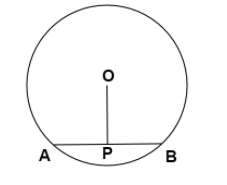
In the figure \[O\] is the centre of the circle. \[OB = 5{\text{ }}cm\] , Distance from \[O\] to chord \[AB\] is \[3{\text{ }}cm\] .Find the length of \[AB\]
Answer
 Verified
547.2k+ views
Hint: First we will input the given data into the diagram so that it will be easy to understand. When we will input the data, a triangle \[OPB\] will be formed. Then we will apply the Pythagoras theorem in the triangle \[OPB\] to get the value of \[PB\] and hence multiply it by \[2\] to get the value of \[AB\] because we know that the perpendicular from the centre of circle bisects the chord.
Complete step by step answer:
A figure is given in which \[O\] is the centre of the circle and the value of \[OB\] is given as \[5{\text{ }}cm\] and the value of distance from \[O\] to chord \[AB\] i.e., \[OP\] is given as \[3{\text{ }}cm\] and we have to find the length of chord \[AB\]
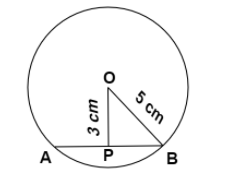
As it can be seen in the figure that \[OP\] is drawn perpendicular to \[O\] on the line \[AB\]
So, \[\angle P = {90^ \circ }\]
Now we will apply the Pythagoras theorem in the triangle \[OPB\] to get the value of \[PB\] because we have the values of the other two sides of the triangle and also \[\angle P = {90^ \circ }\]
So, according to Pythagoras theorem,
\[{H^2} = {B^2} + {P^2}\]
where \[H\] represents the hypotenuse of a triangle, \[B\] represents the base of the triangle and \[P\] represents the perpendicular of the triangle.
In triangle \[OPB\] , by Pythagoras theorem
\[O{B^2} = O{P^2} + P{B^2}\]
Now, substitute the values of \[OB\] and \[OP\] in the above expression to find the value of \[PB\]
\[ \Rightarrow {5^2} = {3^2} + P{B^2}\]
\[ \Rightarrow 25 = 9 + P{B^2}\]
On simplifying it, we get
\[ \Rightarrow P{B^2} = 25 - 9\]
\[ \Rightarrow P{B^2} = 16\]
Taking square roots both sides, we get
\[PB = 4\]
Hence the value of \[PB\] is \[4{\text{ }}cm\]
Now, we have the value of \[PB\] and as we know that the perpendicular from the centre of the circle bisects the chord into two equal parts
\[\therefore AB = 2 \times PB\]
On Substituting the value of \[PB\] we get
\[AB = 2 \times 4\]
\[ \Rightarrow AB = 8\]
Hence, the length of \[AB\] is \[{\text{8 }}cm\]
Note:
Remember that the perpendicular drawn from the centre of the circle to the chord always bisects the chord in two equal parts, thus we can conclude that \[AP = BP\] in the given problem because it is the base point of the whole solution. Also, while taking square roots do not consider the negative root as \[OP\] denotes the distance of length and length can never be negative. The length of \[AB\] is itself a distance we require.
Complete step by step answer:
A figure is given in which \[O\] is the centre of the circle and the value of \[OB\] is given as \[5{\text{ }}cm\] and the value of distance from \[O\] to chord \[AB\] i.e., \[OP\] is given as \[3{\text{ }}cm\] and we have to find the length of chord \[AB\]
As it can be seen in the figure that \[OP\] is drawn perpendicular to \[O\] on the line \[AB\]
So, \[\angle P = {90^ \circ }\]
Now we will apply the Pythagoras theorem in the triangle \[OPB\] to get the value of \[PB\] because we have the values of the other two sides of the triangle and also \[\angle P = {90^ \circ }\]
So, according to Pythagoras theorem,
\[{H^2} = {B^2} + {P^2}\]
where \[H\] represents the hypotenuse of a triangle, \[B\] represents the base of the triangle and \[P\] represents the perpendicular of the triangle.
In triangle \[OPB\] , by Pythagoras theorem
\[O{B^2} = O{P^2} + P{B^2}\]
Now, substitute the values of \[OB\] and \[OP\] in the above expression to find the value of \[PB\]
\[ \Rightarrow {5^2} = {3^2} + P{B^2}\]
\[ \Rightarrow 25 = 9 + P{B^2}\]
On simplifying it, we get
\[ \Rightarrow P{B^2} = 25 - 9\]
\[ \Rightarrow P{B^2} = 16\]
Taking square roots both sides, we get
\[PB = 4\]
Hence the value of \[PB\] is \[4{\text{ }}cm\]
Now, we have the value of \[PB\] and as we know that the perpendicular from the centre of the circle bisects the chord into two equal parts
\[\therefore AB = 2 \times PB\]
On Substituting the value of \[PB\] we get
\[AB = 2 \times 4\]
\[ \Rightarrow AB = 8\]
Hence, the length of \[AB\] is \[{\text{8 }}cm\]
Note:
Remember that the perpendicular drawn from the centre of the circle to the chord always bisects the chord in two equal parts, thus we can conclude that \[AP = BP\] in the given problem because it is the base point of the whole solution. Also, while taking square roots do not consider the negative root as \[OP\] denotes the distance of length and length can never be negative. The length of \[AB\] is itself a distance we require.
Recently Updated Pages
Basicity of sulphurous acid and sulphuric acid are

Master Class 12 Economics: Engaging Questions & Answers for Success
Master Class 12 Biology: Engaging Questions & Answers for Success
Master Class 11 English: Engaging Questions & Answers for Success
Master Class 11 Physics: Engaging Questions & Answers for Success
Master Class 11 Computer Science: Engaging Questions & Answers for Success
Trending doubts
What is the Total Duration of Football Match?
Explain the Treaty of Vienna of 1815 class 10 social science CBSE
In football, which nation is called "La Roja"?
Why is there a time difference of about 5 hours between class 10 social science CBSE
10 examples of evaporation in daily life with explanations
What is the full form of POSCO class 10 social science CBSE