




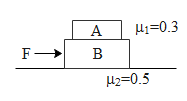
In the figure, ${{m}_{A}}=3kg$ and ${{m}_{B}}=4kg$.For what minimum value of F, A starts slipping over B: $(g=10m{{s}^{-2}})$
a) 50N
b) 59N
c) 36N
d) 45N
Answer
 Verified
585.6k+ views
Hint: In the above diagram we can see that there exists friction between the horizontal surface and between blocks A and B. It is to be noted that on application of force on B, block A will move back. But due to friction it will hold itself on the block B. The block A will slip on block B when the maximum acceleration due to the limiting friction of block A is given to block B. Hence using this condition we will accordingly find the maximum value of F.
Formula used:
${{N}_{A}}={{m}_{A}}g\text{ and }{{N}_{B}}=\left( {{m}_{A}}+{{m}_{B}} \right)g$
$F-{{\mu }_{2}}{{N}_{B}}-{{\mu }_{1}}{{N}_{A}}={{m}_{B}}{{a}_{MAX}}$
Complete step by step answer:
In the above diagram we can see that both the blocks along there are subjected to frictional force. The frictional force is defined as the product of normal reaction times the coefficient of friction. Force of friction on block A is given by,
$\begin{align}
& {{F}_{A}}={{\mu }_{1}}{{N}_{A}} \\
& {{F}_{A}}={{\mu }_{1}}{{m}_{A}}g \\
\end{align}$
Similarly the force of friction by the bottom surface on block B is given by,
$\begin{align}
& {{F}_{B}}={{\mu }_{2}}{{N}_{B}} \\
& {{F}_{B}}={{\mu }_{2}}\left( {{m}_{A}}+{{m}_{A}} \right)g \\
\end{align}$
The block A will move on B as long as the acceleration of the block does not cross the maximum value of acceleration due to the limiting force of friction i.e. $({{F}_{A}})$. Hence the maximum acceleration is given by,
$\begin{align}
& {{F}_{A}}={{m}_{A}}{{a}_{MAX}} \\
& \Rightarrow {{\mu }_{1}}{{m}_{A}}g={{m}_{A}}{{a}_{MAX}} \\
& \Rightarrow {{\mu }_{1}}g={{a}_{MAX}} \\
& \Rightarrow {{a}_{MAX}}=0.3\times 10=3m{{s}^{-2}} \\
\end{align}$
If block B starts moving with this acceleration then the blocks will hardly move together. But if the acceleration of the block B is slightly greater than this the block A will slip over B. The force of friction acts on the top of block B as well as its bottom. Hence taking the maximum acceleration of the block B such that the block A does not slip over it the force on block B can be written as,
$\begin{align}
& F-{{F}_{B}}-{{F}_{A}}={{m}_{B}}{{a}_{MAX}} \\
& \Rightarrow F-{{\mu }_{2}}{{N}_{B}}-{{\mu }_{1}}{{N}_{A}}={{m}_{B}}{{a}_{MAX}} \\
& \Rightarrow F={{\mu }_{2}}{{N}_{B}}+{{\mu }_{1}}{{N}_{A}}+{{m}_{B}}{{a}_{MAX}} \\
& \Rightarrow F={{\mu }_{2}}\left( {{m}_{A}}+{{m}_{B}} \right)g+{{\mu }_{1}}{{m}_{A}}g+{{m}_{B}}{{a}_{MAX}} \\
& \Rightarrow F=0.5\left( 3+4 \right)10+0.3\times 3\times 10+5\times 3 \\
& \Rightarrow F=35+9+15 \\
& \Rightarrow F=59N \\
\end{align}$
So, the correct answer is “Option B”.
Note:
It is to be noted that all the physical units have to be in SI units. Otherwise the answer obtained will not be in standard units. To solve the above question it is always necessary to draw the free body diagram for simplicity.
Formula used:
${{N}_{A}}={{m}_{A}}g\text{ and }{{N}_{B}}=\left( {{m}_{A}}+{{m}_{B}} \right)g$
$F-{{\mu }_{2}}{{N}_{B}}-{{\mu }_{1}}{{N}_{A}}={{m}_{B}}{{a}_{MAX}}$
Complete step by step answer:
In the above diagram we can see that both the blocks along there are subjected to frictional force. The frictional force is defined as the product of normal reaction times the coefficient of friction. Force of friction on block A is given by,
$\begin{align}
& {{F}_{A}}={{\mu }_{1}}{{N}_{A}} \\
& {{F}_{A}}={{\mu }_{1}}{{m}_{A}}g \\
\end{align}$
Similarly the force of friction by the bottom surface on block B is given by,
$\begin{align}
& {{F}_{B}}={{\mu }_{2}}{{N}_{B}} \\
& {{F}_{B}}={{\mu }_{2}}\left( {{m}_{A}}+{{m}_{A}} \right)g \\
\end{align}$
The block A will move on B as long as the acceleration of the block does not cross the maximum value of acceleration due to the limiting force of friction i.e. $({{F}_{A}})$. Hence the maximum acceleration is given by,
$\begin{align}
& {{F}_{A}}={{m}_{A}}{{a}_{MAX}} \\
& \Rightarrow {{\mu }_{1}}{{m}_{A}}g={{m}_{A}}{{a}_{MAX}} \\
& \Rightarrow {{\mu }_{1}}g={{a}_{MAX}} \\
& \Rightarrow {{a}_{MAX}}=0.3\times 10=3m{{s}^{-2}} \\
\end{align}$
If block B starts moving with this acceleration then the blocks will hardly move together. But if the acceleration of the block B is slightly greater than this the block A will slip over B. The force of friction acts on the top of block B as well as its bottom. Hence taking the maximum acceleration of the block B such that the block A does not slip over it the force on block B can be written as,
$\begin{align}
& F-{{F}_{B}}-{{F}_{A}}={{m}_{B}}{{a}_{MAX}} \\
& \Rightarrow F-{{\mu }_{2}}{{N}_{B}}-{{\mu }_{1}}{{N}_{A}}={{m}_{B}}{{a}_{MAX}} \\
& \Rightarrow F={{\mu }_{2}}{{N}_{B}}+{{\mu }_{1}}{{N}_{A}}+{{m}_{B}}{{a}_{MAX}} \\
& \Rightarrow F={{\mu }_{2}}\left( {{m}_{A}}+{{m}_{B}} \right)g+{{\mu }_{1}}{{m}_{A}}g+{{m}_{B}}{{a}_{MAX}} \\
& \Rightarrow F=0.5\left( 3+4 \right)10+0.3\times 3\times 10+5\times 3 \\
& \Rightarrow F=35+9+15 \\
& \Rightarrow F=59N \\
\end{align}$
So, the correct answer is “Option B”.
Note:
It is to be noted that all the physical units have to be in SI units. Otherwise the answer obtained will not be in standard units. To solve the above question it is always necessary to draw the free body diagram for simplicity.
Recently Updated Pages
Master Class 11 Computer Science: Engaging Questions & Answers for Success

Master Class 11 Business Studies: Engaging Questions & Answers for Success
Master Class 11 Economics: Engaging Questions & Answers for Success
Master Class 11 English: Engaging Questions & Answers for Success
Master Class 11 Maths: Engaging Questions & Answers for Success
Master Class 11 Biology: Engaging Questions & Answers for Success
Trending doubts
One Metric ton is equal to kg A 10000 B 1000 C 100 class 11 physics CBSE
There are 720 permutations of the digits 1 2 3 4 5 class 11 maths CBSE
Discuss the various forms of bacteria class 11 biology CBSE
Draw a diagram of a plant cell and label at least eight class 11 biology CBSE
State the laws of reflection of light
Explain zero factorial class 11 maths CBSE