




In the figure given below (not to scale), \[AM:MC = 3:4\], \[BP:PM = 3:2\] and \[BN = 12{\text{ cm}}\]. Then AN is

Answer
 Verified
628.2k+ views
Hint: First, we will construct \[MR||CN\] and \[MR||PN\]. Then we will take triangle \[\Delta BMR\] and use the basic proportionality theorem, \[\dfrac{{BN}}{{NR}} = \dfrac{{BP}}{{PM}}\]. Then we will take triangle \[\Delta ANC\]and use the basic proportionality theorem in \[\Delta ANC\]. Then we will add the value of AR and RN to find the value of AN.
Complete step by step answer:
We are given that \[AM:MC = 3:4\], \[BP:PM = 3:2\] and \[BN = 12{\text{ cm}}\].
Now, we will construct \[MR||CN\] and \[MR||PN\].
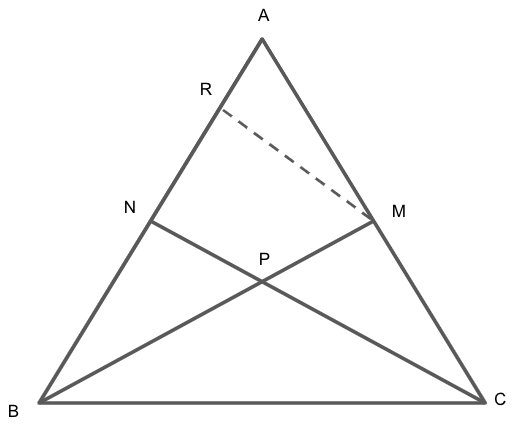
In triangle \[\Delta BMR\], we have
We know that the basic proportionality theorem, which states that if a line is drawn parallel to one side of a triangle intersecting the other two sides in distinct points, then the other two sides are divided in the same ratio.\[ \Rightarrow \dfrac{{12}}{{NR}} = \dfrac{3}{2}\]
Using the above basic proportionality theorem in \[\Delta BMR\], we get
\[\dfrac{{BN}}{{NR}} = \dfrac{{BP}}{{PM}}\]
Substituting the value of \[BN\] and \[\dfrac{{BP}}{{PM}}\] in the above equation, we get
Cross-multiplying the above equation, we get
\[ \Rightarrow 24 = 3NR\]
Dividing the above equation by 3 on both sides, we get
\[
\Rightarrow \dfrac{{24}}{3} = \dfrac{{3NR}}{3} \\
\Rightarrow NR = 8{\text{ cm}} \\
\]
In triangle \[\Delta ANC\], we have
Using the above basic proportionality theorem in \[\Delta ANC\], we get
\[\dfrac{{AR}}{{RN}} = \dfrac{{AM}}{{MC}}\]
Substituting the value of \[RN\] and \[\dfrac{{AM}}{{MC}}\] in the above equation, we get
\[ \Rightarrow \dfrac{{AR}}{8} = \dfrac{3}{4}\]
Cross-multiplying the above equation, we get
\[ \Rightarrow 4AR = 24\]
Dividing the above equation by 4 on both sides, we get
\[
\Rightarrow \dfrac{{3NR}}{3} = \dfrac{{24}}{3} \\
\Rightarrow AR = 6{\text{ cm}} \\
\]
Adding the value of AR and RN to find the value of AN, we get
\[
\Rightarrow AN = 6 + 8 \\
\Rightarrow AN = 14{\text{ cm}} \\
\]
Thus, the value of AN is 14 cm.
Note: In solving these types of questions, first draw the pictorial representation of the given problem for better understanding. You need to know the properties of triangles and their midpoint. Then we will use the properties accordingly. The basic proportionality theorem, which states that if a line is drawn parallel to one side of a triangle intersecting the other two sides in distinct points, then the other two sides are divided in the same ratio.
Complete step by step answer:
We are given that \[AM:MC = 3:4\], \[BP:PM = 3:2\] and \[BN = 12{\text{ cm}}\].
Now, we will construct \[MR||CN\] and \[MR||PN\].
In triangle \[\Delta BMR\], we have
We know that the basic proportionality theorem, which states that if a line is drawn parallel to one side of a triangle intersecting the other two sides in distinct points, then the other two sides are divided in the same ratio.\[ \Rightarrow \dfrac{{12}}{{NR}} = \dfrac{3}{2}\]
Using the above basic proportionality theorem in \[\Delta BMR\], we get
\[\dfrac{{BN}}{{NR}} = \dfrac{{BP}}{{PM}}\]
Substituting the value of \[BN\] and \[\dfrac{{BP}}{{PM}}\] in the above equation, we get
Cross-multiplying the above equation, we get
\[ \Rightarrow 24 = 3NR\]
Dividing the above equation by 3 on both sides, we get
\[
\Rightarrow \dfrac{{24}}{3} = \dfrac{{3NR}}{3} \\
\Rightarrow NR = 8{\text{ cm}} \\
\]
In triangle \[\Delta ANC\], we have
Using the above basic proportionality theorem in \[\Delta ANC\], we get
\[\dfrac{{AR}}{{RN}} = \dfrac{{AM}}{{MC}}\]
Substituting the value of \[RN\] and \[\dfrac{{AM}}{{MC}}\] in the above equation, we get
\[ \Rightarrow \dfrac{{AR}}{8} = \dfrac{3}{4}\]
Cross-multiplying the above equation, we get
\[ \Rightarrow 4AR = 24\]
Dividing the above equation by 4 on both sides, we get
\[
\Rightarrow \dfrac{{3NR}}{3} = \dfrac{{24}}{3} \\
\Rightarrow AR = 6{\text{ cm}} \\
\]
Adding the value of AR and RN to find the value of AN, we get
\[
\Rightarrow AN = 6 + 8 \\
\Rightarrow AN = 14{\text{ cm}} \\
\]
Thus, the value of AN is 14 cm.
Note: In solving these types of questions, first draw the pictorial representation of the given problem for better understanding. You need to know the properties of triangles and their midpoint. Then we will use the properties accordingly. The basic proportionality theorem, which states that if a line is drawn parallel to one side of a triangle intersecting the other two sides in distinct points, then the other two sides are divided in the same ratio.
Recently Updated Pages
Master Class 11 English: Engaging Questions & Answers for Success

Master Class 11 Social Science: Engaging Questions & Answers for Success
Master Class 11 Maths: Engaging Questions & Answers for Success
Master Class 11 Biology: Engaging Questions & Answers for Success
Master Class 11 Physics: Engaging Questions & Answers for Success
Master Class 11 Chemistry: Engaging Questions & Answers for Success
Trending doubts
One Metric ton is equal to kg A 10000 B 1000 C 100 class 11 physics CBSE
Difference Between Prokaryotic Cells and Eukaryotic Cells
Find the value of the expression given below sin 30circ class 11 maths CBSE
Difference between physical and chemical change class 11 chemistry CBSE
Two of the body parts which do not appear in MRI are class 11 biology CBSE
Draw a diagram of a plant cell and label at least eight class 11 biology CBSE