




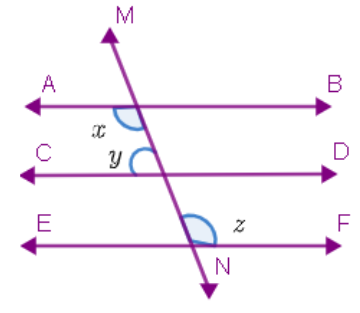
In the figure given below, if \[AB\parallel CD,CD\parallel EF\text{ AND y}:z=3:7,\] find the value of $x$
Answer
 Verified
576.9k+ views
Hint: To find the value of $x$ , we will first consider an angle $\angle CON=m$ . From the given ratio, we will get $y=\dfrac{3}{7}z.$ . Now, let us consider the parallel lines $CD\text{ and }EF$ where $m=z$ using alternate interior angles rule. Also along the line MN, we can see the linear pairs $y+m={{180}^{\circ }}$ .
Hence, substituting the previous equations in this equation, we will get the value of z and hence y. Let us consider the parallel line AB and CD on which MN is transversal which leads to the equation $x+y={{180}^{\circ }}$ due to supplementary rule. By solving this, we will get the value of x.
Complete step-by-step solution
We have to find the value of $x$ . let us first consider the ratio $y:z=3:7$ . That is
$\dfrac{y}{z}=\dfrac{3}{7}$
This can be written as
$y=\dfrac{3}{7}z...(i)$
Let us consider $\angle CON=m$
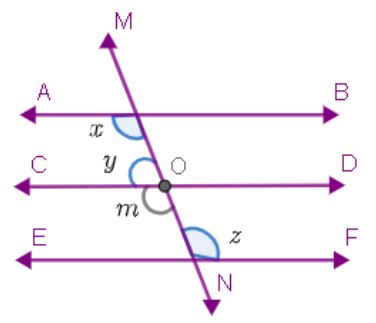
Let us consider the parallel lines $CD\text{ and }EF$ .
$m=z...(ii)$ due to alternate interior angles rule of two parallel lines.
Also along the line MN, we can see the linear pairs. That is
$y+m={{180}^{\circ }}$
From (ii), we can write the above equation as
$y+z={{180}^{\circ }}$
Using equation (i), we will get
$\dfrac{3}{7}z+z={{180}^{\circ }}$
Solving this, we will get
$\dfrac{10}{7}z={{180}^{\circ }}$
From this, we can find z. This is shown below.
\[\begin{align}
& z={{180}^{\circ }}\times \dfrac{7}{10} \\
& \Rightarrow z=18\times 7={{126}^{\circ }} \\
\end{align}\]
Now, we can find the value of y using (i).
$\begin{align}
& y=\dfrac{3}{7}\times {{126}^{\circ }} \\
& \Rightarrow y={{54}^{\circ }}...(iii) \\
\end{align}$
Now, let us consider the parallel line AB and CD on which MN is transversal.
Hence, using the theorem, sum of interior angles on the same side of the transversal are supplementary, we will get
$x+y={{180}^{\circ }}$
Using (iii) we will get
$x+{{54}^{\circ }}={{180}^{\circ }}$
Let us solve this. We will get
$\begin{align}
& x={{180}^{\circ }}-{{54}^{\circ }} \\
&\Rightarrow x={{126}^{\circ }} \\
\end{align}$
Hence, the value of $x={{126}^{\circ }}$ .
Note: The rules and theorems of straight lines should be thorough. We can also find the value of x using the parallel lines AB and EF and the transversal MN. Hence, using the theorem that alternate interior angles are equal, we will get
$\begin{align}
& x=z \\
& \Rightarrow x={{126}^{\circ }} \\
\end{align}$
Hence, substituting the previous equations in this equation, we will get the value of z and hence y. Let us consider the parallel line AB and CD on which MN is transversal which leads to the equation $x+y={{180}^{\circ }}$ due to supplementary rule. By solving this, we will get the value of x.
Complete step-by-step solution
We have to find the value of $x$ . let us first consider the ratio $y:z=3:7$ . That is
$\dfrac{y}{z}=\dfrac{3}{7}$
This can be written as
$y=\dfrac{3}{7}z...(i)$
Let us consider $\angle CON=m$
Let us consider the parallel lines $CD\text{ and }EF$ .
$m=z...(ii)$ due to alternate interior angles rule of two parallel lines.
Also along the line MN, we can see the linear pairs. That is
$y+m={{180}^{\circ }}$
From (ii), we can write the above equation as
$y+z={{180}^{\circ }}$
Using equation (i), we will get
$\dfrac{3}{7}z+z={{180}^{\circ }}$
Solving this, we will get
$\dfrac{10}{7}z={{180}^{\circ }}$
From this, we can find z. This is shown below.
\[\begin{align}
& z={{180}^{\circ }}\times \dfrac{7}{10} \\
& \Rightarrow z=18\times 7={{126}^{\circ }} \\
\end{align}\]
Now, we can find the value of y using (i).
$\begin{align}
& y=\dfrac{3}{7}\times {{126}^{\circ }} \\
& \Rightarrow y={{54}^{\circ }}...(iii) \\
\end{align}$
Now, let us consider the parallel line AB and CD on which MN is transversal.
Hence, using the theorem, sum of interior angles on the same side of the transversal are supplementary, we will get
$x+y={{180}^{\circ }}$
Using (iii) we will get
$x+{{54}^{\circ }}={{180}^{\circ }}$
Let us solve this. We will get
$\begin{align}
& x={{180}^{\circ }}-{{54}^{\circ }} \\
&\Rightarrow x={{126}^{\circ }} \\
\end{align}$
Hence, the value of $x={{126}^{\circ }}$ .
Note: The rules and theorems of straight lines should be thorough. We can also find the value of x using the parallel lines AB and EF and the transversal MN. Hence, using the theorem that alternate interior angles are equal, we will get
$\begin{align}
& x=z \\
& \Rightarrow x={{126}^{\circ }} \\
\end{align}$

Recently Updated Pages
Master Class 8 Social Science: Engaging Questions & Answers for Success

Master Class 8 English: Engaging Questions & Answers for Success
Class 8 Question and Answer - Your Ultimate Solutions Guide
Master Class 8 Maths: Engaging Questions & Answers for Success
Master Class 8 Science: Engaging Questions & Answers for Success
Master Class 7 English: Engaging Questions & Answers for Success
Trending doubts
What is BLO What is the full form of BLO class 8 social science CBSE
Citizens of India can vote at the age of A 18 years class 8 social science CBSE
Full form of STD, ISD and PCO
Advantages and disadvantages of science
Right to vote is a AFundamental Right BFundamental class 8 social science CBSE
What are the 12 elements of nature class 8 chemistry CBSE