



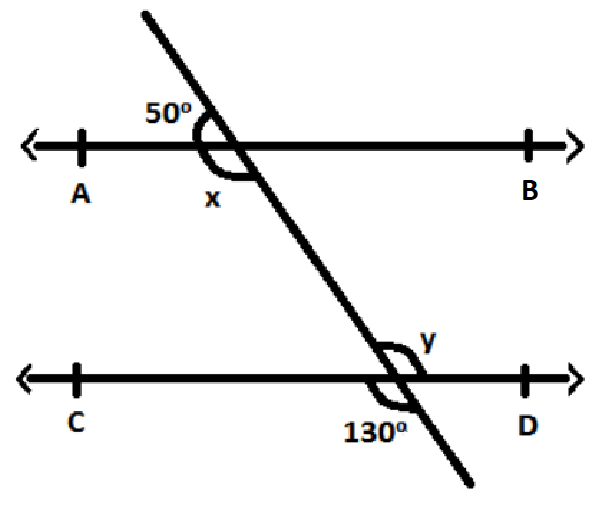
In the figure, find the values of $x$ and $y$ and then show that $AB\parallel CD$.
Answer
 Verified
597.6k+ views
Hint: In this question, we need to determine the values of $x$ and $y$ and then show that $AB\parallel CD$. Here, we will find the values of $x$ and $y$ using the concept that the sum of linear pairs of angles are equal to $180^\circ $ and vertically opposite angles are equal. Then, by using the theorem if a transversal intersects two lines such that pairs of alternate interior angles are equal, then lines are parallel we will show $AB\parallel CD$.
Complete step by step answer:
In the given figure, a transversal intersects two lines $AB$ and $CD$.
We know that the sum of linear pairs of angles is equal to $180^\circ $. Here, the angle $50^\circ $ and $\angle X$ are in the linear pair.
Therefore, we have,
$50^\circ + x = 180^\circ $
$x = 180^\circ - 50^\circ $
$x = 130^\circ $
We know that vertically opposite angles are equal. Here, $130^\circ $ and $\angle Y$ are vertically opposite angles.
Therefore, we have,
$y = 130^\circ $
Hence, $\angle x = \angle y$
Therefore, alternate interior angles are equal.
From the theorem we know that if a transversal intersects two lines such that the pair of alternate interior angles are equal, then the lines are parallel.
$\therefore AB\parallel CD$
Hence, $\angle x = \angle y = 130^\circ $ and $AB\parallel CD$.
Note: In the question it is important to note that, the linear pair is a pair of angles that share a side and a base. Alternately, they are the two angles created along the line when two lines intersect. Here, the angle $50^\circ $ and $\angle X$ are in the linear pair. And the sum of linear pairs of angles is equal to $180^\circ $. Then, vertically opposite angles are the angles opposite to each other when the two lines cross. Here, $130^\circ $ and $\angle Y$ are vertically opposite angles.
Complete step by step answer:
In the given figure, a transversal intersects two lines $AB$ and $CD$.
We know that the sum of linear pairs of angles is equal to $180^\circ $. Here, the angle $50^\circ $ and $\angle X$ are in the linear pair.
Therefore, we have,
$50^\circ + x = 180^\circ $
$x = 180^\circ - 50^\circ $
$x = 130^\circ $
We know that vertically opposite angles are equal. Here, $130^\circ $ and $\angle Y$ are vertically opposite angles.
Therefore, we have,
$y = 130^\circ $
Hence, $\angle x = \angle y$
Therefore, alternate interior angles are equal.
From the theorem we know that if a transversal intersects two lines such that the pair of alternate interior angles are equal, then the lines are parallel.
$\therefore AB\parallel CD$
Hence, $\angle x = \angle y = 130^\circ $ and $AB\parallel CD$.
Note: In the question it is important to note that, the linear pair is a pair of angles that share a side and a base. Alternately, they are the two angles created along the line when two lines intersect. Here, the angle $50^\circ $ and $\angle X$ are in the linear pair. And the sum of linear pairs of angles is equal to $180^\circ $. Then, vertically opposite angles are the angles opposite to each other when the two lines cross. Here, $130^\circ $ and $\angle Y$ are vertically opposite angles.
Recently Updated Pages
Master Class 8 English: Engaging Questions & Answers for Success

Master Class 8 Science: Engaging Questions & Answers for Success
Master Class 8 Maths: Engaging Questions & Answers for Success
Class 8 Question and Answer - Your Ultimate Solutions Guide
Master Class 8 Social Science: Engaging Questions & Answers for Success
Master Class 12 Economics: Engaging Questions & Answers for Success
Trending doubts
What is BLO What is the full form of BLO class 8 social science CBSE
Which Indian state shares the longest international class 8 social science CBSE
Citizens of India can vote at the age of A 18 years class 8 social science CBSE
Right to vote is a AFundamental Right BFundamental class 8 social science CBSE
Full form of STD, ISD and PCO
What is the area formula of an obtuse triangle class 8 maths CBSE