




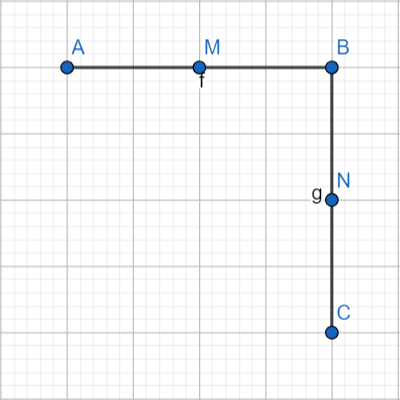
In the figure, BM = BN, M is the midpoint of AB and N is the midpoint of BC. Then the statement AB = BC is
A. True
B. False
Answer
 Verified
649.8k+ views
Hint: Identify the relation between AB and BM, and also BC and BN. Then accordingly adjust the given condition in the question to find the relation between AB and BC. Thus, comment whether the statement AB = BC is true or false.
Complete step-by-step answer:
It is given that M is the midpoint of AB. Thus, it can be said that the length of BM is half of that of AB.
$\begin{align}
& \therefore \text{ BM = }\dfrac{\text{AB}}{2}\text{ } \\
& \Rightarrow \text{ AB = 2BM }....\left( \text{i} \right) \\
\end{align}$
Similarly, N is the midpoint of BC. Thus, the length of BN is half of that of BC.
$\begin{align}
& \therefore \text{ BN = }\dfrac{\text{BC}}{2}\text{ } \\
& \Rightarrow \text{BC = 2BN }.....\text{(ii)} \\
\end{align}$
The condition given in the question is BM = BN.
Multiplying both sides of the above equation by 2, we get,
$\begin{align}
& 2\text{BM = 2BN} \\
& \therefore \text{ AB }\text{= BC }\left[ \text{from the eqns}\text{. }\left( \text{i} \right)\text{ and }\left( \text{ii} \right) \right] \\
\end{align}$
Thus, it is proved that the statement AB = BC is true.
Hence, the correct answer is option A.
Note: The statement AB = BC would not have been true, if M and N were random points on AB and BC respectively. The two line segments will be equal if and only if the points’ distances from the point B are proportionate to the lengths of AB and BC respectively.
Complete step-by-step answer:
It is given that M is the midpoint of AB. Thus, it can be said that the length of BM is half of that of AB.
$\begin{align}
& \therefore \text{ BM = }\dfrac{\text{AB}}{2}\text{ } \\
& \Rightarrow \text{ AB = 2BM }....\left( \text{i} \right) \\
\end{align}$
Similarly, N is the midpoint of BC. Thus, the length of BN is half of that of BC.
$\begin{align}
& \therefore \text{ BN = }\dfrac{\text{BC}}{2}\text{ } \\
& \Rightarrow \text{BC = 2BN }.....\text{(ii)} \\
\end{align}$
The condition given in the question is BM = BN.
Multiplying both sides of the above equation by 2, we get,
$\begin{align}
& 2\text{BM = 2BN} \\
& \therefore \text{ AB }\text{= BC }\left[ \text{from the eqns}\text{. }\left( \text{i} \right)\text{ and }\left( \text{ii} \right) \right] \\
\end{align}$
Thus, it is proved that the statement AB = BC is true.
Hence, the correct answer is option A.
Note: The statement AB = BC would not have been true, if M and N were random points on AB and BC respectively. The two line segments will be equal if and only if the points’ distances from the point B are proportionate to the lengths of AB and BC respectively.
Recently Updated Pages
Master Class 11 English: Engaging Questions & Answers for Success

Master Class 11 Social Science: Engaging Questions & Answers for Success
Master Class 11 Maths: Engaging Questions & Answers for Success
Master Class 11 Biology: Engaging Questions & Answers for Success
Master Class 11 Physics: Engaging Questions & Answers for Success
Master Class 11 Chemistry: Engaging Questions & Answers for Success
Trending doubts
One Metric ton is equal to kg A 10000 B 1000 C 100 class 11 physics CBSE
Difference Between Prokaryotic Cells and Eukaryotic Cells
Find the value of the expression given below sin 30circ class 11 maths CBSE
Two of the body parts which do not appear in MRI are class 11 biology CBSE
Draw a diagram of a plant cell and label at least eight class 11 biology CBSE
10 examples of friction in our daily life