




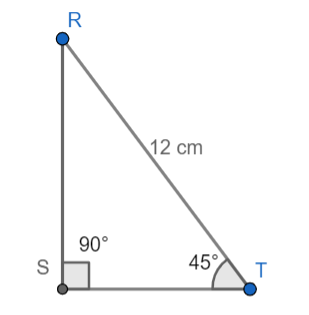
In the figure below, a triangle RST with $\angle S=90{}^\circ ,\angle T=45{}^\circ $, RT = 12 cm is given. Find RS and ST.
Answer
 Verified
644.1k+ views
Hint: We will use that the sum of all three angles in a triangle is $180{}^\circ $ and we use Pythagoras theorem to find the length of sides as the above triangle is a right-angled triangle.
Complete step-by-step solution -
The sum of three angles in a triangle is $180{}^\circ $. So, we will use this condition to find the $\angle R$ in this triangle.
The above triangle is a right-angled triangle and right-angled at S.
So, $\angle S=90{}^\circ $ and $\angle T=45{}^\circ $. We will find $\angle R$ by subtracting $\angle S$ and $\angle T$ from $180{}^\circ $.
So, $\angle R=180{}^\circ -(\angle S+\angle T)$
$\begin{align}
& \Rightarrow 180{}^\circ -(90{}^\circ +45{}^\circ ) \\
& \Rightarrow 180{}^\circ -(135{}^\circ ) \\
& \Rightarrow 45{}^\circ \\
\end{align}$
Both $\angle R$ and $\angle S$ are equal. So, the above triangle is a right-angled isosceles triangle.
In the above right-angled isosceles triangle, the hypotenuse is the side opposite to the right-angled triangle. So, the length of hypotenuse ST is 12 cm and let the length of side ST be x and length of the side RS also becomes x, as the triangle is an isosceles triangle.
We use Pythagoras theorem as the above triangle is a right-angled triangle, Pythagoras theorem states that in a right angle triangle square of the hypotenuse is equal to the sum of squares of other two sides in it.
So, by Pythagoras theorem $R{{S}^{2}}+S{{T}^{2}}=R{{T}^{2}}\cdot \cdot \cdot \cdot \left( 1 \right)$
Now we will substitute RT = 12 cm, RS = x cm, ST = x cm in equation (1).
Equation (1) becomes, $\Rightarrow {{x}^{2}}+{{x}^{2}}={{12}^{2}}$
Now we will solve for x, $\Rightarrow 2{{x}^{2}}=144$
$\begin{align}
& \Rightarrow {{x}^{2}}=72 \\
& \Rightarrow x=\sqrt{72} \\
\end{align}$
$\sqrt{72}$ can be expressed as $\sqrt{36\times 2}$ then further simplifying it, we obtain $\pm 6\sqrt{2}$.
Therefore, $x=\pm 6\sqrt{2}$.
We do not consider $x=-6\sqrt{2}$ because the length of the side of a triangle cannot be negative.
Hence, $x=6\sqrt{2}$.
So, RS = ST = $6\sqrt{2}$.
Note: The length of the side of a triangle cannot be negative and in an isosceles triangle two sides will be equal. The Pythagora's theorem is only applicable to right-angled triangles. We can also solve this question using the relation between angles and sides of a right-angles triangle. We can compute side RS by using sine of angle $45{}^\circ $, as RS $=12\sin 45{}^\circ =6\sqrt{2}$ and ST using the cosine of angle $45{}^\circ $, as ST $=12\cos 45{}^\circ =6\sqrt{2}$.
Complete step-by-step solution -
The sum of three angles in a triangle is $180{}^\circ $. So, we will use this condition to find the $\angle R$ in this triangle.
The above triangle is a right-angled triangle and right-angled at S.
So, $\angle S=90{}^\circ $ and $\angle T=45{}^\circ $. We will find $\angle R$ by subtracting $\angle S$ and $\angle T$ from $180{}^\circ $.
So, $\angle R=180{}^\circ -(\angle S+\angle T)$
$\begin{align}
& \Rightarrow 180{}^\circ -(90{}^\circ +45{}^\circ ) \\
& \Rightarrow 180{}^\circ -(135{}^\circ ) \\
& \Rightarrow 45{}^\circ \\
\end{align}$
Both $\angle R$ and $\angle S$ are equal. So, the above triangle is a right-angled isosceles triangle.
In the above right-angled isosceles triangle, the hypotenuse is the side opposite to the right-angled triangle. So, the length of hypotenuse ST is 12 cm and let the length of side ST be x and length of the side RS also becomes x, as the triangle is an isosceles triangle.
We use Pythagoras theorem as the above triangle is a right-angled triangle, Pythagoras theorem states that in a right angle triangle square of the hypotenuse is equal to the sum of squares of other two sides in it.
So, by Pythagoras theorem $R{{S}^{2}}+S{{T}^{2}}=R{{T}^{2}}\cdot \cdot \cdot \cdot \left( 1 \right)$
Now we will substitute RT = 12 cm, RS = x cm, ST = x cm in equation (1).
Equation (1) becomes, $\Rightarrow {{x}^{2}}+{{x}^{2}}={{12}^{2}}$
Now we will solve for x, $\Rightarrow 2{{x}^{2}}=144$
$\begin{align}
& \Rightarrow {{x}^{2}}=72 \\
& \Rightarrow x=\sqrt{72} \\
\end{align}$
$\sqrt{72}$ can be expressed as $\sqrt{36\times 2}$ then further simplifying it, we obtain $\pm 6\sqrt{2}$.
Therefore, $x=\pm 6\sqrt{2}$.
We do not consider $x=-6\sqrt{2}$ because the length of the side of a triangle cannot be negative.
Hence, $x=6\sqrt{2}$.
So, RS = ST = $6\sqrt{2}$.
Note: The length of the side of a triangle cannot be negative and in an isosceles triangle two sides will be equal. The Pythagora's theorem is only applicable to right-angled triangles. We can also solve this question using the relation between angles and sides of a right-angles triangle. We can compute side RS by using sine of angle $45{}^\circ $, as RS $=12\sin 45{}^\circ =6\sqrt{2}$ and ST using the cosine of angle $45{}^\circ $, as ST $=12\cos 45{}^\circ =6\sqrt{2}$.
Recently Updated Pages
Master Class 12 Economics: Engaging Questions & Answers for Success

Master Class 12 English: Engaging Questions & Answers for Success
Master Class 12 Social Science: Engaging Questions & Answers for Success
Master Class 12 Maths: Engaging Questions & Answers for Success
Master Class 12 Physics: Engaging Questions & Answers for Success
Master Class 9 General Knowledge: Engaging Questions & Answers for Success
Trending doubts
Explain the Treaty of Vienna of 1815 class 10 social science CBSE
Why is it 530 pm in india when it is 1200 afternoon class 10 social science CBSE
What is the full form of POSCO class 10 social science CBSE
Define Potential, Developed, Stock and Reserved resources
The speaker of the Lok Sabha is elected by the APresident class 10 social science CBSE
Complete the sentence with the most appropriate word class 10 english CBSE