




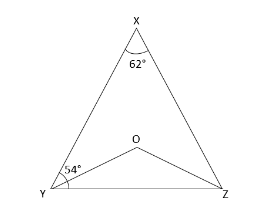
In the figure, $ \angle X = 62^\circ $ , $ \angle XYZ = 54^\circ $ . If $ YO $ and $ ZO $ are the bisectors of $ \angle XYZ $ and $ \angle XZY $ respectively of $ \Delta XZY $ , find $ \angle OZY $ and $ \angle YOZ. $

Answer
 Verified
576.9k+ views
Hint: Use the property that the sum of angles of a triangle is equal to $ {180^0} $ to first find $ \angle XZY $ . Then use the property of angle bisectors to find $ \angle OZY $ . Then use this angle and the angle sum property of a triangle to find $ \angle YOZ $
Complete step-by-step answer:
It is given in the question that,
$ \angle X = 62^\circ $ , $ \angle XYZ = 54^\circ $
And YO and ZO are angle bisectors of $ \angle XYZ $ and $ \angle XZY $
We know that the addition of all three angles of a triangle is equal to $ 180^\circ $
i.e. $ \angle XYZ + \angle YXZ + \angle XZY = 180^\circ $
by substituting the given values in the above equation, we can write.
$ {54^0} + {62^0} + \angle XZY = 180^\circ $
By simplifying it, we get
$ \therefore \angle XZY = 180^\circ - 116^\circ $
$ \Rightarrow \angle XZY = 64^\circ $
Now, since, OY is an angle bisector. We can write,
$ \angle OYZ = \dfrac{1}{2} \times 54 $
$ \Rightarrow \angle OYZ = 27^\circ $
Similarly, since, OZ is angle bisector, we can write,
$ \angle OZY = \dfrac{1}{2} \times 64 $
$ \Rightarrow \angle OZY = 32^\circ $
So, now, in $ \Delta OYZ $
We know that the sum of the angles of a triangle is equal to \[{180^0}\]. Therefore, we can write,
$ \angle YOZ + \angle OYZ + \angle OZY = 180^\circ $
By substituting the values of $ \angle OYZ $ and $ \angle OZY $ , we get
$ \angle YOZ + 27^\circ + 32^\circ = 180^\circ $
By simplifying it, we get
$ \angle YOZ = 121^\circ $
Therefore, form the above explanation, we can conclude that, $ \angle OZY = 32^\circ $ and $ \angle YOZ = 121^\circ $
Note: You might be tempted to think that OY and OZ are equal. And hence, you might use the property of isosceles triangles. But that would be incorrect. OY and OZ can only be equal if the $ \Delta XYZ $ is either isosceles or equilateral triangle. Which is not given in the question. So you cannot assume that.
Complete step-by-step answer:
It is given in the question that,
$ \angle X = 62^\circ $ , $ \angle XYZ = 54^\circ $
And YO and ZO are angle bisectors of $ \angle XYZ $ and $ \angle XZY $
We know that the addition of all three angles of a triangle is equal to $ 180^\circ $
i.e. $ \angle XYZ + \angle YXZ + \angle XZY = 180^\circ $
by substituting the given values in the above equation, we can write.
$ {54^0} + {62^0} + \angle XZY = 180^\circ $
By simplifying it, we get
$ \therefore \angle XZY = 180^\circ - 116^\circ $
$ \Rightarrow \angle XZY = 64^\circ $
Now, since, OY is an angle bisector. We can write,
$ \angle OYZ = \dfrac{1}{2} \times 54 $
$ \Rightarrow \angle OYZ = 27^\circ $
Similarly, since, OZ is angle bisector, we can write,
$ \angle OZY = \dfrac{1}{2} \times 64 $
$ \Rightarrow \angle OZY = 32^\circ $
So, now, in $ \Delta OYZ $
We know that the sum of the angles of a triangle is equal to \[{180^0}\]. Therefore, we can write,
$ \angle YOZ + \angle OYZ + \angle OZY = 180^\circ $
By substituting the values of $ \angle OYZ $ and $ \angle OZY $ , we get
$ \angle YOZ + 27^\circ + 32^\circ = 180^\circ $
By simplifying it, we get
$ \angle YOZ = 121^\circ $
Therefore, form the above explanation, we can conclude that, $ \angle OZY = 32^\circ $ and $ \angle YOZ = 121^\circ $
Note: You might be tempted to think that OY and OZ are equal. And hence, you might use the property of isosceles triangles. But that would be incorrect. OY and OZ can only be equal if the $ \Delta XYZ $ is either isosceles or equilateral triangle. Which is not given in the question. So you cannot assume that.

Recently Updated Pages
Master Class 8 Social Science: Engaging Questions & Answers for Success

Master Class 8 English: Engaging Questions & Answers for Success
Class 8 Question and Answer - Your Ultimate Solutions Guide
Master Class 8 Maths: Engaging Questions & Answers for Success
Master Class 8 Science: Engaging Questions & Answers for Success
Master Class 7 English: Engaging Questions & Answers for Success
Trending doubts
What is BLO What is the full form of BLO class 8 social science CBSE
Citizens of India can vote at the age of A 18 years class 8 social science CBSE
Full form of STD, ISD and PCO
Advantages and disadvantages of science
Right to vote is a AFundamental Right BFundamental class 8 social science CBSE
What are the 12 elements of nature class 8 chemistry CBSE