




In the figure an object is kept on the principal axis of a concave mirror in front of it. Magnification of image is found $ - \dfrac{2}{3}$ at this position. Now the mirror is shifted towards the object keeping the object fixed by an amount of $10cm$. At this new position, the distance of the object from the mirror becomes the same as the distance of the image from the mirror before displacing the mirror. Answer the following questions.
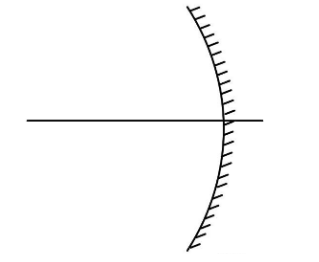
(a) Distance of object from mirror before displacing the mirror is:
(A) $10cm$
(B) $20cm$
(C) $30cm$
(D) $40cm$
(b) Focal length of the mirror is:
(A) $6cm$
(B) $8cm$
(C) $10cm$
(D) $12cm$
(c) Magnification at the new position of mirror is:
(A) $ - \dfrac{3}{2}$
(B) $ - 3$
(C) $ - 2$
(D) $ - \dfrac{1}{3}$
Answer
 Verified
608.1k+ views
Hint:Here, you are given two situations, first is in which the mirror is placed at a position shown in figure and the second is in which the mirror is placed at a position which is $10cm$ towards left from the previous position. What you do is assume unknowns to be some variables and then solve for the unknowns using the mirror formula and magnification formula.
Complete step by step answer:
Let us first consider the first situation. Let the distance of the object initially from the mirror be $u$ and the image formed from the mirror be at a distance $v$. The magnification in case of mirrors is given by $m = - \dfrac{v}{u}$ and the magnification is given to be $ - \dfrac{2}{3}$, so we have $ - \dfrac{v}{u} = - \dfrac{2}{3} \to v = \dfrac{{2u}}{3}$.
(a) Now, let us go for the second situation. The mirror is shifted towards left (towards the object) by a distance of $10cm$, so now the distance from the mirror will be $\left( {u - 10} \right)$. It is given that the distance of the object in the second situation is equal to the distance of the image from the mirror in the first situation, mathematically we can write $u - 10 = v$. So, we have two equations and two unknowns, let us find them by solving the equations.
$u - 10 = v \\
\Rightarrow u - 10 = \dfrac{{2u}}{3} \\
\therefore u = 30cm \\ $
Therefore, the distance of object from mirror before displacing the mirror is $30cm$.Hence,option C is correct.
(b) The focal length is obtained from the formula $\dfrac{1}{v} - \dfrac{1}{u} = \dfrac{1}{f}$.
As $u = 30cm$, we get $v = \dfrac{{2 \times 30}}{3} = 20cm$.
Therefore,
$\dfrac{1}{{{v_1}}} - \dfrac{1}{{{u_1}}} = \dfrac{1}{f} \\
\Rightarrow\dfrac{1}{{20}} - \dfrac{1}{{ - 30}} = \dfrac{1}{f} \\
\therefore f = 12cm \\ $
Therefore, the focal length of the mirror is $12cm$.Hence,option D is correct.
(c) The image formed in the second situation will be given by the formula $\dfrac{1}{v} - \dfrac{1}{u} = \dfrac{1}{f}$.
$\dfrac{1}{{{v_2}}} - \dfrac{1}{{{u_2}}} = \dfrac{1}{f} \\
\Rightarrow\dfrac{1}{{{v_2}}} - \dfrac{1}{{ - \left( {u - 10} \right)}} = \dfrac{1}{f} \\
\Rightarrow\dfrac{1}{{{v_2}}} - \dfrac{1}{{ - \left( {30 - 10} \right)}} = \dfrac{1}{{60}} \\
\Rightarrow{v_2} = - 30cm \\ $
The magnification when the mirror is moved will be given by ${m_1} = - \dfrac{{{v_1}}}{{{u_1}}}$.
Therefore,
${m_1} = - \dfrac{{ - 30}}{{ - 20}} \\
\therefore{m_1} = - \dfrac{3}{2} \\ $
Hence, magnification at the new position of mirror is $ - \dfrac{3}{2}$.Thus,option A is correct.
Note:We have used the mirror formula which gives you the relation between the object distance from the mirror, image distance from the mirror and the focal length of the mirror, so you should keep this in mind. Also, we used one more formula, that was for magnification, that is also to be kept in mind. While applying formulas in optics, you need to follow the sign convention properly, else you will land on the wrong answer, so be careful with signs while putting the distances in the formula.
Complete step by step answer:
Let us first consider the first situation. Let the distance of the object initially from the mirror be $u$ and the image formed from the mirror be at a distance $v$. The magnification in case of mirrors is given by $m = - \dfrac{v}{u}$ and the magnification is given to be $ - \dfrac{2}{3}$, so we have $ - \dfrac{v}{u} = - \dfrac{2}{3} \to v = \dfrac{{2u}}{3}$.
(a) Now, let us go for the second situation. The mirror is shifted towards left (towards the object) by a distance of $10cm$, so now the distance from the mirror will be $\left( {u - 10} \right)$. It is given that the distance of the object in the second situation is equal to the distance of the image from the mirror in the first situation, mathematically we can write $u - 10 = v$. So, we have two equations and two unknowns, let us find them by solving the equations.
$u - 10 = v \\
\Rightarrow u - 10 = \dfrac{{2u}}{3} \\
\therefore u = 30cm \\ $
Therefore, the distance of object from mirror before displacing the mirror is $30cm$.Hence,option C is correct.
(b) The focal length is obtained from the formula $\dfrac{1}{v} - \dfrac{1}{u} = \dfrac{1}{f}$.
As $u = 30cm$, we get $v = \dfrac{{2 \times 30}}{3} = 20cm$.
Therefore,
$\dfrac{1}{{{v_1}}} - \dfrac{1}{{{u_1}}} = \dfrac{1}{f} \\
\Rightarrow\dfrac{1}{{20}} - \dfrac{1}{{ - 30}} = \dfrac{1}{f} \\
\therefore f = 12cm \\ $
Therefore, the focal length of the mirror is $12cm$.Hence,option D is correct.
(c) The image formed in the second situation will be given by the formula $\dfrac{1}{v} - \dfrac{1}{u} = \dfrac{1}{f}$.
$\dfrac{1}{{{v_2}}} - \dfrac{1}{{{u_2}}} = \dfrac{1}{f} \\
\Rightarrow\dfrac{1}{{{v_2}}} - \dfrac{1}{{ - \left( {u - 10} \right)}} = \dfrac{1}{f} \\
\Rightarrow\dfrac{1}{{{v_2}}} - \dfrac{1}{{ - \left( {30 - 10} \right)}} = \dfrac{1}{{60}} \\
\Rightarrow{v_2} = - 30cm \\ $
The magnification when the mirror is moved will be given by ${m_1} = - \dfrac{{{v_1}}}{{{u_1}}}$.
Therefore,
${m_1} = - \dfrac{{ - 30}}{{ - 20}} \\
\therefore{m_1} = - \dfrac{3}{2} \\ $
Hence, magnification at the new position of mirror is $ - \dfrac{3}{2}$.Thus,option A is correct.
Note:We have used the mirror formula which gives you the relation between the object distance from the mirror, image distance from the mirror and the focal length of the mirror, so you should keep this in mind. Also, we used one more formula, that was for magnification, that is also to be kept in mind. While applying formulas in optics, you need to follow the sign convention properly, else you will land on the wrong answer, so be careful with signs while putting the distances in the formula.
Recently Updated Pages
Class 10 Question and Answer - Your Ultimate Solutions Guide

Master Class 12 Economics: Engaging Questions & Answers for Success
Master Class 12 Social Science: Engaging Questions & Answers for Success
Master Class 12 English: Engaging Questions & Answers for Success
Master Class 12 Maths: Engaging Questions & Answers for Success
Master Class 12 Physics: Engaging Questions & Answers for Success
Trending doubts
Explain the Treaty of Vienna of 1815 class 10 social science CBSE
The slogan Jai Hind was given by A Lal Bahadur Shastri class 10 social science CBSE
10 examples of evaporation in daily life with explanations
What is the full form of POSCO class 10 social science CBSE
Identify the feminine form of noun nephew a shenephew class 10 english CBSE
CSIR full form?