



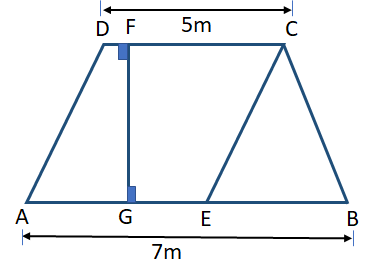
In the figure, ADCE is a parallelogram. Then the area of $\triangle ECB$ equals
A.$21{m^2}$
B.$15.5{m^2}$
C.$3.5{m^2}$
D.$6.5{m^2}$
Answer
 Verified
577.8k+ views
Hint: Draw a line perpendicular to AB from C. You can find EB by subtracting AE from AB. After this you have base and height of triangle so you can find the area of triangle by formula:
$ \Rightarrow A = \dfrac{1}{2} \times b \times h$
Where A is the area of the triangle, b is the base of the triangle and h is the height of the triangle.
Complete step-by-step answer:
In this question a figure is given in which ABCE is a parallelogram and we have to find the area of $\triangle ECB$. The figure is as shown below:
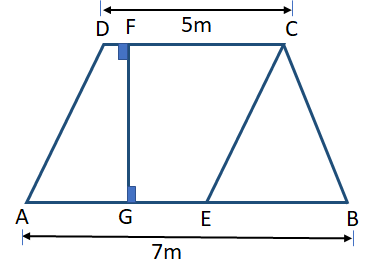
If ABCE is a parallelogram then by the property of parallelogram opposite sides are equal i.e.
$ \Rightarrow AE = DC$and
$ \Rightarrow AD = CE$
It is given that $AE = 7cm$ and $DC = 5cm$. Therefore,
$ \Rightarrow AE = 5cm$ ………..(1)
To find the area of $\triangle ECB$we will draw a line from C perpendicular to AB and meets AB at H as shown below:
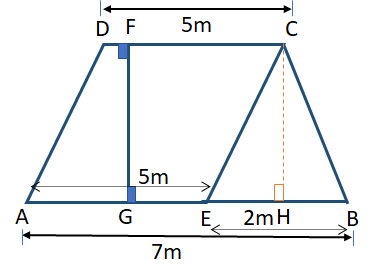
The length of all perpendiculars drawn between two parallel lines is equal. Here, FG and CH are the perpendiculars between two parallel lines DC and AE. Therefore,
$ \Rightarrow FG = CH$ ………..(2)
The measure of FG is given in figure i.e.
$ \Rightarrow FG = 3.5cm$ ………..(3)
From 2 and 3 we get,
$ \Rightarrow CH = 3.5cm$ ………….(4)
In $\triangle ECB$, CH is the height and EB is the base. The measure of EB can be obtained by subtracting AE from AB i.e.
$ \Rightarrow EB = AB - AE$
By putting the value of AB and AE in above equation we get,
$ \Rightarrow EB = 7 - 5 = 2cm$ …………..(5)
The formula for area of triangle is given below:
$ \Rightarrow A = \dfrac{1}{2} \times b \times h$
As, CH is the height and EB is the base of $\triangle ECB$. Therefore,
$ \Rightarrow A = \dfrac{1}{2} \times EB \times CH$
Now, by putting the values of EB and CH from equation 5 and 4 respectively we get,
$ \Rightarrow A = \dfrac{1}{2} \times 2 \times 3.5$
By cancelling of 2 from denominator with numerator we get,
$ \Rightarrow A = 3.5c{m^2}$
Therefore, the correct answer is option 3.
Note: Generally, students get confused to find the base of the triangle because they are unable to consider the property of parallelogram to find AE. If they know AE and AB is given to us then EB can be calculated.
Second mistake they do in formula i.e. they forget to take half in the formula. You can remember this by relating it with a parallelogram as area of parallelogram can be calculated by multiplying base and height. A triangle can be formed by dividing parallelogram into half so the area also gets half. Therefore, the area of the triangle is given by half of base multiplied with height.
$ \Rightarrow A = \dfrac{1}{2} \times b \times h$
Where A is the area of the triangle, b is the base of the triangle and h is the height of the triangle.
Complete step-by-step answer:
In this question a figure is given in which ABCE is a parallelogram and we have to find the area of $\triangle ECB$. The figure is as shown below:
If ABCE is a parallelogram then by the property of parallelogram opposite sides are equal i.e.
$ \Rightarrow AE = DC$and
$ \Rightarrow AD = CE$
It is given that $AE = 7cm$ and $DC = 5cm$. Therefore,
$ \Rightarrow AE = 5cm$ ………..(1)
To find the area of $\triangle ECB$we will draw a line from C perpendicular to AB and meets AB at H as shown below:
The length of all perpendiculars drawn between two parallel lines is equal. Here, FG and CH are the perpendiculars between two parallel lines DC and AE. Therefore,
$ \Rightarrow FG = CH$ ………..(2)
The measure of FG is given in figure i.e.
$ \Rightarrow FG = 3.5cm$ ………..(3)
From 2 and 3 we get,
$ \Rightarrow CH = 3.5cm$ ………….(4)
In $\triangle ECB$, CH is the height and EB is the base. The measure of EB can be obtained by subtracting AE from AB i.e.
$ \Rightarrow EB = AB - AE$
By putting the value of AB and AE in above equation we get,
$ \Rightarrow EB = 7 - 5 = 2cm$ …………..(5)
The formula for area of triangle is given below:
$ \Rightarrow A = \dfrac{1}{2} \times b \times h$
As, CH is the height and EB is the base of $\triangle ECB$. Therefore,
$ \Rightarrow A = \dfrac{1}{2} \times EB \times CH$
Now, by putting the values of EB and CH from equation 5 and 4 respectively we get,
$ \Rightarrow A = \dfrac{1}{2} \times 2 \times 3.5$
By cancelling of 2 from denominator with numerator we get,
$ \Rightarrow A = 3.5c{m^2}$
Therefore, the correct answer is option 3.
Note: Generally, students get confused to find the base of the triangle because they are unable to consider the property of parallelogram to find AE. If they know AE and AB is given to us then EB can be calculated.
Second mistake they do in formula i.e. they forget to take half in the formula. You can remember this by relating it with a parallelogram as area of parallelogram can be calculated by multiplying base and height. A triangle can be formed by dividing parallelogram into half so the area also gets half. Therefore, the area of the triangle is given by half of base multiplied with height.
Recently Updated Pages
Master Class 9 General Knowledge: Engaging Questions & Answers for Success

Master Class 9 Social Science: Engaging Questions & Answers for Success
Master Class 9 English: Engaging Questions & Answers for Success
Master Class 9 Maths: Engaging Questions & Answers for Success
Master Class 9 Science: Engaging Questions & Answers for Success
Class 9 Question and Answer - Your Ultimate Solutions Guide
Trending doubts
Difference Between Plant Cell and Animal Cell
Fill the blanks with the suitable prepositions 1 The class 9 english CBSE
Who is eligible for RTE class 9 social science CBSE
Which places in India experience sunrise first and class 9 social science CBSE
What is pollution? How many types of pollution? Define it
Name 10 Living and Non living things class 9 biology CBSE