




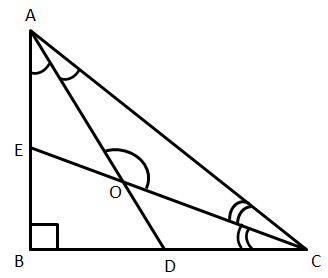
In the figure, $AD$ and $CE$ are the angle bisectors of $\angle A$ and $\angle C$ respectively. If $\angle ABC = 90^\circ $ then find $\angle AOC$.
Answer
 Verified
581.4k+ views
Hint:
Here, we will use the angle sum property of triangles to find different angles. Then using the values of obtained angles and the given information we will find the required angle. Angle sum property of triangles states that the sum of interior angles of a triangle is $180^\circ $.
Complete Step by Step Solution:
According to the question, it is given that, $AD$ and $CE$ are the angle bisectors of $\angle A$ and $\angle C$ respectively and $\angle ABC = 90^\circ $ .
Now In $\vartriangle ABC$, by angle sum property of triangles, we get
$\angle A + \angle B + \angle C = 180^\circ $
But it is given that $\angle ABC = 90^\circ $, hence,
$ \Rightarrow \angle A + 90^\circ + \angle C = 180^\circ $
$ \Rightarrow \angle A + \angle C = 90^\circ $……………………………..$\left( 1 \right)$
Now, in $\vartriangle AOC$,
Again by angle sum property of triangles,
$\angle OAC + \angle AOC + \angle OCA = 180^\circ $…………………………….$\left( 2 \right)$
But, it is given that $AD$ and $CE$ are the angle bisectors of $\angle A$ and $\angle C$ respectively.
This means that they divide the angles $\angle A$ and $\angle C$ in two equal angles.
$\therefore \angle OAC = \dfrac{1}{2}\angle A$
Also, $\angle OCA = \dfrac{1}{2}\angle C$
Hence, from equation $\left( 2 \right)$, we get
$\dfrac{1}{2}\angle A + \angle AOC + \dfrac{1}{2}\angle C = 180^\circ $
$ \Rightarrow \dfrac{1}{2}\left( {\angle A + \angle C} \right) + \angle AOC = 180^\circ $
Now, substituting $\angle A + \angle C = 90^\circ $ in the above equation, we get
$ \Rightarrow \dfrac{1}{2}\left( {90^\circ } \right) + \angle AOC = 180^\circ $
$ \Rightarrow 45^\circ + \angle AOC = 180^\circ $
Solving further,
$ \Rightarrow \angle AOC = 180^\circ - 45^\circ = 135^\circ $
Therefore, the required value of $\angle AOC = 135^\circ $
Note:
A triangle is a 3-sides polygon having 3 sides, 3 angles and 3 vertices. Also, the sum of any two sides of a triangle is always greater than the third side. Whenever a bisector bisects the angle of a triangle, the angle bisector divides the triangle into two parts such that they are congruent to each other. The bisector divides its opposite side into two segments which are proportional to each other, hence, helping to prove the congruence of these triangles.
Here, we will use the angle sum property of triangles to find different angles. Then using the values of obtained angles and the given information we will find the required angle. Angle sum property of triangles states that the sum of interior angles of a triangle is $180^\circ $.
Complete Step by Step Solution:
According to the question, it is given that, $AD$ and $CE$ are the angle bisectors of $\angle A$ and $\angle C$ respectively and $\angle ABC = 90^\circ $ .
Now In $\vartriangle ABC$, by angle sum property of triangles, we get
$\angle A + \angle B + \angle C = 180^\circ $
But it is given that $\angle ABC = 90^\circ $, hence,
$ \Rightarrow \angle A + 90^\circ + \angle C = 180^\circ $
$ \Rightarrow \angle A + \angle C = 90^\circ $……………………………..$\left( 1 \right)$
Now, in $\vartriangle AOC$,
Again by angle sum property of triangles,
$\angle OAC + \angle AOC + \angle OCA = 180^\circ $…………………………….$\left( 2 \right)$
But, it is given that $AD$ and $CE$ are the angle bisectors of $\angle A$ and $\angle C$ respectively.
This means that they divide the angles $\angle A$ and $\angle C$ in two equal angles.
$\therefore \angle OAC = \dfrac{1}{2}\angle A$
Also, $\angle OCA = \dfrac{1}{2}\angle C$
Hence, from equation $\left( 2 \right)$, we get
$\dfrac{1}{2}\angle A + \angle AOC + \dfrac{1}{2}\angle C = 180^\circ $
$ \Rightarrow \dfrac{1}{2}\left( {\angle A + \angle C} \right) + \angle AOC = 180^\circ $
Now, substituting $\angle A + \angle C = 90^\circ $ in the above equation, we get
$ \Rightarrow \dfrac{1}{2}\left( {90^\circ } \right) + \angle AOC = 180^\circ $
$ \Rightarrow 45^\circ + \angle AOC = 180^\circ $
Solving further,
$ \Rightarrow \angle AOC = 180^\circ - 45^\circ = 135^\circ $
Therefore, the required value of $\angle AOC = 135^\circ $
Note:
A triangle is a 3-sides polygon having 3 sides, 3 angles and 3 vertices. Also, the sum of any two sides of a triangle is always greater than the third side. Whenever a bisector bisects the angle of a triangle, the angle bisector divides the triangle into two parts such that they are congruent to each other. The bisector divides its opposite side into two segments which are proportional to each other, hence, helping to prove the congruence of these triangles.
Recently Updated Pages
Master Class 9 Social Science: Engaging Questions & Answers for Success

Master Class 9 Science: Engaging Questions & Answers for Success
Master Class 9 Maths: Engaging Questions & Answers for Success
Master Class 9 General Knowledge: Engaging Questions & Answers for Success
Class 9 Question and Answer - Your Ultimate Solutions Guide
Master Class 8 Social Science: Engaging Questions & Answers for Success
Trending doubts
Find the sum of series 1 + 2 + 3 + 4 + 5 + + 100 class 9 maths CBSE
What is the Full Form of ISI and RAW
Fill the blanks with the suitable prepositions 1 The class 9 english CBSE
Difference Between Plant Cell and Animal Cell
Who is eligible for RTE class 9 social science CBSE
What is pollution? How many types of pollution? Define it