



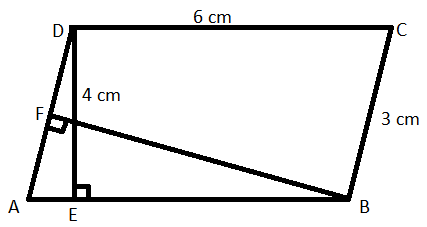
In the figure, ABCD is a parallelogram. If DE = 4cm, then BF equals:
$\left( a \right)$ 2 cm
$\left( b \right)$ 4 cm
$\left( c \right)$ 8 cm
$\left( d \right)$ 16 cm.
Answer
 Verified
629.7k+ views
Hint: In this particular question use the concept that the area of the parallelogram is half times the product of base and perpendicular height from that base so use this concept to reach the solution of the question.
Complete step by step answer:
Given data:
ABCD is a parallelogram
DE = 4 cm.
And from figure, BC = 3 cm and CD = 6 cm.
Now as we know that in parallelogram opposite sides are equal so we have,
BC = AD = 3cm, and AB = CD = 6 cm.
Now as we know that the area of the parallelogram is half times the product of base and perpendicular height from that base.
So from the figure, DE is perpendicular on AB.
So the area of the parallelogram is, ${A_1} = \dfrac{1}{2}\left( {DE \times AB} \right)$ square units................. (1)
Now again from the figure, BF is perpendicular on AD.
So the area of the parallelogram is, ${A_2} = \dfrac{1}{2}\left( {BF \times AD} \right)$ square units................. (2)
Now both of the above equations are the area of the parallelogram so equate them we have,
$ \Rightarrow \dfrac{1}{2}\left( {DE \times AB} \right) = \dfrac{1}{2}\left( {BF \times AD} \right)$
$ \Rightarrow \left( {DE \times AB} \right) = \left( {BF \times AD} \right)$
Now substitute the values we have,
$ \Rightarrow \left( {4 \times 6} \right) = \left( {BF \times 3} \right)$
$ \Rightarrow BF = \dfrac{{24}}{3} = 8$ Cm.
So this is the required length of the BF.
So, the correct answer is “Option c”.
Note: Whenever we face such types of questions the key concept we have to remember is that always recall the formula of the area of the parallelogram in terms of height and the base of the parallelogram which is stated above then simply equate these areas formula as above and simplify we will get the required length of BF.
Complete step by step answer:
Given data:
ABCD is a parallelogram
DE = 4 cm.
And from figure, BC = 3 cm and CD = 6 cm.
Now as we know that in parallelogram opposite sides are equal so we have,
BC = AD = 3cm, and AB = CD = 6 cm.
Now as we know that the area of the parallelogram is half times the product of base and perpendicular height from that base.
So from the figure, DE is perpendicular on AB.
So the area of the parallelogram is, ${A_1} = \dfrac{1}{2}\left( {DE \times AB} \right)$ square units................. (1)
Now again from the figure, BF is perpendicular on AD.
So the area of the parallelogram is, ${A_2} = \dfrac{1}{2}\left( {BF \times AD} \right)$ square units................. (2)
Now both of the above equations are the area of the parallelogram so equate them we have,
$ \Rightarrow \dfrac{1}{2}\left( {DE \times AB} \right) = \dfrac{1}{2}\left( {BF \times AD} \right)$
$ \Rightarrow \left( {DE \times AB} \right) = \left( {BF \times AD} \right)$
Now substitute the values we have,
$ \Rightarrow \left( {4 \times 6} \right) = \left( {BF \times 3} \right)$
$ \Rightarrow BF = \dfrac{{24}}{3} = 8$ Cm.
So this is the required length of the BF.
So, the correct answer is “Option c”.
Note: Whenever we face such types of questions the key concept we have to remember is that always recall the formula of the area of the parallelogram in terms of height and the base of the parallelogram which is stated above then simply equate these areas formula as above and simplify we will get the required length of BF.
Recently Updated Pages
Master Class 11 English: Engaging Questions & Answers for Success

Master Class 11 Social Science: Engaging Questions & Answers for Success
Master Class 11 Maths: Engaging Questions & Answers for Success
Master Class 11 Biology: Engaging Questions & Answers for Success
Master Class 11 Physics: Engaging Questions & Answers for Success
Master Class 11 Chemistry: Engaging Questions & Answers for Success
Trending doubts