




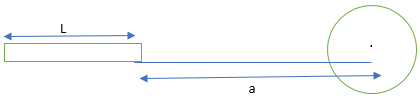
In the figure a spherical body of mass ${m_1}$ is at a distance a from one end of a uniform rod of length L and mass ${m_2}$. The gravitational force between them is
A. $\dfrac{{G{m_1}{m_2}}}{{{a^2}}}$
B. $\dfrac{{G{m_1}{m_2}}}{{a(a + L)}}$
C. $\dfrac{{G{m_1}{m_2}}}{{{{[a + (L/2)]}^2}}}$
D. $\dfrac{{G{m_1}{m_2}}}{{2{{(a/L)}^2}}}$
Answer
 Verified
572.7k+ views
Hint: Sphere can be treated as a point on its centre because the rod is outside of the sphere, now it’s a question of gravitational force by a rod on a point and in order to calculate it.we will have to use integration.
Complete step by step answer:
Since rod is outside of the sphere we can treat sphere as point mass and it will look like

Now, lets take an elemental dx length of the rod at a distance x from the left end

Total length of the rod is L and mass is ${m_2}$
So mass of elemental length dx will be $\dfrac{{{m_2}dx}}{L}$.
Gravitational force due to this dx on ${m_1}$ will be $\dfrac{{G{m_1}{m_2}dx}}{{L{{(a + L - x)}^2}}}$.
Net force will be $\int\limits_0^L {\dfrac{{G{m_1}{m_2}dx}}{{L{{(a + L - x)}^2}}}}
= - \left. {\dfrac{{G{m_1}{m_2}}}{{L(a + L - x)}}_0^L} \right]
= \dfrac{{G{m_1}{m_2}}}{{L(a + L)}} - \dfrac{{G{m_1}{m_2}}}{{L(a + L - L)}}
= - \dfrac{{G{m_1}{m_2}}}{{(a)(a + L)}}$.
So, the correct answer is “Option B”.
Note:
Here in this question rod is outside of the sphere so we can consider it as a point mass now since rod is not a symmetrical object we cannot consider it as a point mass nor can we take centre of mass of the rod as the point mass for the rod (some students do make this mistake by thinking that they can take the centre of mass of the rod as a single point and then solve it which is incorrect because all the elemental particle of the rod apply force of different magnitude on the rod and in an unsymmetrical way.
Complete step by step answer:
Since rod is outside of the sphere we can treat sphere as point mass and it will look like
Now, lets take an elemental dx length of the rod at a distance x from the left end
Total length of the rod is L and mass is ${m_2}$
So mass of elemental length dx will be $\dfrac{{{m_2}dx}}{L}$.
Gravitational force due to this dx on ${m_1}$ will be $\dfrac{{G{m_1}{m_2}dx}}{{L{{(a + L - x)}^2}}}$.
Net force will be $\int\limits_0^L {\dfrac{{G{m_1}{m_2}dx}}{{L{{(a + L - x)}^2}}}}
= - \left. {\dfrac{{G{m_1}{m_2}}}{{L(a + L - x)}}_0^L} \right]
= \dfrac{{G{m_1}{m_2}}}{{L(a + L)}} - \dfrac{{G{m_1}{m_2}}}{{L(a + L - L)}}
= - \dfrac{{G{m_1}{m_2}}}{{(a)(a + L)}}$.
So, the correct answer is “Option B”.
Note:
Here in this question rod is outside of the sphere so we can consider it as a point mass now since rod is not a symmetrical object we cannot consider it as a point mass nor can we take centre of mass of the rod as the point mass for the rod (some students do make this mistake by thinking that they can take the centre of mass of the rod as a single point and then solve it which is incorrect because all the elemental particle of the rod apply force of different magnitude on the rod and in an unsymmetrical way.
Recently Updated Pages
Master Class 11 Computer Science: Engaging Questions & Answers for Success

Master Class 11 Business Studies: Engaging Questions & Answers for Success
Master Class 11 Economics: Engaging Questions & Answers for Success
Master Class 11 English: Engaging Questions & Answers for Success
Master Class 11 Maths: Engaging Questions & Answers for Success
Master Class 11 Biology: Engaging Questions & Answers for Success
Trending doubts
One Metric ton is equal to kg A 10000 B 1000 C 100 class 11 physics CBSE
There are 720 permutations of the digits 1 2 3 4 5 class 11 maths CBSE
Discuss the various forms of bacteria class 11 biology CBSE
Draw a diagram of a plant cell and label at least eight class 11 biology CBSE
State the laws of reflection of light
10 examples of friction in our daily life