




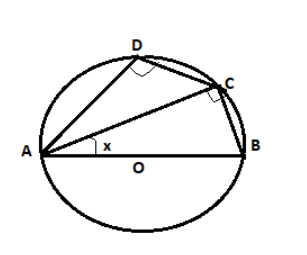
In the fig. O is the centre of a circle and \[\angle ADC = 120^\circ \]. Find the value of x .
Answer
 Verified
632.7k+ views
Hint :- In this question we know that ADCB is a cyclic quadrilateral. So here we can use the properties of cyclic quadrilaterals. And this quadrilateral is inscribed in the semicircle so we also have to keep this in mind while solving the problem. With the help of various properties we can solve this question.
Complete step-by-step answer:
As we all know that ABCD here is a cyclic quadrilateral .
So, by the property of cyclic quadrilateral which states that the sum of each pairs of cyclic quadrilateral is \[180^\circ \]
\[ \Rightarrow \]\[\angle ABC + \angle ADC = 180^\circ \]
\[ \Rightarrow \]\[\angle ABC\]= \[180^\circ \]- \[\angle ADC\] = \[180^\circ \]- \[120^\circ \]
\[ \Rightarrow \]\[\angle ABC\]= \[60^\circ \]
Also, we know that if an angle is inscribed in a semicircle then that angle must be \[90^\circ \].
So, \[\angle ACB\]= \[90^\circ \]
Now in \[\vartriangle \]ABC we have
\[\angle ACB\] + \[\angle ABC\] + \[\angle CAB\] = \[180^\circ \] ( by angle sum property of a triangle )
Now putting the values of \[\angle CAB\],\[\angle ABC\] and \[\angle ACB\] in above equation
\[ \Rightarrow \] \[90^\circ \] + \[60^\circ \] + x = \[180^\circ \]
\[ \Rightarrow \] x = \[180^\circ \] - \[150^\circ \] = \[30^\circ \]
Hence the value of x is \[30^\circ \].
Note :- Whenever we come up with this type of problems in which a quadrilateral is inscribed in a circle than we had keep also the properties of cyclic quadrilateral in our mind and at that time we should think about the properties that which one will help us to find the angles such as here the basic property of cyclic quadrilateral ( i.e. sum of opposite angles = \[180^\circ \] ) had solved the most important part of question so easily and quickly. And this would be the most convenient way to solve such types of problems.
Complete step-by-step answer:
As we all know that ABCD here is a cyclic quadrilateral .
So, by the property of cyclic quadrilateral which states that the sum of each pairs of cyclic quadrilateral is \[180^\circ \]
\[ \Rightarrow \]\[\angle ABC + \angle ADC = 180^\circ \]
\[ \Rightarrow \]\[\angle ABC\]= \[180^\circ \]- \[\angle ADC\] = \[180^\circ \]- \[120^\circ \]
\[ \Rightarrow \]\[\angle ABC\]= \[60^\circ \]
Also, we know that if an angle is inscribed in a semicircle then that angle must be \[90^\circ \].
So, \[\angle ACB\]= \[90^\circ \]
Now in \[\vartriangle \]ABC we have
\[\angle ACB\] + \[\angle ABC\] + \[\angle CAB\] = \[180^\circ \] ( by angle sum property of a triangle )
Now putting the values of \[\angle CAB\],\[\angle ABC\] and \[\angle ACB\] in above equation
\[ \Rightarrow \] \[90^\circ \] + \[60^\circ \] + x = \[180^\circ \]
\[ \Rightarrow \] x = \[180^\circ \] - \[150^\circ \] = \[30^\circ \]
Hence the value of x is \[30^\circ \].
Note :- Whenever we come up with this type of problems in which a quadrilateral is inscribed in a circle than we had keep also the properties of cyclic quadrilateral in our mind and at that time we should think about the properties that which one will help us to find the angles such as here the basic property of cyclic quadrilateral ( i.e. sum of opposite angles = \[180^\circ \] ) had solved the most important part of question so easily and quickly. And this would be the most convenient way to solve such types of problems.
Recently Updated Pages
Master Class 12 Economics: Engaging Questions & Answers for Success

Master Class 12 English: Engaging Questions & Answers for Success
Master Class 12 Social Science: Engaging Questions & Answers for Success
Master Class 12 Maths: Engaging Questions & Answers for Success
Master Class 12 Physics: Engaging Questions & Answers for Success
Master Class 10 English: Engaging Questions & Answers for Success
Trending doubts
Explain the Treaty of Vienna of 1815 class 10 social science CBSE
Why is it 530 pm in india when it is 1200 afternoon class 10 social science CBSE
What is the full form of POSCO class 10 social science CBSE
Define Potential, Developed, Stock and Reserved resources
The speaker of the Lok Sabha is elected by the APresident class 10 social science CBSE
Complete the sentence with the most appropriate word class 10 english CBSE