




In the extrinsic clotting pathway, the active factor VII activates which factors?
A. X and XI
B. IX and XI
C. IX and X
D. XI and XII
Answer
 Verified
599.4k+ views
Hint: Deficiency of this factor (clotting protein)is responsible for Christmas disease which is a genetic disorder. The extrinsic clotting pathway is one of the shortest pathways of secondary hemostasis. After the damage is done to the vessels the release of tissue factor by the endothelial cells takes place and this release furtherly activates the factors for clotting.
Complete answer:
The extrinsic route is the shortest route for secondary hemostasis. Once the vessel is damaged, endothelial cells release tissue factor which then activates factor VII into factor VIIa. Factor VIIa now activates factor X into factor Xa
Additional information: Recombinant activated factor VII (factor VIIa) is indicated in patients with inhibitors of coagulation factors VIII and IX. Therefore, FVIIa exists only in a partially active form and is entrained in the active glycoprotein (50 kDa) involved in the extrinsic pathway of blood coagulation.
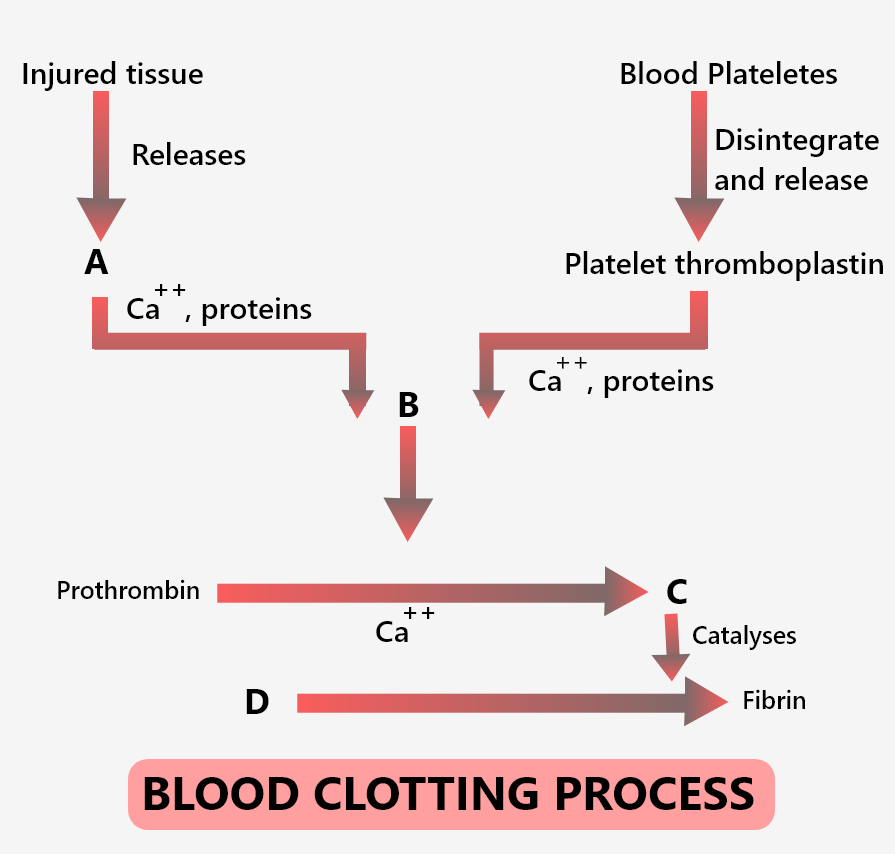
Factor VII is the most sensitive of the vitamin K dependent coagulation factors. The mode of action is tissue factor-dependent activation of factors Xa and IXa on activated platelet surfaces. Factor Xa leads to the generation of thrombin and hemostasis, by converting fibrinogen into fibrin.
So, the correct answer is IX and X.
Note: After vascular injury, tissue factor is exposed to circulating blood and factor VII. Once bound to TF, FVII is activated to FVIIa by various proteases, including thrombin (factor IIa), factor Xa, IXa, XIIa, and the FVIIa-TF complex itself. Some of the factors that affect the blood clotting factor are Fibrinogen which is factor 1, Prothrombin which is factor 2, thromboplastin which is factor 3, calcium which is factor 4, Proaccelerin or Labile Factor which is factor 5, Stable Factor which is factor 6 and many more factors are involved in the blood clotting.
Complete answer:
The extrinsic route is the shortest route for secondary hemostasis. Once the vessel is damaged, endothelial cells release tissue factor which then activates factor VII into factor VIIa. Factor VIIa now activates factor X into factor Xa
Additional information: Recombinant activated factor VII (factor VIIa) is indicated in patients with inhibitors of coagulation factors VIII and IX. Therefore, FVIIa exists only in a partially active form and is entrained in the active glycoprotein (50 kDa) involved in the extrinsic pathway of blood coagulation.
Factor VII is the most sensitive of the vitamin K dependent coagulation factors. The mode of action is tissue factor-dependent activation of factors Xa and IXa on activated platelet surfaces. Factor Xa leads to the generation of thrombin and hemostasis, by converting fibrinogen into fibrin.
So, the correct answer is IX and X.
Note: After vascular injury, tissue factor is exposed to circulating blood and factor VII. Once bound to TF, FVII is activated to FVIIa by various proteases, including thrombin (factor IIa), factor Xa, IXa, XIIa, and the FVIIa-TF complex itself. Some of the factors that affect the blood clotting factor are Fibrinogen which is factor 1, Prothrombin which is factor 2, thromboplastin which is factor 3, calcium which is factor 4, Proaccelerin or Labile Factor which is factor 5, Stable Factor which is factor 6 and many more factors are involved in the blood clotting.
Recently Updated Pages
Master Class 11 Social Science: Engaging Questions & Answers for Success

Master Class 11 English: Engaging Questions & Answers for Success
Master Class 11 Maths: Engaging Questions & Answers for Success
Master Class 11 Chemistry: Engaging Questions & Answers for Success
Master Class 11 Biology: Engaging Questions & Answers for Success
Master Class 11 Physics: Engaging Questions & Answers for Success
Trending doubts
One Metric ton is equal to kg A 10000 B 1000 C 100 class 11 physics CBSE
Difference Between Prokaryotic Cells and Eukaryotic Cells
There are 720 permutations of the digits 1 2 3 4 5 class 11 maths CBSE
Draw a diagram of a plant cell and label at least eight class 11 biology CBSE
Two of the body parts which do not appear in MRI are class 11 biology CBSE
Which gas is abundant in air class 11 chemistry CBSE