




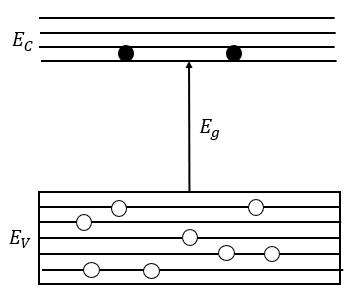
In the energy band diagram of the material shown below, the open circles and filled circles denote holes and electrons respectively. The material mostly likely a/an
A. p-type semiconductor
B. insulator
C. metal
D. n-type semiconductor
Answer
 Verified
611.7k+ views
Hint: Recall the concept of metal, insulator and semiconductors. We know that what factor differentiates the metals, insulators and semiconductors. n-type and p-type are the types of semiconductors. The number density of electrons and holes in the conduction band and valence band respectively differentiates the type of semiconductor.
Complete step by step answer:
There are two types of semiconductor: p-type and n-type semiconductor.
In p-type semiconductor, the number density of holes in the valence is greater than the number density of electrons in the conduction band. Therefore, the conduction band has a smaller number of electrons than the holes in the valence band.
In the given figure, the valence band has more holes as compared to the number of electrons in the conduction band. Therefore, the material is most likely a p-type semiconductor.
So, the correct answer is option (A).
Let’s analyze other options as well.
(B) Insulator
In insulators, the band gap is infinite. But the band gap is not infinite in the above figure.
Therefore, the option (B) is incorrect.
(C) Metal
In metals, the band gap is zero. But in the above figure, the material has a certain band gap.
Therefore, the option (C) is incorrect.
(D) n-type semiconductor
In n-type semiconductor, the number density of holes in the valence is less than the number density of electrons in the conduction band. Therefore, the conduction band has a greater number of electrons than the holes in the valence band.
So, the correct answer is “Option A”.
Note:
The energy band diagram plays an important role for recognition of material as metal, insulator or semiconductor.
In the given figure, the valence band has more holes as compared to the number of electrons in the conduction band.
Complete step by step answer:
There are two types of semiconductor: p-type and n-type semiconductor.
In p-type semiconductor, the number density of holes in the valence is greater than the number density of electrons in the conduction band. Therefore, the conduction band has a smaller number of electrons than the holes in the valence band.
In the given figure, the valence band has more holes as compared to the number of electrons in the conduction band. Therefore, the material is most likely a p-type semiconductor.
So, the correct answer is option (A).
Let’s analyze other options as well.
(B) Insulator
In insulators, the band gap is infinite. But the band gap is not infinite in the above figure.
Therefore, the option (B) is incorrect.
(C) Metal
In metals, the band gap is zero. But in the above figure, the material has a certain band gap.
Therefore, the option (C) is incorrect.
(D) n-type semiconductor
In n-type semiconductor, the number density of holes in the valence is less than the number density of electrons in the conduction band. Therefore, the conduction band has a greater number of electrons than the holes in the valence band.
So, the correct answer is “Option A”.
Note:
The energy band diagram plays an important role for recognition of material as metal, insulator or semiconductor.
In the given figure, the valence band has more holes as compared to the number of electrons in the conduction band.
Recently Updated Pages
Master Class 12 Business Studies: Engaging Questions & Answers for Success

Master Class 12 Chemistry: Engaging Questions & Answers for Success
Master Class 12 Biology: Engaging Questions & Answers for Success
Class 12 Question and Answer - Your Ultimate Solutions Guide
Master Class 11 Social Science: Engaging Questions & Answers for Success
Master Class 11 Chemistry: Engaging Questions & Answers for Success
Trending doubts
Which are the Top 10 Largest Countries of the World?
Draw a labelled sketch of the human eye class 12 physics CBSE
Name the crygenes that control cotton bollworm and class 12 biology CBSE
Differentiate between homogeneous and heterogeneous class 12 chemistry CBSE
In a transcription unit the promoter is said to be class 12 biology CBSE
Sulphuric acid is known as the king of acids State class 12 chemistry CBSE