




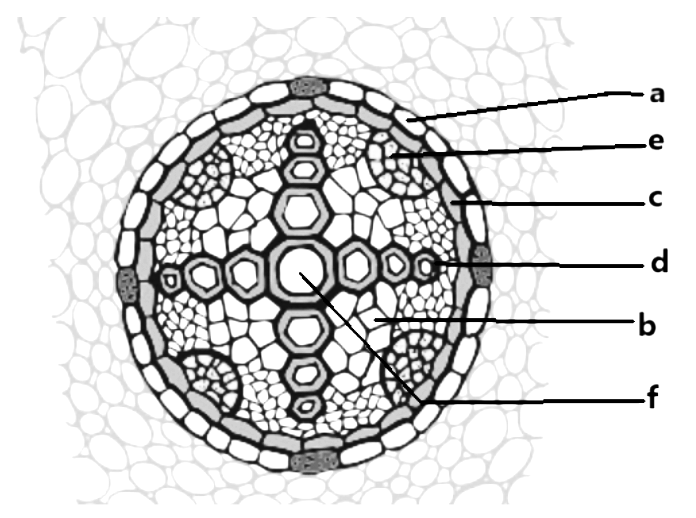
In the diagram of the T.S stele of dicot root, the different parts have been indicated by alphabets. Choose the correct combination.
A. a- pericycle, b-conjunctive tissue, c-metaxylem, d-protoxylem, e-phloem, f-pith
B. a- endodermis, b-conjunctive tissue, c-protoxylem, d-metaxylem, e-phloem, f-pith
C. a- endodermis, b- conjunctive tissue, c- metaxylem, d- protoxylem, e- phloem, f-pith
D. a- endodermis, b-pith, c- protoxylem, d-metaxylem, e- phloem, f-conjunctive tissue
Answer
 Verified
612.3k+ views
Hint: In stele of dicot the arrangements of the xylem and phloem are in an x shape. Vascular tissue in monocot is arranged in a ring shape around the pith. When it comes to the arrangements of vascular tissue in typical dicots it is placed in the center of the root in an X shape.
Complete answer:
Parenchyma tissue particularly really present between xylem and phloem is called Conjunctive tissue, which for all intents and purposes kind of shows that tetrarch stele essentially mostly is present, generally, for the most part, means stele with four xylem strands, showing how in the stele of dicot root, the outermost part is the pericycle, and inner vascular bundles medulla, conjunctive tissue is present, which is fairly significant.
So, in the pretty generally transverse section of dicot root stele shows, outer pericycle, generally really followed by vascular bundles, conjunctive tissue, and medulla, so parenchyma tissue generally actually present between xylem and phloem essentially mostly is called Conjunctive tissue, which for the most part shows that tetrarch stele is present, for all intents and purposes generally means stele with four xylem strands, showing how in the stele of dicot root, the outermost part is the pericycle, and inner vascular bundles medulla, conjunctive tissue is particularly present.
So, The correct combination is a- endodermis, b-conjunctive tissue, c-protoxylem, d-metaxylem, e-phloem, and f-pith.
Hence, the correct answer is option (B).
Note: The xylem and phloem are placed in different places in the dicot. Xylem is placed inside the center where the phloem covers the xylem from outside. The organization of tissue layers within monocot and dicot roots is illustrated in the diagram.
Complete answer:
Parenchyma tissue particularly really present between xylem and phloem is called Conjunctive tissue, which for all intents and purposes kind of shows that tetrarch stele essentially mostly is present, generally, for the most part, means stele with four xylem strands, showing how in the stele of dicot root, the outermost part is the pericycle, and inner vascular bundles medulla, conjunctive tissue is present, which is fairly significant.
So, in the pretty generally transverse section of dicot root stele shows, outer pericycle, generally really followed by vascular bundles, conjunctive tissue, and medulla, so parenchyma tissue generally actually present between xylem and phloem essentially mostly is called Conjunctive tissue, which for the most part shows that tetrarch stele is present, for all intents and purposes generally means stele with four xylem strands, showing how in the stele of dicot root, the outermost part is the pericycle, and inner vascular bundles medulla, conjunctive tissue is particularly present.
So, The correct combination is a- endodermis, b-conjunctive tissue, c-protoxylem, d-metaxylem, e-phloem, and f-pith.
Hence, the correct answer is option (B).
Note: The xylem and phloem are placed in different places in the dicot. Xylem is placed inside the center where the phloem covers the xylem from outside. The organization of tissue layers within monocot and dicot roots is illustrated in the diagram.
Recently Updated Pages
Master Class 11 English: Engaging Questions & Answers for Success

Master Class 11 Social Science: Engaging Questions & Answers for Success
Master Class 11 Maths: Engaging Questions & Answers for Success
Master Class 11 Biology: Engaging Questions & Answers for Success
Master Class 11 Physics: Engaging Questions & Answers for Success
Master Class 11 Chemistry: Engaging Questions & Answers for Success
Trending doubts
One Metric ton is equal to kg A 10000 B 1000 C 100 class 11 physics CBSE
Difference Between Prokaryotic Cells and Eukaryotic Cells
Find the value of the expression given below sin 30circ class 11 maths CBSE
Two of the body parts which do not appear in MRI are class 11 biology CBSE
Draw a diagram of a plant cell and label at least eight class 11 biology CBSE
10 examples of friction in our daily life