




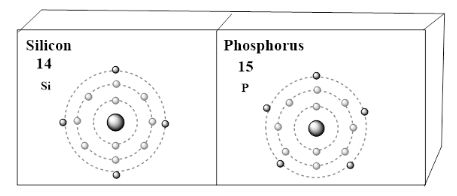
In the diagram, how are valence electrons illustrated? How many valence electrons does each element have?
Answer
 Verified
607.8k+ views
Hint: Valence electrons are electrons in an atom's external energy level that can participate in interactions with other atoms. The valence electrons are usually the most distant electrons from the nucleus. As a result, they may be attracted as much or more to the nucleus of another atom than to their nucleus.
Complete answer:
The electronic configuration says about how the electrons are distributed in atomic orbitals. The electronic configuration is filled according to the energy they have. They follow the standard notion in which electrons containing the atomic subshells are placed in a sequence. For example, the Magnesium’s electron configuration; \[Mg = {\text{ }}1{s^2}2{s^2}2{p^6}3{s^2}\]
The full electronic configuration of any element is written in a standard format. But when it comes to higher elements will consist of many numbers of orbital, so for simplification condensed electronic configuration is noted.
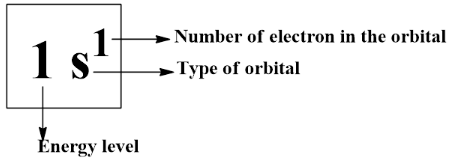
The full electronic configuration of silicon;
\[Si = {\text{ }}1{s^2}2{s^2}2{p^6}3{s^2}\,3{p^2}\]
The full electronic configuration of phosphorus;
\[P = {\text{ }}1{s^2}2{s^2}2{p^6}3{s^2}\,3{p^3}\]
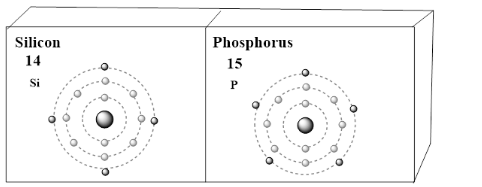
In the case of valence electrons of silicon and phosphorus the outermost electrons present in the darker shade is the valence. These valence electrons are crucial to effective chemical bonding and are usually the sole participants in chemical reactions (as opposed to core participation).
Thus, there are \[4\] valence electrons in silicon atoms and \[5\] in phosphorus atoms.
Note: Silicon \[(Si)\] whose atomic number is \[14\] , which is having \[14\] electrons. The \[14\] protons are there in atomic nuclei. A neutral atom has the same number of protons as well as the same number of electrons. When it comes to the case of silicon, it is in the \[{3^{rd}}\] period of the table and the group \[14\] element. The silicon has \[4\] valence electrons. Phosphorus \[(P)\] whose atomic number is \[15\] , which is having \[15\] electrons. The \[15\] protons are there in atomic nuclei. A neutral atom has the same number of protons as well as the same number of electrons. When it comes to the case of phosphorus, it is in the \[{3^{rd}}\] period of the table and the group \[15\] element. The phosphorus has \[5\] valence electrons.
Complete answer:
The electronic configuration says about how the electrons are distributed in atomic orbitals. The electronic configuration is filled according to the energy they have. They follow the standard notion in which electrons containing the atomic subshells are placed in a sequence. For example, the Magnesium’s electron configuration; \[Mg = {\text{ }}1{s^2}2{s^2}2{p^6}3{s^2}\]
The full electronic configuration of any element is written in a standard format. But when it comes to higher elements will consist of many numbers of orbital, so for simplification condensed electronic configuration is noted.
The full electronic configuration of silicon;
\[Si = {\text{ }}1{s^2}2{s^2}2{p^6}3{s^2}\,3{p^2}\]
The full electronic configuration of phosphorus;
\[P = {\text{ }}1{s^2}2{s^2}2{p^6}3{s^2}\,3{p^3}\]
In the case of valence electrons of silicon and phosphorus the outermost electrons present in the darker shade is the valence. These valence electrons are crucial to effective chemical bonding and are usually the sole participants in chemical reactions (as opposed to core participation).
Thus, there are \[4\] valence electrons in silicon atoms and \[5\] in phosphorus atoms.
Note: Silicon \[(Si)\] whose atomic number is \[14\] , which is having \[14\] electrons. The \[14\] protons are there in atomic nuclei. A neutral atom has the same number of protons as well as the same number of electrons. When it comes to the case of silicon, it is in the \[{3^{rd}}\] period of the table and the group \[14\] element. The silicon has \[4\] valence electrons. Phosphorus \[(P)\] whose atomic number is \[15\] , which is having \[15\] electrons. The \[15\] protons are there in atomic nuclei. A neutral atom has the same number of protons as well as the same number of electrons. When it comes to the case of phosphorus, it is in the \[{3^{rd}}\] period of the table and the group \[15\] element. The phosphorus has \[5\] valence electrons.
Recently Updated Pages
Master Class 11 Social Science: Engaging Questions & Answers for Success

Master Class 11 English: Engaging Questions & Answers for Success
Master Class 11 Accountancy: Engaging Questions & Answers for Success
Master Class 11 Physics: Engaging Questions & Answers for Success
Master Class 11 Computer Science: Engaging Questions & Answers for Success
Master Class 11 Business Studies: Engaging Questions & Answers for Success
Trending doubts
One Metric ton is equal to kg A 10000 B 1000 C 100 class 11 physics CBSE
Find the value of the expression given below sin 30circ class 11 maths CBSE
Draw a diagram of nephron and explain its structur class 11 biology CBSE
10 examples of friction in our daily life
Proton was discovered by A Thomson B Rutherford C Chadwick class 11 chemistry CBSE
The teeth used for biting and cutting food are called class 11 biology CBSE