




In the diagram given by the side, different parts are indicated by alphabets. Choose the answer in which these alphabets correctly match with the parts they indicate.
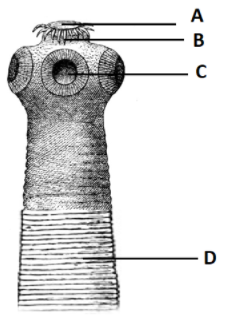
A) A-Mouth, B-Tentacles, C-Sucker, D-Segments
B) A-Sucker, B-Hairs, C-Ring, D-Proglottids
C) A-Rostellum, B-Hooks, C-Sucker, D-Proglottids
D) A-Suctorial mouth, B-Hooks, C-Sucker, D-Segments
Answer
 Verified
571.8k+ views
Hint: The diagram given in the question is of a tapeworm. Tapeworms are parasitic worms that belong to the phylum Platyhelminthes and class Cestode. They have complex life cycles which involves growth in both vertebrates and invertebrates.
Complete answer:
The adult tapeworm arises from larva and may be host-specific or may be able to be parasitic to a wide variety of hosts. Let us discuss the parts of the tapeworm.
Each adult tapeworm comprises a head also known as scolex, a neck and a segmented body consisting of proglottids(D).
The knob-like structure at the extreme anterior end of the tapeworm is known as rostellum (A). It consists of concentric rows of hooks (B).
The tapeworms are capable of anchoring themselves inside the human intestine by means of either hooks or suckers or both which is present in the scolex.
After attaching to the intestine, they absorb nutrients from there and are devoid of mouths. Tapeworms are generally hermaphrodites thus their reproductive system comprises both male and female parts. They mostly carry out reproduction by cross-fertilization but sometimes self-fertilization also takes place. The diagram showing different parts of the tapeworm is given below.
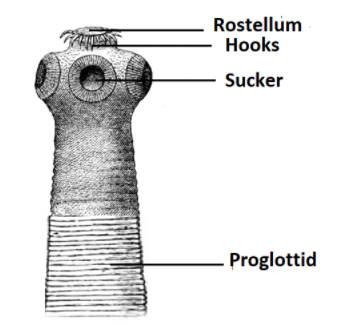
So the correct option is (C) A-Rostellum, B-Hooks, C-Sucker, D-Proglottids.
Note: Humans affected by tapeworm may show few or no symptoms. Identification of tapeworm infection can be done by examining the stool which would contain one or more proglottids. Infection can be treated by various anthelminthic drugs such as praziquantel, niclosamide, etc.
Complete answer:
The adult tapeworm arises from larva and may be host-specific or may be able to be parasitic to a wide variety of hosts. Let us discuss the parts of the tapeworm.
Each adult tapeworm comprises a head also known as scolex, a neck and a segmented body consisting of proglottids(D).
The knob-like structure at the extreme anterior end of the tapeworm is known as rostellum (A). It consists of concentric rows of hooks (B).
The tapeworms are capable of anchoring themselves inside the human intestine by means of either hooks or suckers or both which is present in the scolex.
After attaching to the intestine, they absorb nutrients from there and are devoid of mouths. Tapeworms are generally hermaphrodites thus their reproductive system comprises both male and female parts. They mostly carry out reproduction by cross-fertilization but sometimes self-fertilization also takes place. The diagram showing different parts of the tapeworm is given below.
So the correct option is (C) A-Rostellum, B-Hooks, C-Sucker, D-Proglottids.
Note: Humans affected by tapeworm may show few or no symptoms. Identification of tapeworm infection can be done by examining the stool which would contain one or more proglottids. Infection can be treated by various anthelminthic drugs such as praziquantel, niclosamide, etc.
Recently Updated Pages
Master Class 11 English: Engaging Questions & Answers for Success

Master Class 11 Physics: Engaging Questions & Answers for Success
Master Class 11 Computer Science: Engaging Questions & Answers for Success
Master Class 11 Chemistry: Engaging Questions & Answers for Success
Master Class 11 Social Science: Engaging Questions & Answers for Success
Master Class 11 Accountancy: Engaging Questions & Answers for Success
Trending doubts
Difference Between Prokaryotic Cells and Eukaryotic Cells
Two of the body parts which do not appear in MRI are class 11 biology CBSE
One Metric ton is equal to kg A 10000 B 1000 C 100 class 11 physics CBSE
10 examples of friction in our daily life
Draw a diagram of nephron and explain its structur class 11 biology CBSE
Draw a diagram of a plant cell and label at least eight class 11 biology CBSE