




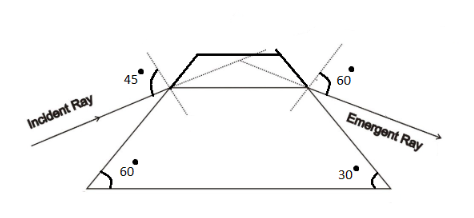
In the diagram a rat is passing through a broken prism, find angular deviation for the ray:
A) ${105^ \circ }$
B) ${30^ \circ }$
C) ${60^ \circ }$
D) ${15^ \circ }$
Answer
 Verified
585.3k+ views
Hint:In this question, the broken prism is given. We can find the angle of the prism by reconstructing the prism. After finding the angle of the prism, we can find the angle of deviation using the angle of incidence and angle of emergence.
Complete step by step solution: - We know that a prism is in a triangular shape. According to the question, the top of the prism is broken. So, the prism is changed into a quadrilateral shape.
Let us reconstruct the prism. So that it turns into a triangle.
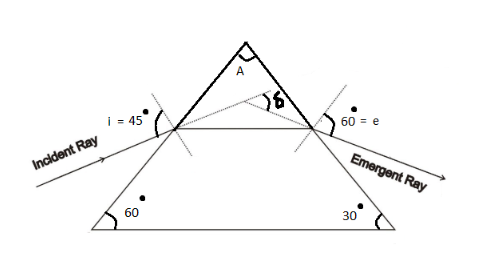
From the figure, we have two angles of the triangle are \[{30^ \circ }\] and\[{60^ \circ }\].
We know that the sum of all the interior angles is\[{180^ \circ }\].
So, sum of all the angles of prism is given by-
\[\begin{array}{*{20}{l}}
{{{180}^ \circ } = A + {{30}^ \circ } + {{60}^ \circ }} \\
{ \Rightarrow A = {{90}^ \circ }}
\end{array}\]
So, the angle of the prism is\[{90^ \circ }\].
According to the question, we have the angle of incidence \[i = {45^ \circ }\] and the angle of emergence\[e = {60^ \circ }\] . So, the deviation $\delta $ will be given as-
$
\delta = i + e - A \\
\Rightarrow \delta = {45^ \circ } + {60^ \circ } - {90^ \circ } \\
\Rightarrow \delta = {15^ \circ } \\
$
So, the angle of deviation is ${15^ \circ }$.
Hence, option D is correct.
Additional Information: - When a ray is incident on the prism, then some part of the ray is refracted from the prism. The angle at which the ray incident on the prism is known as incident angle and the angle at which the refracted ray comes out from the prism is called angle of emergence.
Angle of deviation- The overall amount of refracted rays is termed as angle of deviation.
Angle of prism- Angle of prism is the angle between the two surfaces from which the ray of incidence and ray of emergence are related.
Note: - In this question, we have to keep in mind that the angle of prism is necessary to find the angle of deviation. We can find the angle of the prism by reconstructing the prism. Angle of prism and angle of deviation are two different angles of a prism.
Complete step by step solution: - We know that a prism is in a triangular shape. According to the question, the top of the prism is broken. So, the prism is changed into a quadrilateral shape.
Let us reconstruct the prism. So that it turns into a triangle.
From the figure, we have two angles of the triangle are \[{30^ \circ }\] and\[{60^ \circ }\].
We know that the sum of all the interior angles is\[{180^ \circ }\].
So, sum of all the angles of prism is given by-
\[\begin{array}{*{20}{l}}
{{{180}^ \circ } = A + {{30}^ \circ } + {{60}^ \circ }} \\
{ \Rightarrow A = {{90}^ \circ }}
\end{array}\]
So, the angle of the prism is\[{90^ \circ }\].
According to the question, we have the angle of incidence \[i = {45^ \circ }\] and the angle of emergence\[e = {60^ \circ }\] . So, the deviation $\delta $ will be given as-
$
\delta = i + e - A \\
\Rightarrow \delta = {45^ \circ } + {60^ \circ } - {90^ \circ } \\
\Rightarrow \delta = {15^ \circ } \\
$
So, the angle of deviation is ${15^ \circ }$.
Hence, option D is correct.
Additional Information: - When a ray is incident on the prism, then some part of the ray is refracted from the prism. The angle at which the ray incident on the prism is known as incident angle and the angle at which the refracted ray comes out from the prism is called angle of emergence.
Angle of deviation- The overall amount of refracted rays is termed as angle of deviation.
Angle of prism- Angle of prism is the angle between the two surfaces from which the ray of incidence and ray of emergence are related.
Note: - In this question, we have to keep in mind that the angle of prism is necessary to find the angle of deviation. We can find the angle of the prism by reconstructing the prism. Angle of prism and angle of deviation are two different angles of a prism.
Recently Updated Pages
Master Class 12 Economics: Engaging Questions & Answers for Success

Master Class 12 Physics: Engaging Questions & Answers for Success
Master Class 12 English: Engaging Questions & Answers for Success
Master Class 12 Social Science: Engaging Questions & Answers for Success
Master Class 12 Maths: Engaging Questions & Answers for Success
Master Class 12 Business Studies: Engaging Questions & Answers for Success
Trending doubts
Which are the Top 10 Largest Countries of the World?
What are the major means of transport Explain each class 12 social science CBSE
Draw a labelled sketch of the human eye class 12 physics CBSE
Differentiate between insitu conservation and exsitu class 12 biology CBSE
Draw a neat and well labeled diagram of TS of ovary class 12 biology CBSE
Give 10 examples of unisexual and bisexual flowers