




In the depletion region of an unbiased P-N junction diode there are
Answer
 Verified
676.5k+ views
Hint: During the formation of the P-N junction diode, a thin layer is set up on both sides of the junction called depletion layer and it is devoid of free charge carriers. Its width is about 1μm. A barrier potential is also developed across the junction.
Complete step by step answer:
A P-N junction diode is a semiconductor material with one of its halves doped by P- type impurity and the other half is doped by N- type impurities. The division or junction between both the halves is called P-N junction. When P-N junction is formed, it has holes in P- region and electrons in N- region. The number of holes is higher in P- region (exists as majority carriers) than N- region (exists as minority carriers). In the same way, the quantity of electrons in N- region (exists as majority carriers) is higher than P- region (exists as minority carriers). The difference in density of carriers results in major carrier diffusion. So that, holes diffuse from P to N region and electrons diffuse from N to P region. The depletion layer is formed by the recombination of free or mobile holes and electrons that produce a narrow layer. And the region is depleted of free or mobile charge carriers. But it contains fixed and immobile charges. The production of ions is because of the impurity atoms that have let electrons and holes behind by themselves in an isolated state by having a charge that is opposite to the departed.
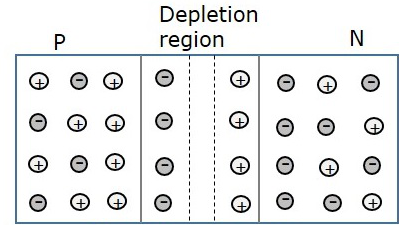
In the depletion region of an unbiased P-N junction diode there are only fixed or immobile positive and negative atoms.
Note: As the depletion layer contains no free or mobile charge carriers but only fixed and immobile ions, this layer (or region) behaves like an insulator. And due to the presence of rows of fixed and immobile charges, it possesses capacitance.
Complete step by step answer:
A P-N junction diode is a semiconductor material with one of its halves doped by P- type impurity and the other half is doped by N- type impurities. The division or junction between both the halves is called P-N junction. When P-N junction is formed, it has holes in P- region and electrons in N- region. The number of holes is higher in P- region (exists as majority carriers) than N- region (exists as minority carriers). In the same way, the quantity of electrons in N- region (exists as majority carriers) is higher than P- region (exists as minority carriers). The difference in density of carriers results in major carrier diffusion. So that, holes diffuse from P to N region and electrons diffuse from N to P region. The depletion layer is formed by the recombination of free or mobile holes and electrons that produce a narrow layer. And the region is depleted of free or mobile charge carriers. But it contains fixed and immobile charges. The production of ions is because of the impurity atoms that have let electrons and holes behind by themselves in an isolated state by having a charge that is opposite to the departed.
In the depletion region of an unbiased P-N junction diode there are only fixed or immobile positive and negative atoms.
Note: As the depletion layer contains no free or mobile charge carriers but only fixed and immobile ions, this layer (or region) behaves like an insulator. And due to the presence of rows of fixed and immobile charges, it possesses capacitance.
Recently Updated Pages
Explain the structure of megasporangium class 12 biology CBSE

Why is chloroform kept in dark coloured bottles class 12 chemistry CBSE
Derive the balancing condition of a Wheatstone bri class 12 physics CBSE
Draw VI characteristics of a pn junction diode Explain class 12 physics CBSE
Is it possible to carry pride in ones language too class 12 english CBSE
In a population at Hardy Weinberg equilibrium the allele class 12 biology CBSE
Trending doubts
Draw a labelled sketch of the human eye class 12 physics CBSE
Which are the Top 10 Largest Countries of the World?
Draw ray diagrams each showing i myopic eye and ii class 12 physics CBSE
One megawatt is equal to how many units of electri class 12 physics CBSE
Which is the correct genotypic ratio of mendel dihybrid class 12 biology CBSE
Give 10 examples of unisexual and bisexual flowers