



In the complex $[CoC{{l}_{2}}{{(en)}_{2}}]Br$, the coordination number and oxidation state of cobalt are:
(A) 6 and +3
(B) 3 and +3
(C) 4 and +2
(D) 6 and +1
Answer
 Verified
581.7k+ views
Hint: To solve this question, we first need to know what is coordination number and oxidation state.
The coordination of a central atom in a compound is the number of atoms that are attached to it.
In a chemical compound, the oxidation number or the oxidation state is used to determine the degree of oxidation of an atom.
Complete answer:
Now, let us take a look at the structure of $[CoC{{l}_{2}}{{(en)}_{2}}]Br$.
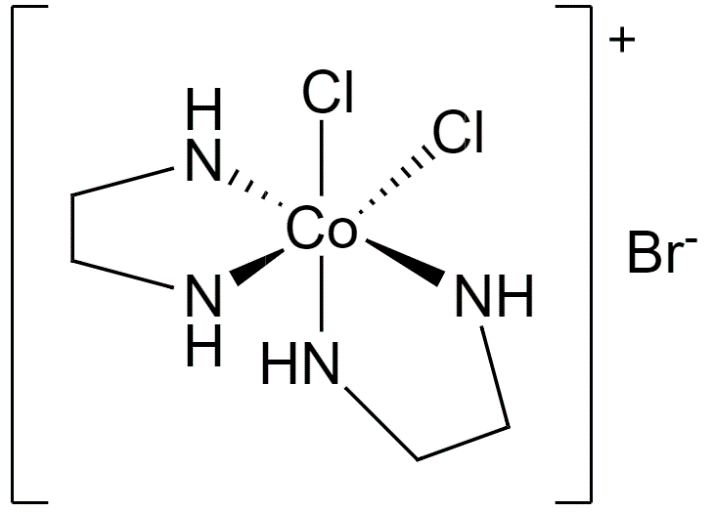
Dichlorobis(ethylenediamine)cobalt(III) bromide
Since 6 atoms are attached to the cobalt central atom, its coordination number is 6.
Now, let us look at the rules to determine the oxidation number of an element.
- For a free element, the oxidation number of an element in a is always 0.
For example, in helium and nitrogen, the oxidation number of the He and N molecule will be 0.
Similarly, the sum of all the atom's oxidation numbers of a compound that is neutral is 0.
- The oxidation number of an ion, whether it is monatomic or polyatomic, is equal to the charge on the in.
For example, the oxidation number of $M{{g}^{2+}}$ is +2. The oxidation number of phosphate ions $P{{O}_{4}}^{3-}$ is -3.
- The usual oxidation number of
Hydrogen = +1
Oxygen = -2
Group I(A) = +1
Group II(A) = +2
Group VII(A) = -1
So, from the rules stated above, we can say that in $[CoC{{l}_{2}}{{(en)}_{2}}]Br$,
Co + 2(-1) + 2(0) + (-1) = 0
Co = +3
So, the coordination number and oxidation state of cobalt in $[CoC{{l}_{2}}{{(en)}_{2}}]Br$ are option (A) 6 and +3.
Note:
It should be noted that there are some exceptions while assigning the oxidation states of atoms in a molecule.
- When a hydrogen atom is bonded to a less electronegative atom, its oxidation number is -1.
- When an oxygen atom is bonded to a more electronegative atom, it exists in a peroxide ion, its oxidation number changes.
- When a Group VII(A) atom is bonded to a more electronegative atom, its oxidation number changes.
The coordination of a central atom in a compound is the number of atoms that are attached to it.
In a chemical compound, the oxidation number or the oxidation state is used to determine the degree of oxidation of an atom.
Complete answer:
Now, let us take a look at the structure of $[CoC{{l}_{2}}{{(en)}_{2}}]Br$.
Dichlorobis(ethylenediamine)cobalt(III) bromide
Since 6 atoms are attached to the cobalt central atom, its coordination number is 6.
Now, let us look at the rules to determine the oxidation number of an element.
- For a free element, the oxidation number of an element in a is always 0.
For example, in helium and nitrogen, the oxidation number of the He and N molecule will be 0.
Similarly, the sum of all the atom's oxidation numbers of a compound that is neutral is 0.
- The oxidation number of an ion, whether it is monatomic or polyatomic, is equal to the charge on the in.
For example, the oxidation number of $M{{g}^{2+}}$ is +2. The oxidation number of phosphate ions $P{{O}_{4}}^{3-}$ is -3.
- The usual oxidation number of
Hydrogen = +1
Oxygen = -2
Group I(A) = +1
Group II(A) = +2
Group VII(A) = -1
So, from the rules stated above, we can say that in $[CoC{{l}_{2}}{{(en)}_{2}}]Br$,
Co + 2(-1) + 2(0) + (-1) = 0
Co = +3
So, the coordination number and oxidation state of cobalt in $[CoC{{l}_{2}}{{(en)}_{2}}]Br$ are option (A) 6 and +3.
Note:
It should be noted that there are some exceptions while assigning the oxidation states of atoms in a molecule.
- When a hydrogen atom is bonded to a less electronegative atom, its oxidation number is -1.
- When an oxygen atom is bonded to a more electronegative atom, it exists in a peroxide ion, its oxidation number changes.
- When a Group VII(A) atom is bonded to a more electronegative atom, its oxidation number changes.
Recently Updated Pages
Master Class 11 English: Engaging Questions & Answers for Success

Master Class 11 Physics: Engaging Questions & Answers for Success
Master Class 11 Computer Science: Engaging Questions & Answers for Success
Master Class 11 Chemistry: Engaging Questions & Answers for Success
Master Class 11 Social Science: Engaging Questions & Answers for Success
Master Class 11 Accountancy: Engaging Questions & Answers for Success
Trending doubts
Difference Between Prokaryotic Cells and Eukaryotic Cells
Two of the body parts which do not appear in MRI are class 11 biology CBSE
One Metric ton is equal to kg A 10000 B 1000 C 100 class 11 physics CBSE
10 examples of friction in our daily life
Draw a diagram of nephron and explain its structur class 11 biology CBSE
Draw a diagram of a plant cell and label at least eight class 11 biology CBSE