




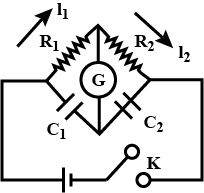
In the circuit shown in figure, if no current flows through the galvanometer when the key (k) is closed, the bridge is balanced. The balancing condition for bridge is:
$\begin{align}
& (A)\dfrac{{{C}_{1}}}{{{C}_{2}}}=\dfrac{{{R}_{1}}}{{{R}_{2}}} \\
& (B)\dfrac{{{C}_{1}}}{{{C}_{2}}}=\dfrac{{{R}_{2}}}{{{R}_{1}}} \\
& (C)\dfrac{{{C}_{1}}^{2}}{{{C}_{2}}^{2}}=\dfrac{{{R}_{1}}}{{{R}_{2}}} \\
& (D)\dfrac{{{C}_{1}}^{2}}{{{C}_{2}}^{2}}=\dfrac{{{R}_{2}}}{{{R}_{1}}} \\
\end{align}$
Answer
 Verified
602.7k+ views
Hint: Since, the bridging condition is achieved after the key has been closed. We will therefore work under the assumption that sufficiently long time has passed and that both the capacitors are in their steady state. Now, under steady state no current flows through a capacitor. We will use this and the fact that, since there is no current through the galvanometer, therefore its two ends will be at the same potential.
Complete answer:
Let us first assign the different points in the given figure:
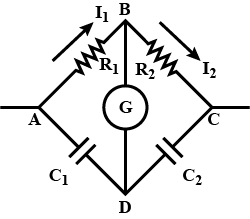
From the above figure, we can conclude that there will be no current in the branch AD and branch DC, since capacitors are in steady state.
Also, since there will be no current through the galvanometer in the bridging condition, therefore the potential at B will be equal to potential at D.
And lastly, since there is no current in the BD branch, the charge distribution on both the capacitors will be the same.
Now, we shall proceed as follows:
Let the charge on each capacitor be ‘q’.
Since, there is no current through any of the capacitors, therefore:
$\Rightarrow {{I}_{1}}={{I}_{2}}$ [Let this expression be equation number (1)]
Also,
$\begin{align}
& \Rightarrow {{V}_{B}}={{V}_{D}} \\
& \Rightarrow {{V}_{A}}-{{V}_{B}}={{V}_{A}}-{{V}_{D}} \\
\end{align}$
$\Rightarrow {{I}_{1}}{{R}_{1}}=\dfrac{q}{{{C}_{1}}}$ [Let this expression be equation number (2)]
Similarly, approaching both the terminals through opposite sides, we can write:
$\begin{align}
& \Rightarrow {{V}_{B}}={{V}_{D}} \\
& \Rightarrow {{V}_{B}}-{{V}_{C}}={{V}_{D}}-{{V}_{C}} \\
\end{align}$
$\Rightarrow {{I}_{2}}{{R}_{2}}=\dfrac{q}{{{C}_{2}}}$ [Let this expression be equation number (3)]
Thus, on dividing equation number (3) by (2), we get:
$\begin{align}
& \Rightarrow \dfrac{\dfrac{q}{{{C}_{2}}}}{\dfrac{q}{{{C}_{1}}}}=\dfrac{{{I}_{2}}{{R}_{2}}}{{{I}_{1}}{{R}_{1}}} \\
& \Rightarrow \dfrac{{{C}_{1}}}{{{C}_{2}}}=\dfrac{{{I}_{2}}{{R}_{2}}}{{{I}_{1}}{{R}_{1}}} \\
\end{align}$
Therefore, on using equation number (1), we get:
$\therefore \dfrac{{{C}_{1}}}{{{C}_{2}}}=\dfrac{{{R}_{2}}}{{{R}_{1}}}$
Hence, the ratio for the condition of bridging comes out to be as $\dfrac{{{C}_{1}}}{{{C}_{2}}}=\dfrac{{{R}_{2}}}{{{R}_{1}}}$.
Hence, option (B) is the correct option.
Note:
We had to assume that the capacitors are in their steady states because, if not so, then the current in the whole circuit would be varying with time, as current through a capacitor decreases exponentially with time which would have made no sense in solving our problem. So, sometimes even if it isn’t mentioned in the problem we should make proper assumptions before solving the problem.
Complete answer:
Let us first assign the different points in the given figure:
From the above figure, we can conclude that there will be no current in the branch AD and branch DC, since capacitors are in steady state.
Also, since there will be no current through the galvanometer in the bridging condition, therefore the potential at B will be equal to potential at D.
And lastly, since there is no current in the BD branch, the charge distribution on both the capacitors will be the same.
Now, we shall proceed as follows:
Let the charge on each capacitor be ‘q’.
Since, there is no current through any of the capacitors, therefore:
$\Rightarrow {{I}_{1}}={{I}_{2}}$ [Let this expression be equation number (1)]
Also,
$\begin{align}
& \Rightarrow {{V}_{B}}={{V}_{D}} \\
& \Rightarrow {{V}_{A}}-{{V}_{B}}={{V}_{A}}-{{V}_{D}} \\
\end{align}$
$\Rightarrow {{I}_{1}}{{R}_{1}}=\dfrac{q}{{{C}_{1}}}$ [Let this expression be equation number (2)]
Similarly, approaching both the terminals through opposite sides, we can write:
$\begin{align}
& \Rightarrow {{V}_{B}}={{V}_{D}} \\
& \Rightarrow {{V}_{B}}-{{V}_{C}}={{V}_{D}}-{{V}_{C}} \\
\end{align}$
$\Rightarrow {{I}_{2}}{{R}_{2}}=\dfrac{q}{{{C}_{2}}}$ [Let this expression be equation number (3)]
Thus, on dividing equation number (3) by (2), we get:
$\begin{align}
& \Rightarrow \dfrac{\dfrac{q}{{{C}_{2}}}}{\dfrac{q}{{{C}_{1}}}}=\dfrac{{{I}_{2}}{{R}_{2}}}{{{I}_{1}}{{R}_{1}}} \\
& \Rightarrow \dfrac{{{C}_{1}}}{{{C}_{2}}}=\dfrac{{{I}_{2}}{{R}_{2}}}{{{I}_{1}}{{R}_{1}}} \\
\end{align}$
Therefore, on using equation number (1), we get:
$\therefore \dfrac{{{C}_{1}}}{{{C}_{2}}}=\dfrac{{{R}_{2}}}{{{R}_{1}}}$
Hence, the ratio for the condition of bridging comes out to be as $\dfrac{{{C}_{1}}}{{{C}_{2}}}=\dfrac{{{R}_{2}}}{{{R}_{1}}}$.
Hence, option (B) is the correct option.
Note:
We had to assume that the capacitors are in their steady states because, if not so, then the current in the whole circuit would be varying with time, as current through a capacitor decreases exponentially with time which would have made no sense in solving our problem. So, sometimes even if it isn’t mentioned in the problem we should make proper assumptions before solving the problem.
Recently Updated Pages
If x a + bt + ct2 where x is in meters and t is in class 11 physics CBSE

A car covers the first half distance between two places class 11 physics CBSE
The resultant of two vectors overrightarrow P and overrightarrow class 11 physics CBSE
Find the value of cos 135 class 11 maths CBSE
A mass M is held in place by an applied force F and class 11 physics CBSE
A solution of glucose in water is labelled as 10 dfracwv class 11 chemistry CBSE
Trending doubts
One Metric ton is equal to kg A 10000 B 1000 C 100 class 11 physics CBSE
Find the value of the expression given below sin 30circ class 11 maths CBSE
Draw a diagram of nephron and explain its structur class 11 biology CBSE
10 examples of friction in our daily life
Proton was discovered by A Thomson B Rutherford C Chadwick class 11 chemistry CBSE
Bond order ofO2 O2+ O2 and O22 is in order A O2 langle class 11 chemistry CBSE