




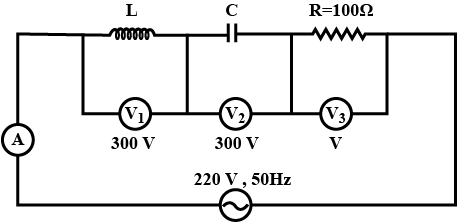
In the circuit shown below, what will be the readings of the voltmeter $ {V_3} $ and ammeter $ A $ ?
$ (A)800V,2A $
$ (B)200V,2A $
$ (C)220V,2.2A $
$ (D)100V,2V $
Answer
 Verified
519.6k+ views
Hint: A voltmeter is an instrument used for measuring the potential difference between two points in an electric circuit whereas an ammeter is a measuring device used to measure the electric current in a circuit.
Complete answer:
A voltmeter is always connected in series and never in a parallel combination. This is because
A voltmeter has high resistance and if it is connected in series then it would consume all the current. On the other hand an ammeter is always connected in series combination and never in a parallel combination. This is because an ammeter has a low resistance and if it is connected in parallel with the circuit, then all the current would flow through the ammeter and nothing would flow in the circuit.
This question is based on the LC circuit. An LC circuit, also called a resonant circuit, tank circuit, or tuned circuit, is an electric circuit consisting of an inductor and a capacitor connected together.
In this question, we can clearly see that,
$ {V_1} = {V_2} $
So, this a condition for resonance and we know that in resonance,
$ {V_3} = V $
$ {V_3} = 220V $
So, the reading of voltmeter $ {V_3} $ is $ 220V $ .
Now, we need to measure current in order to get the reading of the ammeter $ A $ .
So the ammeter reading, $ I = \dfrac{V}{R} $
$ I = \dfrac{{220}}{{100}} $
$ I = 2.2A $
So, the reading in the ammeter is $ 2.2A $ .
So, the final answer is $ (C)220V,2.2A $
Note:
There are various applications of LC circuits in our day to day lives which mainly include in radio, television, high-frequency heating, and generators, etc. This oscillator uses a tank circuit which includes a capacitor 'C' and an inductor 'L'.
Complete answer:
A voltmeter is always connected in series and never in a parallel combination. This is because
A voltmeter has high resistance and if it is connected in series then it would consume all the current. On the other hand an ammeter is always connected in series combination and never in a parallel combination. This is because an ammeter has a low resistance and if it is connected in parallel with the circuit, then all the current would flow through the ammeter and nothing would flow in the circuit.
This question is based on the LC circuit. An LC circuit, also called a resonant circuit, tank circuit, or tuned circuit, is an electric circuit consisting of an inductor and a capacitor connected together.
In this question, we can clearly see that,
$ {V_1} = {V_2} $
So, this a condition for resonance and we know that in resonance,
$ {V_3} = V $
$ {V_3} = 220V $
So, the reading of voltmeter $ {V_3} $ is $ 220V $ .
Now, we need to measure current in order to get the reading of the ammeter $ A $ .
So the ammeter reading, $ I = \dfrac{V}{R} $
$ I = \dfrac{{220}}{{100}} $
$ I = 2.2A $
So, the reading in the ammeter is $ 2.2A $ .
So, the final answer is $ (C)220V,2.2A $
Note:
There are various applications of LC circuits in our day to day lives which mainly include in radio, television, high-frequency heating, and generators, etc. This oscillator uses a tank circuit which includes a capacitor 'C' and an inductor 'L'.
Recently Updated Pages
Master Class 12 Business Studies: Engaging Questions & Answers for Success

Master Class 12 Biology: Engaging Questions & Answers for Success
Master Class 12 Chemistry: Engaging Questions & Answers for Success
Class 12 Question and Answer - Your Ultimate Solutions Guide
Master Class 11 Social Science: Engaging Questions & Answers for Success
Master Class 11 English: Engaging Questions & Answers for Success
Trending doubts
Draw a labelled sketch of the human eye class 12 physics CBSE
Name the part of the flower which the tassels of the class 12 biology CBSE
The value of constant k in coulombs law is beginalign class 12 physics CBSE
What is the structural formula of Aspirin A B C D class 12 chemistry CBSE
Why should a magnesium ribbon be cleaned before burning class 12 chemistry CBSE
Quantisation of charge implies a Charge does not exist class 12 physics CBSE