




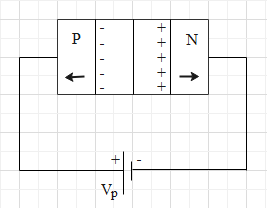
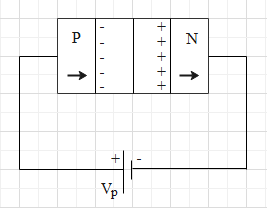
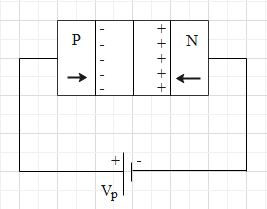
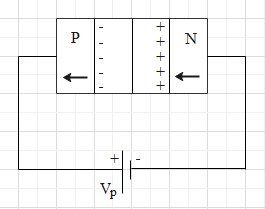
In the case of forward biasing of PN-junction, which one of the following figures correctly depicts the direction of flow of carriers:
A.)
B.)
C.)
D.)
Answer
 Verified
644.4k+ views
Hint: When a PN-junction is forward biased, we attach the positive terminal of the battery to the P side of the junction while negative terminal is attached to the N side of the junction. The motion of the charge carriers will be such that they travel to the oppositely charged terminal of battery.
Complete step-by-step answer:
A PN-junction can be created by joining a p-type semiconductor with n-type semiconductor. A p-type semiconductor has majority charge carriers as holes while a n-type semiconductor has majority charge carriers as electrons. When two types of semiconductors are joined with each other, the electrons and holes near the joining surface fuse with each other creating a region of neutrality called space charge region.
Biasing a PN-junction means that we are attaching a battery to the two sides of the diode. This can be done in two ways: Either we put the positive terminal of the battery to the p-side of the junction and negative terminal to the n-side, this is called forward biasing the diode. Or we can put the negative terminal of the battery to the p-side and positive terminal to the n-side, which is called reverse biasing the diode.
Now on attaching the battery to the junction, the charge carriers will flow towards the oppositely charged terminals of the battery. This means that in forward biasing, the holes from p-side move towards the negative terminal while electrons from n-side move towards the positive terminal.
Keeping this reasoning in mind, we can say that option C shows the direction of flow of charge carriers correctly.
Note: A PN-junction is a device which conducts only in one direction and blocks the flow of current in another direction. This is true because current flows only during forward bias while during reverse bias, large current cannot flow as it can lead to breakdown of diode.
Complete step-by-step answer:
A PN-junction can be created by joining a p-type semiconductor with n-type semiconductor. A p-type semiconductor has majority charge carriers as holes while a n-type semiconductor has majority charge carriers as electrons. When two types of semiconductors are joined with each other, the electrons and holes near the joining surface fuse with each other creating a region of neutrality called space charge region.
Biasing a PN-junction means that we are attaching a battery to the two sides of the diode. This can be done in two ways: Either we put the positive terminal of the battery to the p-side of the junction and negative terminal to the n-side, this is called forward biasing the diode. Or we can put the negative terminal of the battery to the p-side and positive terminal to the n-side, which is called reverse biasing the diode.
Now on attaching the battery to the junction, the charge carriers will flow towards the oppositely charged terminals of the battery. This means that in forward biasing, the holes from p-side move towards the negative terminal while electrons from n-side move towards the positive terminal.
Keeping this reasoning in mind, we can say that option C shows the direction of flow of charge carriers correctly.
Note: A PN-junction is a device which conducts only in one direction and blocks the flow of current in another direction. This is true because current flows only during forward bias while during reverse bias, large current cannot flow as it can lead to breakdown of diode.
Recently Updated Pages
Master Class 12 Business Studies: Engaging Questions & Answers for Success

Master Class 12 Chemistry: Engaging Questions & Answers for Success
Master Class 12 Biology: Engaging Questions & Answers for Success
Class 12 Question and Answer - Your Ultimate Solutions Guide
Master Class 11 English: Engaging Questions & Answers for Success
Master Class 11 Social Science: Engaging Questions & Answers for Success
Trending doubts
Which are the Top 10 Largest Countries of the World?
Draw a labelled sketch of the human eye class 12 physics CBSE
Differentiate between homogeneous and heterogeneous class 12 chemistry CBSE
Differentiate between Pyramid of energy and pyramid class 12 biology CBSE
Why is the cell called the structural and functional class 12 biology CBSE
Draw the diagram of the pyramid of energy Explain In class 12 biology CBSE